The Trajectory of Faith and Historical Reality

All histories are potentially divisive. Depending on how one approaches a period, supporters, detractors, identitarians, anyone with a self-appointed mission to either defend or attack certain sacrilized bovines may find agitation to the point of absurdity. The historian must be at least aware of all this before tackling her subject. Not with a view to self-censorship (although that may happen by default) but to know how much referencing and documentation may be required to overcome (somewhat) assaults based on issues having only tangential relation to the history being examined.

Which is one reason a book such as Peter Heather’s new Christendom: the Triumph of a Religion AD 300—1300 is both hefty and well-notated. He is not here interested much in the assertions of Christianity, only in the evolution of the religion over time as a social and political entity. The road from minor cult to the dominant aesthetic and political reality of Europe by the 14th Century is here examined as a system. How did it get to the point where we are still wrestling with questions of cultural legitimacy as they impinge upon the political realities of modern life?

Heather resents his credentials—agnostic, let’s say—as someone interested in what people did and how they did it. This is a history like any history of a country or a people. Dates matter. Major players matter. Shifting demographics matter. This is the story of bureaucracies and armies and successions and, above all, assertions of power. The Christianity that emerged over centuries after Emperor Constantine declared it the state religion of the Roman Empire is, regardless of how individual believers may feel, a political system. After Constantine is certainly became something other than what it started. The road it traveled is fascinating and maps closely to the more usual history with which we are familiar (if we are familiar with it).

This adds a layer as well to the questions of why Rome “fell” and how the Crusades began and failed and the way in which dynastic politics became inextricable from the dissemination of a faith that, in primary ways, was diametrically opposed to everything Europe became.

Two details make this a fascinating take on the topic. One, Heather goes into great detail over the matter of conversion. Of course, we know the famous ones—Augustine, Constantine, the less well-known Pegasios—and by these we understand it to be a dramatic, soul-wrenching experience. But when closely examined, it was never so simple, and for the vast majority of people at the time it was much more mundane. This month we’re worshiping Apollo, next month Sol Invictus, the month after that the Christian God. In order to comply with the law and obtain work, we must change our associations. Constantine’s mandate impacted the Empire through patronage. In order to obtain a position in the government, conversion was required. Heather makes clear with the case of Pegasios (bishop of Ilios, 350s A.D.) that it was a revolving door, as Pegasios had no trouble going back and forth between paganism and Christianity as circumstances dictated. This was not, for him (and presumably many others) a matter of salvation of the soul as it was a matter of livelihood and income.

Moving forward, it then appears obvious that the vast majority of conversions were pro forma. The king has decreed he and his subjects shall be Christians and so the people go to a different church.

This contradicts the idea of a major ideological revolution sweeping the continent. This was political.

Once understood, subsequent Church history makes more and more sense as history. Alliances, territory, prestige—all the values of a strong state—contributed to the eventual displacement of older religions as Christianity became the dominant ideology.

It is in the triumph of that ideology—or, rather, its symbols—that the success is traced. What people followed willingly (and, to our dismay, today) is a successful leader who could demonstrate a special bond to fate. The story of Constantine’s victory at Milvian Bridge is not a single unitarian narrative. There are four versions and it seems obvious in context that each served a public relations purpose. The Chi Rho triumphant, symbol of early Christianity, figures prominently in the story, but not in the same way in the various tellings.

Which is also where Christianity veered off its previous path of peace and harmony and, over time, became a militant religion. The leader who was victorious in battle and claimed aegis of the Christian god got to say which god would be worshiped. The contradiction emerged from the beginning. Peace and War joined in a paradoxical arrangement to underwrite the legitimacy of king or emperor.

The other thing Heather’s history dispels is the myth of the barbarian hordes. We tend to visualize them as rude brutes with no learning pouring brutishly into Roman precincts destroying a sophisticated civilization. In reality, these “barbarians” had learned from Rome and were in many way culturally on par with the empire they were displacing. And they brought with them their own variations of what they saw as True Christianity.

Which leads to another aspect that is oft misunderstood, which is the mythology of the Church Triumphant calling all the shots across Europe. That did happen, but it was a long process and fraught with setbacks and disputes. For much of the millennium being discussed, it was the kings who told the church what to do. Charlemagne’s crowning as the first Holy Roman Emperor was his idea, stage managed on his end, with the Pope going along with it lest there be consequences.

In short, this is an agnostic analysis of the growth of a bureaucratic, political system which follows the twisted paths of such things like any other. And by the time Rome became predominant once more, it was at the head of a religion that barely resembled the early pastoral communities from which it sprang. Each stage was a near-run thing and the unity of the Church was never what it appeared to be. 

Which is a curiously pertinent bit of history to become acquainted with now. Keeping the components separate and knowing how such things happen is a useful tonic in an age where the cries of faiths that claim unalloyed divine cause to overturn anything in their path. 

Dust and Destiny

I went to the theater—an Omnimax—to see Dune Part Two. The anticipation for this film since the first one has been a constant background hum. Other films so hungered for have more often than not disappointed. What could possibly live up to the self-generated hype?

My reaction? I was satisfied.

Oh, it was a thrill to watch, don’t get me wrong. For such a long picture, it flowed effortlessly by, feeling much shorter than its nearly three hours. Scene by scene built logically and solidly upon what went before and while everyone knew how it would end, the ending landed with an acceptable sense of resolution that nevertheless left the door open for the next one, but not in a frustrating way.

The changes from the novel mattered not at all. Denis Villeneuve’s Dune is its own thing. Based as it is on legendary source material, a challenge for any filmmaker and one that often humbles lesser artists, Villeneuve was clearly not intimidated, but even so it would be hard to live up to over half a century of lore and cultish expectation. He succeeded by telling the core story in his own way and with a visual sensibility that supported his SFnal understanding.

The previous two attempts feel more than anything like run-ups to this.

Let me get this out of the way. David Lynch’s 1984 film is an epic miss. Lynch is not a science fiction guy, but a horror film maker, and it shows in what then were and remain odd choices for characterization. That said, he managed to get large chunks of it more or less right and for its day it was quite an achievement, but it did not flow well and Kyle MacLachlan’s Paul is a stiff suit filled with pronouncement. MacLachlan is a fine actor so I do not fault him. There were other choices Lynch made that with a slightly more SFnal attitude might have worked, but he kept giving us monsters. The underbudgeted SyFy Network production is underrated by too many. Whatever its other faults, it told the story much more smoothly and far more comprehensibly than the Lynch and some of the choices in cast and presentation were inspired. Paul was closer to what he ought to be, the Baron was closer to what we find in the novel, and on and on. (It failed mainly with Feyd, but then, who could beat Sting? Well…)

Villeneuve, if nothing else, gets science fiction. He seems to understand that it is not something you do by fixing up a contemporary sensibility with a couple of odd bits to make it strange, but that it is wholly strange. Other. He took the original Blade Runner, which is one of the best dozen SF films ever made, and immersed himself in the Otherness of it and produced a film that was fully science fiction. Arrival, which is the closest to a contemporary tableau as he has done in this vein, is all about the doorway into that Otherness and it does not try to reduce it to a suburban trope.

Now Dune.

Everything about this film is a masterclass in how to approach science fiction. And he treated the characters as real. Not mouthpieces. People caught up in enormities of process and disruption and groping for handholds and in their groping make the world different, whether they intend to or not. That is what makes it accessible. They become something other in the face of an ecology removed from contemporary sensibilities. That is what makes it science fiction.

The question, now that this masterpiece has arrived and we who have lived with the legendary attempts to turn a groundbreaking novel from the 1960s into a film, is: why Dune?

Descriptions of what Frank Herbert created have changed over the years. It was an ecological novel. It was a political novel. It is a novel about human-directed evolution. It is a novel about religious extremism. It is an attempt to produce the War and Peace of science fiction.

It is, of course, all of these things. But I think at its core it is a novel about hubris.

Every institution depicted in the novel takes on the accoutrements of final arbiter of human destiny. It is an imperial culture. It has divided its cultural anchors into those who deal with genetic lines and those who deal with technology and mathematics. Thinking machines are outlawed. Anything that might take such matters out of human hands has been eliminated or so constrained as to be powerless. Even transportation is the preserve of an elite. It is a classic Hellenistic culture in its defining customs. And it is a mercantilist society based on guaranteed monopolies, because only the elect can manage such power.

As the story opens, all these strains of self-professed competence are colliding with a break point no one can see because no one can see past their own sense of destiny. Hubris bound to a destiny is the most volatile combination in politics and religion and once those two things combine, you have a critical mass that can only explode.

Paul, at least in Villeneuve’s version, sees all this clearly, and yet cannot stop it. Because he discovers that “destiny” is the ultimate crowd-sourced motivator. In the end he makes the choice every leader in his position makes, which is to try to control it by succumbing to it.

It is one of the better examples of Greek tragedy science fiction has produced.

That is the most compelling thread of the films, the way Villeneuve shows us the inevitability of Paul’s choices as one by one his options disappear in the face of—destiny. Destiny that too many others want to see, others work to avoid, and the entire network of people and institutions around him have carefully constructed to reach, no doubt expecting a different outcome.

We can poke holes in Dune as a parlor game—the ecology doesn’t work, the history is missing important links, the choices the emperor makes are absurd, and on and on—but none of its flaws matter against the central idea of the cyclic tragedy of human-made destiny born of hubris. This is the feature that makes this story fascinating over multiple generations. (Lynch didn’t understand this and tried to turn Paul into a hero on a hero’s journey. He’s not and this isn’t. The SyFy version almost got it, but turned it into a “rise of the CEO” story and at the end the CEO has to step down when he can no longer “see.”)

For perhaps too many people, the affection for Dune rests on its novelties—the great sandworms, the desert vistas, the valiant guerilla fights attacking a much larger enemy, the idea of the Navigators who “fold space”—and for them, these films are a feast. Villeneuve sees science fiction, which in its own way has always been a visual art, urging us to see the future (which is why so many movies and television shows over the years have disappointed, with a few notable exceptions, because they always fell short of where the writers were taking us.) But even for them, that theme, those subtexts, act as hooks on the unconscious, which is why we’re obsessed over this story.

But to my reaction. Satisfied? Not thrilled? One can be thrilled at a flawed attempt, but never satisfied. Many not-great films are still fun to watch. But afterward, when contemplation begins…it has to satisfy to succeed. And this one? Yes, it satisfies.

Hild and the World

Recently, in discussing my own switch from science fiction to history (one novel, testing the waters), I was asked how different the two were to write, and I had to admit that at base not that big a switch. (Science fiction is perhaps more overtly philosophical.) I realized afterward how true this seemed to be, at least for me. Historical fiction used the same muscles, so to speak, as science fiction, and in some ways was a closer pairing than historical and fantasy. If one intends to be true to the historical period in which the work is set, then it must be admitted that it is very similar to visiting a future and/or alien world. The chief difference, of course, is that in history, we have records and we know what happened.

Or do we? 

The farther back we go, the more work we have to do to imagine living in those times, in that world. Because it really isn’t very much like ours, at least not in the ways necessary to move through it. Obviously, on fundamental levels, people are people—we love, hate, grow old, struggle, and feel all the same emotions—but the trajectory and the triggers vary wildly. First Century B.C.E. Romans did not see the world the same way we do, even if emotionally they may have resonated with it much the same way.

And really, how much of those times do we actually know? Some periods are very well documented, we have a great deal of primary material from which to construct (reconstruct) the world. Other periods and places, not so much.

Nicola Griffith reconstructed Seventh Century C.E. Britain almost from whole cloth. We know certain major dates and names of many of the top players, but the world itself? And in the case of her protagonist, St. Hilda of Whitby, we have the remains of her abbey and a taunting reference from Bede. Taunting because Hilda—Hild—is the only woman mentioned in his history of whom he approves (for anything other than chasteness and religiosity), and praised her as an advisor to kings. 

The first question, pulling back from Bede’s history, would be (one would hope), given the context, just who was this woman?

Griffith then attempted to answer that question by building a world in which Hild’s presence, her character, her essence resulted in that singular mention. She wrote a novel so densely imagined and meticulously constructed that one comes away feeling that if it hadn’t happened this way, it should have.

There have been many novels written to such depth, evocative and persuasive. The closest that comes to mind in relation to Hild would be Mary Stewart’s Arthurian/Merlin novels. In a different vein, a few of James Michener’s. Cecilia Holland, Mary Renault. Few wherein the sheer weight of imagined reconstruction counts so significantly. 

Griffith immerses us not only in the details of court life and the politics of the post-Roman Britain, but the environment. The birds, fish, flora, all become players in the life of Hild, who is put forth by her mother, a canny and skillful political manipulator, to be vital to the king. As a seer, a so-called godmouth, a trusted—and occasionally feared—advisor. Hild learns to notice. Everything. She does not, as those with whom she deals, glean knowledge from the air. She pays attention. She has an almost Holmesian capacity to pay attention and recognize patterns. She is a fully present intellect moving through a culture of people easily overawed by mystical confabulations and the power of the supernatural. 

She steps onto the stage at the point in British history when the Catholic church is making inroads against the old pagan gods. There are Irish priests and Anglisc priests and they do not get along, and the king Hild serves is using the tension to enlarge his territory. He decrees that he will be a Christian king and thus the allegiances change, but as Griffith portrays it, there is no ecstatic revelation among the people. This is a matter of allegiance, of loyalty to the king, a practical thing. Hild is baptized, but remains aloof and somewhat puzzled by this whole Christ thing, and in this way Griffith introduces a level of imperial realism at the grass roots of her Britain that is curiously compelling.

In the first novel, Hild, we watch the child grow to young womanhood and not only become an  influential advisor, but also a powerful warlord in her own right, commanding the loyalty of soldiers, and establishing a reputation as she travels as envoy to Edwin King. She strives to make the realm safe from enemies near to hand. 

Her origin story—daughter of a minor king who is assassinated, cousin to Edwin, a wild card to be played even as she learns to be a player—is captivating. As I say, if it didn’t happen this way, it should have. At the end of that first novel, she has found a place she wants to make her own, make safe, and manages to secure it from the king. She marries Cian, who she grew up with, and the bastard son of her father (no one wants to say so, the refrain repeated “Never say the dangerous thing aloud”), who was her sparring partner as a child and grows up to become one of the king’s best warriors. It would seem all may be well.

The place she has found, Menewood, anchors the new novel of the same name. Everything Hild does is aimed at securing this place and its people, making it safe, making it home. 

Menewood picks up where Hild left off and does not disappoint. The time encompassed by the novel is much shorter than the first one, but so much happens, the entire landscape writhes around her, and she must come back from horrific tragedy and loss to step by step engineer alliances and maneuver armies to finally make secure everything she holds dear. It is a hero’s journey of the highest order and Griffith’s command of landscape and emotion and seventh century politics anchors the story in enviable credibility. Hild becomes a force to be reckoned with, as the saying goes. 

As vivid as Hild is, so too are the people around her. She has true friends, people who love her, those who respect her, loyal companions and willing followers, and she is seen to earn it all. These people are the sort one would wish to impress and inspire, be friends in return, and all of them are distinctly themselves. The earning is hard. The consequences of being significant in this world are harsh. We see, though, that Hild has little choice. At times she contemplates running, but she cannot let those who depend on her down. It is not, in the end, who she is. 

But as engaging as all that is, the added pleasure is that Griffith presents us with a world, an environment, that we want Hild to save and preserve and protect. She shows us the bees, the streams and rivers, the hedgepigs, the horses, the seasons, and trees, the fields and makes it all integral to the lives depicted. For Hild, it is all interconnected, one thing. 

As well, there is a thread of social possibility threaded throughout suggesting that the way things turned out later might not have, that relationships could have been less straitened. There are the beginnings of the kind of behavioral autocracy that came to dominate in later centuries, leading to the circumstances in which the Venerable Bede would only think to honor one woman in his histories for anything other than virginity. None of this rises to the level of polemic. Griffith stays immersed in the substance of the period, but it is there to be found.

And there are battles. Two major ones, and they do not disappoint. But rather than minutely-detailed, stroke-by-stroke descriptions of the carnage, what Griffith gives us (more usefully) is context. Preparation determines outcome. She lays out the necessary groundwork for the coming conflict and gives us the details that go into what leads up to what transpires on the field. The heroics of the combatants, noble as they may be, come to naught if the land is not understood, the supplies are not at hand, and numbers are not properly tallied. Success can be months in the making. It is refreshingly realistic.

At the center of all this, Hild carries the knowledge—what works, what fails, why and how, and that which must be done to secure gains and survive losses—and through her, we inhabit this world. 

At the beginning of this I made a comparison between historical fiction and science fiction. It matters in what we have come to know as world building. In Menewood we find the fruit of that process in the inhabitability of the story told, and in significant ways, Menewood is a built world. We know some, and through archaeology and folklore we know enough to fill in the gaps through the imaginary work of world building. It is not a capricious process. The result must work organically because the story must be reliable in ways we might only notice when the work is done poorly or not all. This novel (along with its predecessor) is master class in how it is done.

Welcome to Menewood.

Seeking Meaning In Sand

I have not yet seen the new film version of Dune. I may write about it after I do, although it is not the entire story. What I am interested in here is the ongoing obsession with the novel. This will be the third cinematic iteration. Famously, there are two uncompleted versions, one by Jodowrosky and another by Ridley Scott. We know how far the former came because there is a fascinating documentary about it, but as for Scott’s version there are mainly rumors and statements that he wanted to do one. Personally, I would have been interested to see that one—I very much like Ridley Scott’s palette: even those of his films that don’t quite work for other reasons I find wonderful to look at—and in some ways he has perhaps played around the edges of it through his Alien franchise. (The first film starts on a world that might have been Arakkis, the second is evocative of Gede Prime, the others keep returning to desert worlds, in theme if not setting. And Ripley becomes a kind of ghola as she is resurrected again and again.)

What is it about the original novel that compels the ongoing obsession, not only of filmmakers, but of fans? (There would be no funding for the films if the audience were not so large and committed. That speaks to the book.)

The history of the novel is something of a publishing legend, like other groundbreaking books. Multiple rejections, ultimate publication, often in a limited way, and a growing audience over years. Dune was famously rejected something like 27 times before finally being taken up by a publisher better known for automobile manuals.

It was, however, serialized in one of the top science fiction magazines, Analog, so dedicated SF readers were the first to encounter it, and doubtless formed the primary audience. I remember reading the ACE paperback from the late Sixties. Its impact on me was almost too large to detail.

I was used to science fiction novels being under 200 pages—average then was 160. From the Golden Age forward you rarely found one more than 250 pages. Stranger In A Strange Land by Robert A. Heinlein was an outlier at 408 in its first hardcover incarnation. So here I find this massive book more like the so called classics I’d been reading—Dickens, Dumas, Dostoevsky, Tolstoy—crammed into the cover of a mass market paperback which included a glossary and indexes, explanatory material (every bit as fictional as the main narrative). It felt important. I was 14, it was dense, I struggled through it. (It led to a profound teaching moment in how to read which I’ve written about elsewhere.) I could feel my horizons expand, even though at the basic level of story it was no more or less fascinating than most other good science fiction novels I had read. But it opened possibilities for narrative depth.

A handful of other novels came out around that time that exploded the confines of the thriller-format SF had been kept to—John Brunner’s Stand On Zanzibar and The Sheep Look Up; Robert A. Heinlein’s The Moon Is A Harsh Mistress; Ursula K. Le Guin’s The Dispossessed and The Left Hand Of Darkness; and the coming rage for trilogies (many of which were single narratives published economically in three volumes). By the mid-Seventies publishing had changed to accommodate a new idea of what an SF novel could be, including expanded length to include what has become known as World Building (a technique which in some instances supplanted more important aspects of fiction). Not all by itself, but certainly as a point of history, Dune helped make this possible by creating a market for fuller expositions and more detailed construction. This alone might make it significant.

But that alone would not have made it a perennial seller, almost constantly in print ever since. If Frank Herbert had written nothing else, Dune would have made his career.

It was followed up by two more—Dune Messiah and Children of Dune—completing a cycle. That first trilogy stands as a unified work. The second two books are plot-driven indulgences, but not superfluous. The second trilogy…publishing had discovered by then that science fiction could be best-selling fiction and a frenzy of large advances and high-profile publications mark the late Seventies and early Eighties. Herbert’s publisher enabled him to indulge himself with a second trilogy that often leaves people puzzled. But it kept the spotlight on the primary work.

David Lynch’s movie enlarged the audience again. That film, by a director with a certain reputation for examining the macabre oddnesses of humanity, is a spectacular curiosity. It is a mixed bag of brilliance and weird choices.

Then came a modestly-budgeted miniseries on the SyFy Channel, which went on to include the second two novels. It did a much better job of telling Herbert’s story. The chief complaints seem to be the results of that budget (and that Sting did not reprise the role of Feyd Rautha). It gets dismissed too readily, as if the world were waiting for the “real” cinema treatment.

Which we now, by all accounts, have.

As I say, I have not seen it yet. I want to address the book and its seeming tenacity.

One of the things Herbert did was lace his tale with wise-sounding profundities in the form of aphorisms and epigrams. Each chapter starts with a quote from some serious work by the presumed chronicler of the hero’s life. They sound like quotes from works like the I Ching or SunTzu’s Art of War. This was not a new trick when Herbert did it, but he was particularly adept at it in this book. It is a far future in which, presumably, philosophy has transformed along with everything else. The quasi-feudal politics and economics are given a veneer of newness this way, as if to signal that while it looks like something one would find in the 12th Century, it is not quite the same thing, but you have to take the author’s word for it, because it is the future. The quotes set an aesthetic tone that, among other things, allows us to assume something else is going on instead of just the same old historical thing. In science fiction, veneers matter—they work like orchestrations in a symphony, selecting the right instrument for the right phrase, coloring it. (Veneers should never be mistaken for the story or the theme, which is something unobservant critics do all the time.)

Seriousness established, every significant decision becomes inhabited by purpose, meaning, resonance, and a justification that raises the level of what we read almost to that of destiny, certainly of mythmaking. With this, the writing itself need not be spectacular, just functional.

There are passages in Dune that are breathtaking in what they describe. The ecological aspects of the novel, while in some ways absurd in terms of actual science, take on the same immanence as anything the actors possess. In a way, Dune is one of the first terraforming novels, embracing the idea that human action can transform an entire world. (A couple of years later, we see much more of this, often more pointedly, as in works like Le Guin’s The Word For World Is Forest—again, the novel opens up a field of possibilities, or at least prepares an audience for more of the same.)

But the characters are hard to relate to—this is a story about archetypes and aristocrats in conflict with emperors and churches. The ordinary people get lost amid the giant legs of the SF manifestations of Greek Heroes. We read this novel for the plot and world and the political revelations. We become engaged because this is in important ways a Lawrence of Arabia story—one toxically mixed with Faust. We read it because we are aware that gods and deserts change the world.

We read it because, as well, we are enamored of the idea of Enlightenment in a Pill.

Herbert was always working in the fields of mind-altering drugs—possibly his best and most relatable novel in this vein is The Santarroga Barrier—and with Melange, the Spice, he created the ultimate in mind-expanding temptations. Its use gives humanity (and others) the universe. Time and space can be brought to heel with it. Visions, prophecies, and clarity are on offer. But it is the ultimate Faustian bargain, for its loss will destroy everything.

It is aptly named. Melange, a mixture of often incongruous elements. A mess, if you will, but messes can evoke wonder, even seem beautiful.

At the heart of this Faustian conundrum are the Fremen, patterned after the Bedu of the Middle East. They are trapped on a world with profoundly limited resources and must be kept that way for the benefit of the rest of the universe. Not quite slaves, but certainly not masters of their own world. Freeing them courts disaster—because part of that freedom entails remaking their world, making it wet. Water, though, is poison to the giant worms that produce the Spice.

Trap after trap after trap populates the novel. Disaster looms. The plot compels.

And of course the relevance to our reality could not be plainer. The teetering sets of balances, all of them with ethical pitfalls, allow Dune to remain trenchant, relevant, challenging. Added to this is the clear connection to the Greek tragedians (especially in the second trilogy—I suggest boning up on Aeschylus and Euripedes before trying them) which gives the book its ongoing frustration of clear, ethical resolution. (And cleverly he took the possibility of building machines that might aid people in their problem-solving off the table, by outlawing thinking machines. It’s all on us and what we bring to the game.)

A final thread woven through the book that seems to make it constantly popular is that it is a coming-of-age story that contains a biting critique of privilege. Whatever Paul might want to be for himself, he is born into a web of expectations that impose their demands from all sides, making any choice he might make impossible outside of a constructed destiny. The adolescent struggling to make sense of the world and find a way to live in it, thinking if only he were god and could command everything to be rational or at least amenable. Paul’s tragedy is that he in fact can become god—and then discovering that this is no solution, either.

How well this new movie deals with all this, I look forward to seeing. For the moment I simply wanted to examine some of the reasons this novel continues to find audiences and why so many filmmakers are drawn to it. The elements it contains transcend the limitations from which it suffers. But whatever the case, this is a novel that allows readers to find meaning—whether that meaning is in the novel or not.

Hild, A World, A Novel

(This is a repost, done to correct  problem in the original)


It is completely fitting that science fiction writers should write historical fiction.  Both forms deal with the same background—alien worlds.

Because we live in a story-saturated era where access to the ages is easily had with a visit to the library, the local bookstore, the internet, movies, it is easy to assume we know—that we understand—the past, with the same cordial familiarity we experience our own personal history.  That people lived differently “back then” seems more a matter of fashion and technology, not a question of thought process or philosophy or world view.*  People lacked central heating and air conditioning, cars, television, telephones, indoor plumbing, antibiotics…but they lived essentially the same way.

Well, one could make a case that they did,  but you have to ask the question “In what ways did they live the same way?”  Therein lies the heart of good historical analysis and extrapolation.

Because while we can connect with people of the past in many very broad ways—they were human, they loved, they hated, they were greedy and generous, they were driven by passions, they dreamed—the specifics can school us in the range of the possible.  What does it mean to be human?

Far more than we might imagine.

But that’s where the novelist comes in, the writer who takes the time to grapple with those myriad distinctions and give us a look into those differences that are still, regardless of how remote they seem from our personal understanding of “human,”  part of who we are, at least potentially.

I mention science fiction at the beginning because at a certain level, if we’re dealing with something deeper than costume drama or plot-driven adventure fiction, the exercise of finding, comprehending, and actualizing on the page an entire period from the past—Republican Rome, Hellenic Greece, the Mesopotamia  of the Sumerians, the Kingdom of Chin, or post Roman England—is much the same as building a world out of logic and broad-based knowledgeable extrapolation.  In some instances, extrapolation is all-important because the fact is we simply do not know enough to more or less copy a record into a fictional setting.  Instead, we have to take the tantalizing scraps of what remain of that world and supply the connective tissue by imagining what must, what probably, what could have been there.  And in the process we discover a new world.

If done well, that newness becomes a mirror for us to perceive what we have overlooked in ourselves.  (Which is what good fiction ought to do anyway, but in the well-constructed historical it is a special kind of revelation.)

Seventh Century England is rich with the unknown, the ambiguous, the seductively out-of-reach.  It existed between one deceptively homogeneous era and another, between the Roman Empire and the emergence of the Holy Roman Empire.  More, it held some of the last vestiges of the once vast Celtic Empire.  It was a land where shadow-pasts vied for hegemony over the mythic substrate defining meaning for the warlords, petty kings, and mystics serving them. Pagan religions found themselves competing with this new Christianity, which had been around a while but was finally beginning to make significant headway among the competing kingdoms, looking for the leverage it needed to make itself an “official” religion with the authority to shove the others aside.

Into this came a woman who eventually mattered enough, given the overwhelming patriarchal structure of the day, to deserve a mention from the Venerable Bede (who saw women much as most men of his time did, necessary creatures in need of guidance and by dint of their sex lesser beings).  In Book 4 of his Ecclesiastical History of the English People we’re told of St. Hilda, who was by any measure of the era (and even ours) astonishing.  “Her prudence was so great…that even kings and princes asked and received her advice.”

A good novel starts with a good question and in this case it would be: Who was this woman and how did she get to this place?

A question to which Nicola Griffith impressively supplies an answer in her new novel, Hild, (Farrar, Strauss, Giroux).

Hild, later St. Hilda of Whitby, lived from 614 to 680.  She was a second daughter of minor nobility whose father died, leaving the family at the mercy of rival kingdoms.  Later she founded an abbey, where she remained the rest of her life, and was a teacher of prelates and princes.

Note that.  Seventh Century, at a time and in a place where women were little more than property, Hild could not only read but commanded respect.  That alone would make her fit subject for a big historical novel.  Certainly she would serve as the basis for a cathartic life-lesson to modern audiences about the innate power of women and the need to find and act upon one’s own identity.

But Griffith avoids this in some ways too easy path to sympathy for her character and does what superb history should—provides context and shows her character in situ, living as she would have.  Hild had her own problems to face and they are not ours.  Through the course of 560 pages of well-chosen and seemingly hand-polished words, Hild is given to us as a person, fully realized, of her own time.  This is a different world and these people did not see it as we do.

The success of a novel is in its ability to bring the reader entirely in and hold them, enmeshed, for the duration.  Griffith’s past novels have demonstrated that she can achieve this in both science fiction (Ammonite, Slow River) and noir thriller (The Blue Place, Stay, Always).  But in some ways those novels presented less of a challenge in their immersive requirements—they were closer to home, nearer to our own world, and allowed for reader assumptions to come into play.  (This is deceptive, of course, and is more a question of laziness on the part of the reader than on any artistic shortcuts a writer might take.)  Hild represents an order of magnitude greater risk on Griffith’s part, a kind of dance through a mine field of possible failures that could cause reader disconnect or, worse, a betrayal of her characters.  It is a great pleasure to note that she made no such missteps, got all the way to other side, world intact, with a character very much herself.

This is what historical fiction ought to do.  Take you and put you in a world that is quantitatively and qualitatively different and still engage your sympathies.  As we follow Hild from birth, through her education (under the guidance of her mother, who is herself remarkable) and into a young adulthood in which she comes into possession of some authority, we find ourselves shifting out of our comfort zones with respect to the givens of the world.

Hild is the first book of a trilogy, which will cover Hild’s whole life.  If the next two books are done with as much care, diligence, and grace as this, we are all in for a remarkable experience.

And out of the richly-wrought tapestry of difference, we really do find a connection across the centuries.  Just not where one might ordinarily look for one.

______________________________________________________

*World view is itself a phrase fraught with change, for to have one requires we have some notion of The World, and that has changed constantly over time.  What world?  How big?  Who is in it?  Look at the changes in the past five centuries, which some historians identify as the modern era.  We have gone from a flat earth at the center of a solar system which defined the limits of space to an uneven sphere orbiting an insignificant middle range star of a small galaxy that is one out of billions and billions of galaxies, with no evident limit to what comprises the universe.

Imperial Relevancy

Confession.

I read John Scalzi’s Old Man’s War when it came out. I enjoyed it. I then read Agent To The Stars and likewise enjoyed it. I bought a copy of Lock In and…

Lots of reasons one fails to continue reading a book or an author, many of them having nothing to do with either.  As a kind of funhouse mirror response to the long line of homages to Starship TroopersOld Man’s War was fine, more interesting than most, and written in a manner that allowed easy enjoyment. I laughed out loud at Agent To The Stars and again, the voice was pleasurable.  I can’t say there was any valid reason to not keep reading Scalzi.  Other than the growing pile of to-be-reads, research for my own projects, reading I need to do for the day-job, and, well, life itself.  I have many books to hand that deserve a read and are languishing because I am mortal.

When the first volume of his new trilogy came along, I bought it, with the full intention of getting back to a writer I felt I ought to pay more attention to.  And then, it sat there. The next volume was released and finally the third. I bought them all, in hardcover, and when the last book arrived, I determined to read them straight through. Why not? I hadn’t done that in some time, read a trilogy in one go.

I’m glad I did. The pleasures of the whole work justify the time.

The Collapsing Empire is, firstly, a lot of fun.  The characters are nicely-drawn humans of wide ranging eccentricities, proclivities, and ambitions. Following them is rewarding, because even when they do something expected, the way they do it and the outcomes are not.

The setting is not unfamiliar, but Scalzi’s perspective is refreshingly realistic. The Interdependency is an interstellar community which relies on the Flow to move from one system to another. The Flow is a kind of extra-dimensional bypass. We are told repeatedly that analogies to rivers and so forth are inaccurate and also that no one actually knows what the Flow really is, but humans use it like a river system.  For a thousand years, the Interdependency has operated over numerous systems, its make-up based on an imperial hierarchy joined to a church and a collection of noble houses each with a monopoly.  The Emperox (an intentionally nongendered term for an old idea in a new form) has been from the same House since the Interdependency was established, the House of Wu, which holds the monopoly on shipbuilding and access to the Flow Shoals, the points of entry into the Flow.

It is clear from the outset that this system has found stability.  Throughout one thing is evident—this is a post-scarcity polity.  There are no poor, although there are discontented, the truly obdurate of which get sent to End, a world at the edge of the Interdependency where over time the malcontents have been deposited. Which has resulted in a local culture of anti-authoritarian rebelliousness that results in repeated cycles of revolution and the overthrow of the local Duke.

End also is the only human habitable planet in all of the Interdependency, the rest of which exists on stations and in surface colonies that have been dug out of worlds inimical to human life.

At some point prior to the creation of the Interdependency, these systems were cut off from Earth by a collapse of the Flow stream connecting them. Earth is legend. Within Interdependency memory, however, another system, Dalasysla, suffered the same fate. The possibility of such collapses is known, but other than those two it has never happened. The Interdependency has continued on as if it never would.

The story opens with exactly that happening. The Flow stream to End is starting to collapse.

At about the same time, the Emperox Atavio VI has died and a new emperox is being elevated, Cardenia, Atavio’s daughter by a former lover. She should never have become emperox. Atavio’s son, Rennered, was supposed to ascend to the throne, but he died in a racing accident.

Cardenia is an academic, raised away from the Court. No one knows much about her in terms of what kind of ruler she might make. But the forms are followed. Not that it matters.  Rennered was supposed to marry Nadashe Nohamapetan, of the House of Nohamapetan,  a house almost the equal of the House of Wu, thus joining the two most powerful houses together. The next heir would then be of both houses.  It is decided that Cardenia will simply marry Nadashe’s brother, Amit.

Cardenia has other ideas. But regardless what was supposed to happen, everything is derailed when on her coronation day a bomb goes off, nearly killing her, but successfully killing her best friend, who was to be her closest adviser.

She then learns two things that alter the course of her rule. One, she is introduced to the Memory Room, a chamber accessible only by the emperox where the personas of all past emperoxes are stored and where she can literally sit down and have a conversation with them.  There she learns the other thing—that her father, Atavio VI, knew the Flow was collapsing. His chief Flow physicist told him. Atavio VI then sent him off to End to continue his research, to verify and make absolutely certain about his findings in a place well away from the chaos of the Court. Which he does. And now the Flow stream to End is beginning to collapse, so he has to get the finished data back to Hub and the Court at Xi’an and the emperox, so some kind of planning might proceed to meet the inevitable isolation about to shut down the entire Interdependency. As another rebellion is happening on End, this one involving the Nohamapetans, he smuggles his son out with the data, sending him to the imperial court on Xi’an.

The stage now set, Scalzi takes us on a thoroughly engrossing ride through conspiracy, technological revelation, palace intrigue, and the discovery of history within a thoroughly imagined and well-constructed world(s).

The parallels to current-world issues could not be more obvious. Factions form over the question of the collapse. Some believe it won’t happen, others believe it won’t happen anytime soon, still others believe it won’t be a collapse so much as a realignment (and this latter group intend to take full advantage of that).  The work to convince enough of the right people that change is coming and the need to act is pressing envelopes Cardenia’s young reign.

Cardenia for her part proves herself up to the task of being emperox, surprising almost everyone. She is not a habitué of the Court, no one knows her, expectations are low.  That gives her an edge, which she uses.  It’s a pleasure watching her grow into the role.  She takes the name of a predecessor who faced similar difficulties, Grayland I, and forms some unexpected alliances that—

The pleasure is in the reading.

What is interesting here is the use of an old form cast in a new arrangement. It’s a valid question, though—why an empire? Why, therefore, an emperor?  Or in this case an emperox.

Empire evokes two broad images, one technical, the other romantic.

The technical side is one of practicality. Empires are, by and large, not practical. The extent of the territory, the problems of ruling a multiplicity of cultures and nationalities, and then the inevitable problems of security make them lumbering, inefficient, doomed-to-collapse bureaucratic fossils. On the relatively modest surface of a planet, it has proven to be untenable over any length of time (unless it is in name only and managed with a high degree of local autonomy, but even then…), the problems explode exponentially over interstellar distances. The idea that a political unit can be managed from a central location over many light years is, well, fantastic.

Which is why empires appear more in fantasy than science fiction.

But there is a long history of empires in science fiction and it is obvious that their creators were more than a little aware of the problems. In one of the most famous examples, Asimov’s Empire, it’s fairly obvious that “the emperor” is an isolated figurehead with no real command of the galactic polity of which he is the titular head. The bureaucracy functions as if he were utterly irrelevant.  Likewise in Poul Anderson’s Terran Empire, wherein the emperor is barely (if at all) mentioned.  The whole is not a homogeneous unit and the idea of empire is problematic.

Indeed, it is the British model that applies, if at all.  But even then, the cracks inherent in the structure virtually guarantee eventual dissolution.   So why “empire?”

That brings us to the romantic model, by which I do not mean anything more than a fabulation of the past superimposed upon a construct for the sake of nostalgia. The idea that somehow the past was more adventurous, perhaps simpler, and the issues more clear-cut. That heroics could be recognized and performed with less ambiguity. That the politics of the day were less tangled and knotty difficulties could be solved by the hack of a sharp blade.  And that monarchies were somehow “easier” than the squabbly morass of democracy.  Escapism, certainly, but you see the model used in fantasy all the time and for good reason.  And EMPIRE has such a ring to it!

And it allows for a kind of homogeneity across vast stretches of territory (and ethnicity) that enables a certain kind of narrative.

But if the point is to react against that system, it can also be…limiting.

Scalzi avoids that by redefining—or, at least, renegotiating the basic nature of empire. Here, more than anything else, it’s a business arrangement, with a large dollop of enlightened self-interest, and a mission statement which is considerably more practical than the usual. For one thing, there seems to be no expansion in this empire. The borders (boundaries) are set, presumably by the nature of the Flow, and there is no hint of conquest. Trade is controlled through monopolies and mutual support is guaranteed by the interdependent nature of the system.

This is more empire as corporation than anything mythic, with the emperox as CEO. (Which permits, in the end, a privileged viewpoint, from a single vantage.)

And the nature of that corporation? Stasis. Keep things running smoothly.  The added wrinkle here is that all the disparate nations/systems are bound to the system because none of them are self-sufficient. Being cut off is a death sentence.

Maybe.

With the revelation that the Flow streams are collapsing, Cardenia/Grayland II is now in a struggle to find a way to save as many people as possible while fending off attempts by the Nohamapetans to displace her and move the capitol to End.  Which, while End actually is a place where humans can survive on the surface of a planet, is by no means a reasonable solution for the billions of Interdependency citizens. End will not support them all or even a significant fraction of them without suffering degradation and eventual environmental collapse.

Of course, the Nohamapetans could not care less. They’re looking out for themselves, their clients, their privilege.

Scalzi has constructed a very neat allegory.  And then set it at arm’s length, because this is a far future space adventure after all, and the Flow isn’t really the Climate…

As if that were not enough, he then adds in the history behind the Interdependency, which has surprises of its own and contributes to the search for solutions in unexpected but perfectly logical ways.  (It may be no surprise to learn that the problem of the collapsing streams is not, after all, a “natural” phenomenon, but one humans inflicted on themselves, for reasons which are also not surprising.)

There are moments when it feels at the point of being too big a story for three rather efficiently-packed novels.  That Scalzi pulls it off so well is a compliment to his skill.  That he manages it so entertainingly is, well, admirable.  He has taken what is a model almost as old as the genre, turned it around, twisted it, and produced what is, essentially, a critique of that model.  We know these things don’t work the way they should, yet we also know that humans (silly humans!) will try them anyway, and that they inevitably collapse.

If there is another interstellar empire to which this bears meaningful comparison, it would be the one in Frank Herbert’s Dune, which is also an ecological tale.  The empire there is a multi-faceted monstrosity based on trade, with a byzantine religion underpinning imperial fiat.  Herbert showed us the flaws in empire by taking it apart and revealing to us the fragile assumptions behind it.

One additional observation before closing.  We read this trilogy together, aloud. It lends itself to that very well, and perhaps benefits from it by allowing some of these characters vocal expression that adds to the overall substance on display.

Time permitting, I will have to go back and see what I’ve missed between Old Man’s War and this.

Recommended.


Resonance of the Modern Era: Erasmus, Luther, and the Common Apocalypse

One of the last books I read in 2019 is Michael Massing’s Fatal Discord: Erasmus, Luther, and the Fight for the Western Mind.  An odd choice, perhaps, but I have my reasons.

At over 800 pages, the book is a thoroughly detailed dual biography as well as history of the period. Luther and Erasmus aside, the period itself is worthy of study because it is, arguably, the beginning of the modern era, if for no other reason than the fact that this was the time wherein the apparent monolithic edifice of Catholic Europe—The West—began to fragment into what we now regard as normal, with its proliferation of contending ideologies, both religious and secular, the rise of the nation-state, and first irreparable chink in the armor of divinely-sanctioned autocracy. During this time was not only the first explorations and colonies in the so-called New World, but also the first inarguable advances of science in the face of tradition, and the beginnings of new economic models that today power the enterprise of the planet. Between 1492 and the end of the 16th Century, the usual arrangements and assumptions changed, evolved, died, reformed, and transmogrified almost beyond recognition, leading to the Thirty Years War which pretty well ended everything that went before, even though certain forms persisted almost to the 19th Century (and a handful to the 20th).

It could be interesting to see what might have become of all that ferment without the two chief instigators of the tectonic shifts in intellectual and religious attitudes that were the driving forces behind it. Without Luther, the Church of Rome might have remained the single religious institution of Europe.  Without Erasmus, Luther might have remained a minor irritant in the body religious. And without the two of them, the various enclaves that sprang up to nurture the nascent philosophies and sciences of the period might have had nothing around which to cohere.

Both men began their careers as monks. Erasmus, however, was an intellectual, a lover of language and old books, who wanted an opportunity to visit other centers of intellectual ferment and do his own work. He managed to gain permission to leave his Augustinian cloister and travel. He studied in Paris, which he loathed because the environs were dirty, the food terrible, and his health never robust.

Wanting never again to be trapped inside a monastic life, he knew he had to make some kind of an income, and he took his first forays into writing and publishing.

Through his writings and his interest in primary texts and languages, he began the serious work of reassessing the Bible, which at that time was a dangerous idea. The Vulgate dominated Christian worship and while certain scholars within the Church understood that it was somewhat corrupted from its original incarnations, it had become wired into the complex system by centuries of use and tradition. What Erasmus’ instigated was a new undertaking that would change fundamental understandings of what the Bible actual said. We still do this today. It’s called Textual Criticism and it is a very rich field of essential linguistic archaeology. Not only what the words may actually mean, but also—and this was the dangerous part—who wrote them and when were they included.

Erasmus produced one of the first fresh translations from the Greek and Hebrew manuscripts still extant and available and published them with extensive glosses explaining his methods and the provenance of what he had found. It is perhaps an understatement to say that this caused controversy.

As well, though, his work spurred the development of a new interest in ancient languages. Europe had already been subjected to the discovery of work thought lost, works by the Greeks and Romans. With the Spanish Reconquista, a flood of ancient works came over the Pyrenees and proliferated. Scholars had long been trying to make Aristotle and Plato conform to current Christian thought, and Aristotle had even been somewhat rehabilitated into a Good Pagan because his work proved so useful in scholastic pursuits. Now Erasmus demonstrated the utility of learning those languages in perhaps finding clearer meanings in Scripture, and whole new centers of learning coalesced. For the span of most of his life, Erasmus was a superstar academic.

Enter Luther, who early on discovered in Erasmus nourishment to feed his own questing urges. During the first part of his career, he was an ardent Erasmian and embraced the idea of studying Scripture through the lens of the languages in which it was written originally. His interest coincided with his desire to purge the Church of corruption, in this instance in the form of the Indulgence.

(An aside. The Indulgence, a device devised by the Roman Church to gather funds in exchange for, ostensibly, shortening or even bypassing time spent in Purgatory, was the match that lit the fuse of the Reformation, and yet I have had many conversations with Catholics who had no idea what they were and when explained to them thought it was ridiculous, even as one can still, I believe, buy one today. )

Many Germans felt the Indulgence was a scam of sorts, one perpetrated mainly on them by the Church. The salesmen were apparently overly aggressive in those territories. Luther was expressing a common perception when he railed against them.  He took it upon himself to challenge the Church. He had not been the first to challenge Church authority, especially Papal authority, but until him those who had managed to successfully raise such challenges to the point of creating movements for possible reform had all been arrested and put to death. Prior to Luther, the most prominent had been Jan Hus, whose memory still informed an underground pool of dissent in Bohemia.

What made Luther more dangerous was the sudden availability of the new translations by Erasmus and the very idea of returning to sources to find Biblical justifications for—

Well, for anything. Luther embraced the language studies with vigor, brought scholars to Wittenberg, and began his own forensic study of Scripture. At which point he began to question Papal authority for an entire slate of practices for which he could find no Biblical support.

What began then as a fairly simple protest against a kind of extortion quickly developed into a general movement against Papal overreach, pitting, essentially, the Bible against 1200 years of bureaucratic tradition. Luther quickly became the center of a storm that had been building for decades if not centuries and found himself unexpectedly at the head of a Reform Movement.

He wrote at a furious pace, an outpouring of opinion and preachment that did not slow for years. It was made more effective by a growing hometown printing industry that put just about everything it could get its hands on out in broadsheets, pamphlets, and books. It ceased being something that could be contained within the boundaries of the Church by the very public exposure the presses provided.

At this point it is impossible not to see the parallels to the present. The printers were the social media of their day. There were no libel or slander laws to speak of and there was no public filter other than the Church, whose historic method was silence.  What began as academic studies by Erasmus (and others in his mold) now exploded into highly politicized position statements demanding action.

Early in this, Luther and Erasmus held each other in mutual regard. Luther praised Erasmus for opening the field. He yearned for Erasmus’ support.

For his part, Erasmus wanted as little to do with overt reform as possible. He was aware of the physical dangers of too firm a statement. Erasmus hated being attacked while Luther relished it. Erasmus wanted to do his studies and be left alone while Luther wanted to slay dragons. The two men could not have been more different temperamentally, yet they were intellectually bound.

This did not last. Luther wanted allies. He wanted support. He had no use for fence-sitters. The longer Erasmus tried to remain above the fray, the less patience Luther had with him. The strains began to show.

The break came over the central tenet of Luther’s new gospel: grace. Luther decided that the only path to salvation was faith.  Works meant nothing. One could not work one’s way into God’s grace any more than one could buy into heaven. And people had no say in it whatsoever. They had to simply have faith and then hope.  Eventually, this position led him to dismiss the idea of free will, and on that Erasmus could not concur. The divide opened on that point and the rest of 16th Century history turned on to which camp who belonged.

Massing does a superb job of showing the consequences of all this on the ground, among the worst of which was the Peasant’s War, an early labor strike that turned into a general rebellion, and resulted in tens of thousands of dead.

Luther, as time passed, revealed himself as a ferociously impatient man who could not handle criticism or find common ground in debate.  Once he realized his power, he became less and less tolerant of differences. He hounded competitors into exile, browbeat his subordinates, castigated the authorities, and responded to attack with a vitriol that seems the opposite of “christian spirit.”  When the Peasant’s War erupted, he sided with the authorities and advocated in writing that all good Christians must, given the opportunity, kill those in rebellion.  He thought he could by sheer force of will impose his ideal state of Christian piety on the world.

But the revolution he began got away from him, as such things usually do. Others picked up his ideas, decided, often, that he was too lax, and imposed their own brand on the new breakaway movements, like John Calvin. As he grew older, there was a “Thank you, Herr Luther, for starting all this, but we’ll take it from here.”

Erasmus, for his part, tried desperately to maintain his independence in a world that was rapidly becoming partisan in the extreme. Popes and monarchs pressured him to take a stand on the question of Luther. He was a scholar, he argued, and he was afraid for his life.

Massing follows their paths and traces the results of their various interactions with religious leaders, their communities, and, from time to time, each other. The two men never met yet between them they set the parameters of the next four centuries of cultural realignment.

At the beginning of this I said that it was an odd choice but I have my reasons.  I was educated in a Lutheran primary school, from third to eighth grade. For a time I considered myself a Lutheran, but it didn’t last. One could say that I had a fey streak of Erasmian sentiment that eventually drew me into the academic side of religious study, which eventually eroded my loyalties and dissolved any investment I had in the subject. Luther’s adamant stand on faith alone I found unsupportable. But what initially drove a wedge between Lutheranism and me was the deep illogic and the social consequences of such a position.

What Massing’s book brings to light is the problem central to all the various sects of what came to be known as Protestantism in the 16th and 17th Centuries and lingers to this day as an inescapably innate requirement in so many of them—the need, the demand, not so much for faith, but for conformity.  John Calvin brought this to the issue as clearly as anyone and his strain of Protestantism informed so many later churches.  None of them could much abide what we now call diversity and certainly privately-held convictions and personal faith was suspect. In reaction to horrific revolts and purges that followed the advent of the New Gospel, the Catholic Church became just as conformist. And when Henry VIII assumed control of the Church of England, there was the same insistence on conformity.

Here, in the first couple of decades of what certainly was a necessary schism, we see the seeds of what grew into monsters of social constraint and intellectual rigidity.

And yet, Erasmus, with his insistence of learning and logic and the willingness to alter one’s ideas in the face of new information, began the other half of that revolution, the one that eventually produced the liberal West with its valuing of knowledge and education and its openness to the new.  The revolution that built a world wherein people could hold differing opinions and not be killed for them. Erasmus faded during the 16th Century, during the rise of the Protestant churches, but in the long run superseded the intolerance endemic to the reformers inspired by Luther. Because of Erasmus we have Galileo and Newton, Kant and Locke and Mill. It could be argued that because of Erasmus we have a civilization.

Despite their profound doctrinal differences, the two men shared many of the prejudices of their day—neither could tolerate the Jews and in Luther’s vitriolic attacks on them we can see the basis for the later horrors of antisemitism emergent in the German state.  Both also shared a conviction that things had to change. Erasmus wanted change from within the prevailing systems and remained a Roman Catholic all his life. Luther quickly came to believe change would only come by tearing things apart. Erasmus feared the results of such a tearing and he was validated by what happened when 1200 years of social continuity through the Church was broken. Like smashing a dam, a torrent of pent-up resentment, much of which had little to do with religion, made a desolation.

Ironically, Luther, watching it all unfold, railed against the anti-intellectualism he saw spreading.  It was all too resonant of what we have around us today.

To know where we are, we have to go back and see where we began.  This is a good place to start.

Stars, Orbits, Crossed Trajectories

William Least Heat-Moon is renowned for his travel writing. Blue Highways, his first book, is a marvel of fine prose, careful observation, poignancy, and great storytelling.  It is deservedly considered a classic. Books that followed were no less fascinating, and each took an unexpected route to give us a look at life on various roads, some by water, others by history, always with an eye on the landscape.

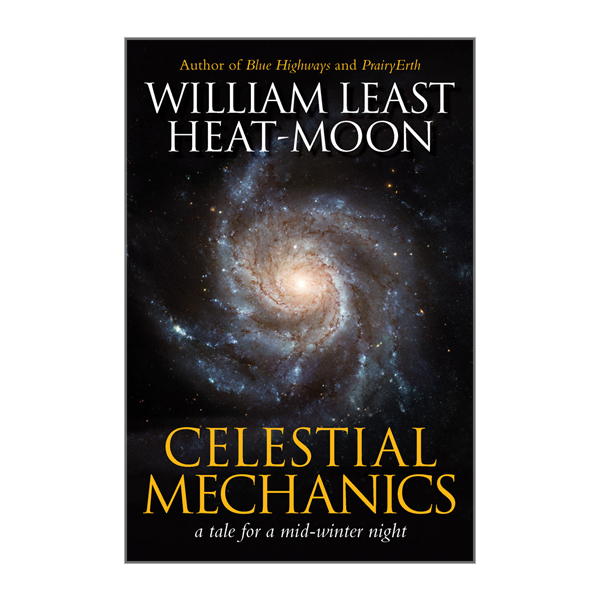
Now he has turned his skills at close observation to fiction.  Celestial Mechanics is Heat-Moon’s first novel and it is as unexpected as any of his past works.

CelestialMechanics-Cover-Comp5-v4.indd

Silas Fortunato, thirty-three, has come home to inhabit a hundred acres inherited from a deceased aunt, and by happenstance encounters Dolores Heppernan, who goes by Dominique, arguing with an inn-keeper over a misplaced reservation. Silas gives her his room and so begins his pursuit to bind the fey Dominique to him. He is smitten. In an idiosyncratic courtship, he convinces Dominique to marry him and move to the Hundred, with its aging ramble of a house and the unimproved woodland around it.

Dominique is a real estate agent–this after having been many things. We’re never entirely sure what Silas was, but it had to do with academia, to be sure, for his is a deeply-read man with a fascination for Marcus Aurelius and aspirations to write a play.  No astrologer, he nevertheless puts great stock in the stars and even builds a platform for stargazing at the top of the house.

Rarely have two people been so mismatched. Heat-Moon understands something about obsessive love because he never explains what it is about Dominique that draws Silas.  He simply chooses her, devotes himself to her, and works mightily to make her happy to be his wife. For her part, almost from the start Dominique questions her own motives for agreeing to the marriage and starts looking, sporadically but with growing urgency, for a way out. To be fair, she does try to pull Silas into her view of life—tries to convince him to sell the Hundred for development, get a house in town, travel.  But Silas—the name means “Wood Dweller”—while willing to make great concessions to her, will not part with the property for any reason so venal as money.  He sees the land as a source of regeneration and hopes Dominique will eventually come to find peace there.

But Dominique is not interested in peace, not that kind, anyway.  She is in headlong pursuit of security of the kind that requires her to depend on no one else.  She wants wealth, travel, independence.  She wants no one to trap her, confine her, or limit her in any way.  While Silas never wanted to do that, the very stability he offers to her is an illusion, a trap, a set of walls.

The truth is, Dominique is on the run. From herself more than anything else.  She sees people as wanting nothing more than to define her and restrain her and her entire life has been a series of escapes.  She is smart, clever, but just enough to know how to manipulate the systems around her to keep from being caught by them.

Silas wants nothing more than to find and understand his place within the world Dominique seems determined not to yield to. Their relationship becomes a congeries of misunderstandings and evasions.

Into this one more person enters, Dominiques sister, Celeste, who is in the process of taking orders in a convent.  She hears of her sister’s marriage and the odd man to whom she has committed herself and now seems ill at ease with, and comes to visit.

It is clear to us that Silas married the wrong one.  Silas, though, has no such thoughts, and though we suspect Celeste does, she is conflicted about what to do.  She wants to stability and peace of the convent but she chafes under the restrictions on imagination within.

In certain ways, the novel proceeds along well-trod paths.  But Heat-Moon knows that the well-trod can surprise, that roads, pathways, trails, and highways can deceive if one does not look close enough at what there is along the way.  Here he gives us the unexpected enfolded in what seems familiar.  People, he shows us, are the least predictable of maps, and even when they seem to be going an obvious direction, the journey can still surprise.

There is even a ghost of sorts in the book.

But this is, as per Heat-Moon’s past offerings, a very layered story, and nothing is quite as neatly comprehensible as it may seem.  Dominique…well, Heat-Moon understands the power of names, as well he should.  Dominique, seeking to be self-contained, is her own passion.  Dolores means “sorrow” and is a not very sly reference to the Virgin Mary.  Dominique means “lord.” She seeks to be her own chosen apotheosis.  But she is stuck entirely in the flight to Egypt.  Celeste, not surprisingly, means “heavenly.”  But Celeste is looking for a very tangible, terrestrial salvation. Heat-Moon plays the full range of contradictions and potentials implied by all these meaning-laden labels and pulls the expected story inside-out.

What we end up with, then, is a road trip of souls.  William Least-Heat Moon has taken a story of people making choices incompatible with their own desires and natures and given us a travelogue of the spirit. The trajectories of these three people, each one trying to find their place in a cosmos crowded with distraction and uncertainty, reveal the geography of the self and the gravity of choice. In the end we’re offered a map of roads oft-traveled and too little remarked on the journey to hope.

Moral Crisis and The Reality of God: Mary Doria Russell’s The Sparrow

Sometimes it is very much worth the wait before reading certain books.  Too early an exposure and the substance could be misapprehended, misinterpreted, misconstrued, or simply missed. Such, I feel, is the case with Mary Doria Russell’s superb The Sparrow, which came out in 1996. I bought a copy shortly after it appeared in paperback and it has remained, unread, on my shelf since. Until this month. Why?

I don’t know, really. I started it a few times and something in the opening pages either left me unengaged or daunted. Whatever the reason, it waited till this year, and perhaps that was as it should be.

I knew enough about the novel to tell people that it is a natural successor to James Blish’s excellent novella, A Case of Conscience, which has many of the same elements. A Jesuit as member of a first contact mission to an alien world and the moral conundrum arising from certain inevitable questions.  Interestingly, I find that both novels hinge on an evolutionary question going directly to matters of fundamental morality.  Blish suggested powerfully that our entire conception of god and its concomitant moral structures may be simply a consequence of how we evolved.  That the sociology resulting from our biology allowed for certain cross-generational assumptions which a different biological system simply wouldn’t produce.

Russell’s concept is less pat than Blish, since in many respects the biology involved is similar enough to ours to muddy those particular waters. She adds another component to the mix, though, that results in a basic difference of moral priority.  In fact, in the end there’s a question of whether or not morality is relevant at all, overwhelmed by opportunity and expedience.

What we have in The Sparrow is deliciously layered examination of cultural assumptions that continues to play even after the book is finished and the afterimages begin cycling through our minds.  She set a series of logical land mines throughout that set each other off with the inevitability of a Socratic dialogue.

Father Emilio Sandoz, Jesuit and linguist, a child of the slums who has through a series of fortunate accidents become more than his beginnings would ever have suggested possible, is on hand when the first evidence of extraterrestrial intelligence is discovered at the large radio array of Arecibo. After analysis, the signals resolve into music. Odd, alien music that is nevertheless compelling, a siren’s call to erstwhile explorers.  There is no question upon hearing this music for Sandoz. We must go.

The mechanism by which they travel to Alpha Centauri is grounded in solid extrapolation of how space technologies may proliferate in the near future.  Asteroid mining is a going activity and it is a matter mainly of financing to turn an abandoned asteroid into a starship.  The Catholic Church, through the offices of the Jesuits, opts to send a mission.  They ask no one’s permission, in fact pretty much tell no one that they’re going.  The U.N. is debating sending a mission and later they do, but this one—the Stella Maris—is the first.

I don’t wish to spoil the plot, which, even without the substantial subtext would be a page-turner.  The careful revelation of detail through which Russell presents her thesis is important to its impact, and that subtext is the whole purpose.  Suffice it to say that the mission fails.  Emilio Sandoz returns to Earth, a broken man, the only survivor of the party of eight.

When I say “a broken man” I mean in every sense of the phrase.  His hands are a wreck, he has numerous physical problems, including scurvy, and his mind is all but gone from the trauma of the mission itself and its costs and from the fact that he was forced to make the return voyage all alone, a long journey through a deeper dark night of the soul than one might ordinarily encounter.  Upon return, he is to be brought before an inquest, established by his own order, to find out the facts of the mission and determine their meaning.

Sandoz doesn’t want to cooperate.  He doesn’t want to relive the events that ended in such failure nor does he want to infect anyone else with the knowledge that has caused him to renounce his faith.

Though not exactly. This is one of the interesting aspects of the layered game Russell plays throughout. It’s an open question, even at the end, whether Sandoz has in fact lost his faith.  He seems to wish it, certainly, angry and bitter he is at a god by which he feels betrayed.  But Sandoz is a brilliant man.  He exemplifies what has become axiomatic about Jesuits and maintains his faith by dint of reason supported by a passionate belief in justice.  No simple “believer” and having emerged from a hellish childhood to become one of the best linguists not only in his order but anywhere, it takes enormous challenge for him to question his commitment to a god which more facile minds would characterize as bizarrely cruel.  Even at the close of the novel he is wrestling with the nature of god.

At the center of the novel is a particular formulation of the question of evil which goes to what might be termed beneficial expedience.  The alien race to which he goes as linguist and missionary lives in apparent harmony with itself and its environment.  A complex harmony, mirrored in the songs that are the first knowledge humankind receives of them.  There is much about them that is admirable but also puzzling—until they realize that what they at first thought to be a single species is in fact two intelligent species and their evolved cohabitation of their world requires of them certain accommodations that for humans would be odious.

There is the question of judgment—not our world, not even our evolutionary history, how are we to judge?  But any concept of a god as source of moral law must necessarily exhibit certain basic consistencies, regardless.  There is the question of expedience—if something works not only for the individual but for the planet as a whole, again, who are we to question?

But finally, Sandoz comes face to face with the human example as baseline for any kind of moral assessment and asks: “What do we have to show as in any way superior, when the condition of our species is questionable at best?”

Russell sets a serious moral trap in this novel, leading us step by step to the point where we must look at our own condition and ask how our own apprehension of moral law plays out.  Does it enforce any kind of justice?  Does it bring us into harmony among ourselves and our environment?  Does the dogma by which our moral adjutants dispense advice and guidance actually serve the function for which it is claimed?

Like a good Jesuit, Sandoz is still asking these questions at the end of his ordeal, and a terrible ordeal it is.  On a certain level, he is brought to the condition of all colonized and oppressed peoples and made to know what it is like to have everything he believes and assumes overwritten by a more powerful circumstance.  By the end he has suffered every indignity. Every single one that arises from basic injustice.

And yet the system which puts him through this is not by its own metrics oppressive—merely an embellished example of evolutionary imperative.  By comparison, Sandoz wonders if the horrors of our own condition are not the results of a fundamental rejection of evolutionary imperatives, the imposition of a wholly artificial system presumed to be based on moral assessment but really little more than a gloss on power relations having little to do with anything “natural.”

In turn, one can then ask the same thing about the aliens and their relationships.  If, which seems to be one of the unspoken assumptions by which Sandoz operates as a moral agent, sapience is the deciding factor in applying standards of justice and equity, then how can the two species on Rakhat maintain the self-evidently immoral system they do?  By the same token, if equality is of such value to us as a basis for our moral decisions, how then can we maintain the cultural systems we do?

There is, Socratically, a dialogue at play throughout the novel, and a rigorous one at that.  Each of the eight humans who go to Rakhat as well as the priests conducting the inquest represent choices and judgments based on different apprehensions of the god question.  Each stands for a different set of conditions calling into question our basic assumptions about civilization and moral action.  Often it’s subtle, but sometimes powerfully visceral.  We realize that this is a novel which, practically from page one, takes every assertion of right and wrong and expedience and morality and says “Sure, but” in the very next passage.

Finally, it is an examination of the limits of accommodation.

The earlier novel, A Case of Conscience, asked a few of these questions, but it shied away from many others.  Nor did it offer such a full range of mirrored arguments.  Its conclusion was in many ways annoyingly ambiguous and turned on a question of epistemology which was less personal, less visceral than what Father Sandoz is forced to face.  But there remains a line between them which is not insignificant, which is that we must ask if any conception of god is not in the end purely a matter of intellectual expedience that cannot stand up to exposure to truly different cultures and biologies.  If, basically, in the end such conceptions are, like anything else, merely systems designed to see us through to the next level of understanding.  They do change.  The Jesuits themselves changed from their beginnings as an order dedicated to the authority of the pope and an enemy of developing knowledge to an order of the best educators and some of the finest scientists on the planet.  Whether admitted or not, their conception of god changed.  Sandoz is dealing with the question of how resilient any such conception is.

Or was Spinoza right and that god is simply nature and morality is ours to construct and adapt and modify?  Sandoz seems at times a closet Spinozan, but as flexible as he often is, he finds his limits and snaps.

Or does he?

I’m not sure I possessed the stuff to appreciate this novel when it came out.  I may not now, but I can at least see, sometimes vaguely perhaps, Russell’s intent.  In any case, it was certainly worth the wait.

Easy Habits and the Consequences of Belief

At first glance, the two books could not be more different. Subject, tone, everything seems different. Not at odds so much as…nonoverlapping.

Which is ironic, since both deal, in their separate ways, with that very idea, the separation of areas of knowing.

Probably because I read them so close together I recognized their shared concerns as clearly as I did. Whatever the reason, it struck me as obvious in so many ways that I began to recall all the other books over the last few years that could be likewise gathered within this same subset, all on distinct topics and yet all based on, to some degree, an analysis of the same human propensity to disregard evidence when it contradicts belief.

Let me begin with the more general of the two.

Jerry A. Coyne is an evolutionary biologist.  Compared to others with public profiles, he has published few books.  Three, to be precise.  His latest, Faith Vs. Fact: Why Science and Religion Are Incompatible, is a direct challenge to Stephen Jay Gould’s idea of “nonoverlapping magisteria.”  Gould’s premise is that science and religion should not conflict with each other because they are concerned with entirely separate realms of knowing—hence the nonoverlapping part—and except for certain agenda-driven partisans, there is no reason for them to be in conflict.  Coyne sees this as accommodationism, which he thoroughly discredits in his book.

My claim is this: science and religion are incompatible because they have different methods for getting knowledge about reality, have different ways of assessing the reliability of that knowledge, and, in the end, arrive at conflicting conclusions about the universe.  “Knowledge” acquired by religion is at odds not only with scientific knowledge, but also with knowledge professed by other religions.  In the end, religion’s methods, unlike those of science, are useless for understanding reality.

Coyne identifies Accommodationism as an attempt not to stir the hornet’s nest, because scientists are often dependent on politically sensitive funding.  Science, especially Big Science dealing with questions of origins, is expensive and the days of the independently wealthy scientist are largely gone.  Rocking the boat by annoying those who hold the purse strings would seem ill-advised.

The conclusions, he goes on to argue, of scientific inquiry continually poke holes in those claims by religion that still assert authority over secular matters.

But more than that, such deferral to authority erodes our critical capacity and can lead to false conclusions and bad judgments, all because we accept the hegemony of “faith.”

…a word defined in the New Testament as “the substance of things hoped for, the evidence of things not seen.”  The philosopher Walter Kaufmann characterized it as “intense, usually confident, belief that is not based on evidence sufficient to command assent from every reasonable person.”

The sticking point for many would be that “reasonable person” proviso, for surely, as Coyne concedes—often—there are many reasonable people who nevertheless espouse a religious faith.  What are we to make of that?  Is the basis for the assessment of “reasonable” perhaps too ill-defined or is the scope of “belief” too broad?

Coyne takes us through the process, giving a thorough explication of why science and religion are incompatible if not a convincing argument for the down-side of belief for belief’s sake.  He tells an anecdote early in the book about how he yearly teaches undergraduates a course in evolution, which the majority do very well at, but admit, after earning their A, to not believing a word of what he taught.  Because it contradicts their religious belief.

It is this that Coyne sees as the dangerous aspect of faith as promulgated through religion, the a priori rejection of evidence in favor of a set of usually unexamined beliefs.  He takes us through a catalogue of negative manifestations, from the rejection of medicines to the acts of terrorists to the rejection of solid science (like climate change), that have their underlying justifications in religion.

Coyne, an admitted atheist, puts all this forward while taking pains to admit the personal comfort to be found in religion by many people.  From a certain point of view he tends to go the extra kilometer to be fair.  Of course, going through the comments on various review sites, those predisposed to reject such arguments accuse him of profound bias if not outright malicious intent.  One cannot help but wonder if they bothered to read the book, all or even in part.

The book makes its case clearly and concisely.  It avoids the polemic outrage to be found in other tomes by big name atheists by sticking largely to evidentiary concerns and philosophical arguments.

But, one may ask, so what?  Religion and science are two realms in which most people would assume they have no stake. Castles in the air, esoteric arguments about things that have no impact on our daily lives.  Most people seem to keep a religion much the same way they have a pet and certainly in the West the majority live secular lives and only rarely feel compelled to apply their religious convictions to anything.  As for science, as long as the technology we depend on works, all the rest is so much theoretical handwaving.  It makes no difference if we have almost no understanding of quantum mechanics and certainly evolution is just tenure-building nonsense having to do with million-year-old bones and what kind of textbooks the school district might use next year.  Nothing to do with us in our daily lives. So what if people rely more on faith and belief in making their daily judgments than on evidence-based science?  We operate more on heuristics defended by aphorism than by reason and applied understanding, or so Daniel Kahneman tells us in his excellent study, Thinking, Fast and Slow, and we by and large get along perfectly well that way.

How does this argument concern me?

Johann Hari’s new book, Chasing The Scream, has an answer to that.  Of sorts, if we but make the epistemological leap.

Hari is writing about the drug war. It is, for him, as much a personal examination as a journalistic one, as he admits to having family and friends who are addicts.  He begins with a simple question.

I scribble down some questions that had puzzled me for years.  Why did the drug war start, and why does it continue?  Why can some people use drugs without any problems, while others can’t?  What really causes addiction?  What happens if you choose a radically different policy?

Okay, three questions.  Still, simple, basic questions, to which any reasonable person might reasonably expect a reasonable answer.

Yet we spend billions, bully small countries, destroy thousands if not millions of lives, all in pursuit of policies which rest on an appalling lack of informed justification.  By the end of the book you come to see that there are no answers to those simjple questions which in any way validate our continuing on with things as they are.  As they have been for a hundred years.

Hari goes back to beginning of the war, before drugs were illegal, and takes use through the history.  Back to Harry Anslinger, the head of the Federal Bureau of Narcotics, who fueled the drug war for the twin purposes of maintaining his agency and exorcizing demons that had possessed him since childhood, even in the face of substantive research and sound arguments denying his approach to the problem had any merit and more than ample evidence—Prohibition—that it would lead to catastrophe, not only on a national but on a global level.  Hari details Anslingers battle to destroy Billie Holiday and his use of intimidation and police tactics and, subsequently, U.S. foreign policy to assure the continued crusade to eradicate drugs and destroy addicts.

Not because of any evidence Anslinger understood that led him to think this was the only if not the best way, but because he believed it in spite of growing mountains of evidence that this was a wrongheaded approach.  He suppressed evidence, hounded physicians who dared present alternative models to the drug problem, intimidated politicians—except those who could secure him funding—and strenuously denied the validity of any evidence that  contradicted his belief.

He believed.

As many did and still do.  It is this that trumps hard evidence.

Even as a young adolescent I thought the argument for our drug policies was lacking.  I thought at the time that I just didn’t understand.  Never having been in the least interested in drugs and knowing few if any who were involved with anything more serious than marijuana, it seemed not to concern me.  Later, I did a short stint as a volunteer drug counselor, but the work was far more than I could handle at the time.  I trusted the people in charge knew what they were doing and certainly the gang violence associated with drugs seemed to make a persuasive case that this was a worthwhile and often desperate fight.

But as the years went by and the war continued, I began to notice bits of research here and there and how certain politicians contradicted themselves and how the prison population, especially in the wake of Nixon’s near militarization of the police community and the drug war ethos, was growing and in very worrisome ways.  I began to seriously rethink my position with Reagan’s zero tolerance policies and the mandatory sentencing guidelines he established through Ed Meese, one of the notable Puritans of the modern age.  Even so, I had the nagging suspicion that maybe I was just missing something.  Certainly I didn’t approve of drug addiction, but I more and more came to believe that these people needed help, not punishment.  We understand that process very well with alcohol, why is it different with narcotics?

And besides, there are plenty of people who receive perfectly legal prescription narcotics and never become addicts.

The number of holes in the picture kept growing.  I no longer trusted stated drug policy, but I didn’t understand the instransigence of people over reform.

Hari’s book lays it out very clearly.  Money is high on the list.  We fund too many of the wrong people at too high a level for them to be easily weaned from the teat.  Foreign policy is also tied to this, especially in these days of international terrorism which has a strong drug component.  But the factor that ties this in to Jerry A. Coyne’s book is the one Hari covers only glancingly.

Belief.

It is easier to rely on what we have always believed than to look at evidence that requires us to change our mind.

Many aspects of our lives are covered by this observation, but where problems arise are those with political and social ramifications.  The persistent beliefs about the poor, about minorities, about people with different beliefs, even when evidence is provided which significantly challenges such beliefs and suggests strongly that not only are they wrong but that we would be better off discarding them, we cling to them.

Hence my conflation of these two books and the suggestion that they share a common idea.

Not that I argue that all beliefs are wrong.  What is wrong is the intractable nature of unquestioned belief.  The only reason the drug war continues is that it has considerable popular support and the only reason it has that is that many people cannot bring themselves to change their minds about it in the face of not only evidence but what we euphemistically call common sense.

But that can be said of so many things which directly and indirectly impact our lives.

Perhaps it is a stretch and perhaps I argue out of my own biases, but it seems to me the most valuable tool we can have in our intellectual toolbox is the ability to say “well, I believe that but I might be wrong.”  Faith cannot maintain, however, among people who are able to say that and apply it to anything and everything.  Science is built on exactly that principle—all knowledge is conditional—but belief, as exemplified by religion, thrives by the absence of that principle.  It says some knowledge is absolute, not to be questioned.

In the contemplation of matters of theological concern, this perhaps offers consolation, comfort, a certain utility, to be sure.  But it is easy for unquestioning acceptance of arguments from authority to become habit and then apply it to anything that our prejudices suggest we may wish to avoid examining.  Drug addiction is an unfortunate affliction and it may be uncomfortable for people to see it for what it is—a disease, like alcoholism.  That discomfort makes room for assertions from authority offered by people who claim to be working on our behalf.  Our unwillingness to ask evidentiary questions is a cozy environment for demagogues and despots.

When you ask “What does this have to do with me?” you might be surprised at the consequences of avoidance and the price of unquestioning trust.  Why should we learn science and how to apply the discipline of examining evidence?  So we don’t hurt ourselves out of the easy habit of belief.