Klara and the Sun

Klara and the Sun is a simple story built upon a deep substrate of subtlety. It realizes its best effects by the very plainness of its presentation. But given a moment’s reflection it becomes clear how profoundly well-imagined is the world he has constructed.

Klara, the viewpoint character throughout, is an AF—and Artificial Friend. A robot built to act as a personal companion for a child or young adult. It’s a very old idea, almost Victorian, from a time when the wealthy, the aristocrat, would pay someone to be companion to a son or daughter. A constant presence that could be relied on to always be supportive and, more or less, guide the subject on a solid path to adulthood. As the novel opens, Klara is resident in the store where AFs are sold, with a view of the busy urban street beyond.

We learn in short order that AFs are solar powered, that they are intent upon finding a place with a customer, that there are different models with different capabilities (Klara is a B2), and that to a significant extent they are emotionally aware. This last detail has always given me pause because emotion is intrinsically hormonal. Living creatures experience emotions because our bodies give us chemicals in response to event, so we know fear and happiness, embarrassment and depression. Without these systems, machines by definition cannot have emotions. (This is a trope in SF that has always troubled me, but it seems wired into things now.) Ishiguro gets us by this small problem by inference that the emotions are programs that seem incapable of serious modification. Even at the end of the novel, in less than ideal circumstances, Klara’s emotional engagement remains consistent. So we can see this as a matter of program response that is self-referential and operates within a relatively broad but constrained range. (There is within this a nod to Turing.)

Details matter, especially in the construction of plausible science fiction narratives, so I point the above out to suggest that Ishiguro has done his homework and built his world well.

Klara is purchased finally by the mother of Josie, who is around 12 or 13, and is not well. She suffers bouts of debilitation. Eventually we learn that this is a consequence of her having been Lifted, a kind of genetic modification intended to enhance a child’s potential, both physically and intellectually. It does not always work out, though. The Mother, Chrissie, has already lost a daughter to this process and now it seems another may die. So the choice of an AF for Josie is shot through with multiple motivations as well a guilt and hope. Klara determines that she is there to see Josie through this.

The setting is the near future. Things are different yet much the same. The social dynamics have found new bases on which to operate, but the results are much as they have always been. Lifting has become the new standard of acceptance and obviously there is a class component. Josie’s best friend, Rick, has not ben Lifted, and so is sort of a misfit in the social groups Josie’s mother wishes her to join. The tension around the process feels very familiar and yet is a disturbingly dissonant option—for some, not all. What emerges regarding Josie’s difficulties, the dynamics between her and her mother and the estranged father, with Klara in the middle for purposes she is not altogether aware of form the ecology of the novel. Klara’s own apprehension of the problem seems at times both naïve and simply off the rails, with her conviction that the Sun is the solution to all these problems. Because Klara is solar powered, it seems logical that she has what amounts to a belief system centered on the Sun as a sort of deity. 

All these components merge into a disturbing yet disturbingly familiar expression of hope and need for purpose that, even as the answers and solutions sought by Klara are often beside the point, speaks to dedication, loyalty, and conviction. Klara succeeds, even thought what she actually does appears to have almost nothing to do with the actual mechanisms with which she wrestles, and experiences…well, perhaps not “life” as we might accept it, but fulfillment of intent that resonates.

Ishiguro has demonstrated a unique method of writing science fiction that “passes” as not. He has been working toward this for decades now, not quite succeeding in the attempt, until now. Just as he managed to recast the Arthurian legends as an unexpectedly trenchant work of mimetic historical fiction that was more concerned with the underpinnings of legend than with the legend itself, here he has given us a thoroughly-conceived work of SF that works as “literary” in the ways our culture accepts the idea. Certainly one can read this is as allegory, Klara herself as a metaphor, and, if one chooses, ignore the dislocations of the world itself. One can pretend this is a kind of riff on The Prince and the Pauper, a page lifted from Pollyana, a gloss on any number of sickly-child stories, even a study of the emotional fallout of adoption and divorce and loss. I suppose it might even work satisfactorily that way.

But it works best when the underlying conceits, which are wholly SFnal, are accepted and engaged. This is a disturbing world, a decade or two removed from ours, strewn with questions about the ethics of genetic engineering, AI, emotional substitution, and the economics of transformative technologies. One could go back through and pick a dropped line and unpack the meanings and marvel as the implications. 

It has long been pondered what it would look like if one day science fiction became simply another mode of literature. I think this may be one of the best examples.

Year in review

I read 94 books in 2024. 

Not what I was shooting for, but not by any means unsatisfying. Upon retirement, I imagined myself spending at least two or three hours a day poring over all the books and devouring the things I’ve always intended to.

Well. That didn’t happen.

But as things get more settled, I might exceed my goal of 100 a year. (The highest number I ever reached was my senior year of high school. I had taken a speed reading course the year before, I was cruising through texts at an average of 2000 words a minute, and I cut class most of my senior year. I spent most of those days at the local library—seriously—and got to where I was doing a book a day. I plowed through many of the so-called classics that way and I might have read 300 books that year. Now, I can’t read that fast anymore and I’m much happier for it, because what I read at the more modest pace of maybe 150 to 200 words a minute means more, has more impact, and stays in my memory. Lately I’ve been revisiting some of those classics I read back then and it’s like reading them for the first time. I remember I read them, but not much else, with a few exceptions.) That would be a respectable number, I think. 

I did a lot of filling in this past year. Books I’ve owned for decades and never got around to, some works of SF that are important if not seminal works that I simply passed up. To that end, I read several of the original Ace Specials, edited in the late 60s-early 70s by Terry Carr. While a couple of them did not quite pass the test of time, I was pleasantly surprised by the D.G.Compton’s—Chronocules, Steel Crocodile, The Silent Multitude, and Synthajoy. I found them very mature works, dealing with human interaction in ways much more sophisticated than a lot of popular SF at the time, with premises that, while certainly science fictional, did not dazzle with hi-tech glitz, but supplied a satisfying substrate for the real action, which is how we treat each other. Compton, I believe, holds the record for the most titles published in the Ace Special line. As well, I read a couple of Bob Shaw’s, a writer who has unfortunately been largely forgotten today. The Two-Timers and The Palace of Eternity are sophisticated stories of seemingly minor shifts in the given tapestry of our lives with outsized effects. 

I also filled a couple of Michael Moorcock gaps with The Ice Schooner, The Black Corridor, The Distant Stars, and The Warlord of the Air. Moorcock can be uneven, but he possesses a singular approach to science fiction that, when effective, elevates his work to a remarkable degree. 

I also tackled a lot of Robert Silverberg. There is a lot of Silverberg. He is one of the most prolific writers, in any genre, and he crossed genres significantly. In his early career, he wrote a great deal of popular SF, potboilers really, and some of it has not aged well. When Silverberg is firing on all cylinders, he can be brilliant. But the volume of work…well, not all of it rose to such vaunted heights, and we shouldn’t expect it to. But in some ways, work which was once seen as cutting-edge and groundbreaking, especially socially, has worn poorly. But among those I read this year that I think remain remarkable I would put Downward To The Earth. It’s a riff on Joseph Conrad’s Heart of Darkness. Silverberg has claimed Conrad as one of his favorites, so it’s not surprising that he would take a page from him from time to time, and this one is rather well done. Another worthy tale is Sailing To Byzantium. It’s elegant and picturesque and in the end poignant. 

There are novels one should read at the right age or, really, when they first appear if possible. I read several older works that, for a variety of reasons, simply have not held up well, despite clever ideas. Sad, really, because I can see in many cases where I would—at age 15 or 16 or 26—have been utterly enthralled by them. Some of this has to do with the natural changes of style that come with the passing of time. We’ve learned how to write this stuff better. Some of it has to do with the priority given to aspects of certain stories we know were they done today would be differently deployed. Times have changed, tastes have evolved, and for better or worse I am someone who has a difficult time Going Back. I can’t read a lot of older work that I know I loved when I first encountered it, because, well, it doesn’t flow anymore. Expectations have mutated, grown, what have you. (I have this problem with period novels. I know people who can happily get lost in the works of Trollope or Galsworthy, but I trip over the prose and stumble. Oh, there are writers from those periods I can read, there are exceptions, but a great deal of popular work from previous eras just doesn’t work for me and it’s not the fault of the work itself.) I will confess here that there is one type of novel I simply grind to a halt with and that is the broad satire. I attempted to read John Sladek’s Mechasm (another of the original Ace Specials) and it’s Vonnegut-esque, which would be a recommendation for many people. But it’s…well, smart-alecky. Tongues visibly in cheeks, caricatures, and just…clever ideas packaged as a series of absurdities. I’m willing to cop to tone-deafness on my part, but too often I’ve been in the middle of work like this before realizing I’m trying to read smart-ass prose as if they were deadly serious. I’m working on that.

Then there are writers whose approach to subject—their strategies, if you will—fails to engage. I have blindspots about this. I read things others tell me are just marvelous and I find them clunky and all but inaccessible. But so many people extoll the virtues of these writers so much that I suspect many of us who are simply not impressed say nothing for fear of spoiling the party. 

One classic, so called, that was surprising in many ways? I finally read The Man In The Gray Flannel Suit. Sloan Wilson’s first novel and  cultural touchstone of sorts. My review is here, so I won’t go into it. I read a few books that in their day were heralded as important. Martin Amis’s Time’s Arrow, which I found clever if not altogether revelatory. And then there was The Futurological Congress by Stanislaw Lem. I understood something about Lem after this one that I hadn’t quite realized before. Lem did not like mot science fiction, especially American SF, and this novel offered a clue as to why that may have been. Lem, I believe, didn’t think humans were…improvable. That we might develop amazing technologies, even make major breakthroughs in science, but we ourselves? Hopeless. I think he may have reacted negatively to the kind of Higher Frontier cheerleading a lot of SF indulges. 

I continue to be impressed with the tor.com series. I’ve read a number of great books from them and not yet encountered a bad one. This year continues with the latest entry in the Murderbot seriea, System Collapse. A Season of Monstrous Conceptions by Lina Rather pushed the boundaries of Steampunk in interesting directions, although I’m beginning to feel that category ought to be retired, at least in many instances. Just because a story is set in a more or less Victorian milieu it should not automatically be regarded as steampunk. Sometimes it’s just alternate history. More often, it seems, it’s an example of horror. Be that as it may, another fine work from tor.com is Aliette de Bodard’s Navigational Entanglements, a very satisfying kind of space opera. Top of the list from that publisher, though, is Ray Nayler’s The Tusks of Extinction, a sobering contemplation on the economics and sociometrics of poaching and the costs of solutions.

Continuing my desultory attempt to catch up on what may have been my Golden Age, I read a couple more Clifford Simak novels—Cemetery World, in particular—and James Blish novels. Blish is another mixed bag. Some of his books have aged poorly, while some are surprisingly still very good. Titan’s Daughter is a mixed bag novel reminiscent of Wells’ Food of the Gods. A thriller of sorts. And Mission To The Heart Stars would seem to be a response to Heinlein’s Have Space Suit, Will Travel, both dealing in different ways with the idea of humanity having to pass muster before a galactic civilization that holds our fate in its grasp. 

Two of the most surprisingly pleasurable reads (for completely different reasons) this year were C.S.E. Cooney’s World Fantasy Award winner  Saint Death’s Daughter and the Booker Prize winner Orbital by Samantha Harvey. The first because normally I would never have picked it up, but it’s a title in my book group’s roster (this month actually), the second because…well, an SF novel written by literary writer that, being SF, won one of the most prestigious literary awards on the planet.

Saint Death’s Daughter is a sprawling bit of world-building that, despite its excellent background construction and detail, is very focused on its characters, who are wide-ranging and unique. Despite some touchpoints that suggest this world is some past (or future) iteration of our own, it quickly becomes irrelevant to the plot, which is twisty and engaging and in certain ways compellingly perverse. It deals with necromancy, includes ghosts, resurrection, and an original take on magic which, by the end of the novel, left me wondering if this were fantasy at all. The world is not Earth, not in any traceable way, and I began to see the traces of a nanotech explanation for much of the so-called magic. But it is written in the manner of a fantasy. It appears to be a fantasy and, as such, is not something I would normally pick up. But it more than paid off the investment in a 640 page novel. 

Orbital on the other hand is exactly the sort of thing I would pick up, as much out of a desire to see how well it was done as for its content. I should be used to finding well-done SF written by otherwise non-SF writers by now. These are artists who have come of age steeped in the brew of science fiction that has soaked contemporary culture. It’s not like the “slumming” that one used to find from mainstream authors who attempted the form that they might otherwise have felt a subspecies of Good Writing. It has become much more acceptable for someone like Kazuo Ishiguro or Emily St. John Mandel or Mat Johnson to produce a work of unapologetic science fiction (even though some publicists still balk at embracing it), but I’m still cautious and surprised when one is done well. In fact, very well. To be sure, Orbital is easily read as mainstream literary, the SFnal elements smoothly entwined with all the rest to make it feel contemporary. But if one of the chief values of science fiction is how is elucidates the human changes wrought by science and technology which are themselves game-changers—paradigm-shifters, if you will—in anticipatory modes, then Orbital qualifies, and it is the respectful flower of internalizing SF as a valid literary form with significant implications.

This past year I’ve read more SF than the last several. Largely, this was a consequence of having to devote myself to more research, but also because my nonfiction-for-pleasure has increased, and in that regard some of the highlights of 2024 have been: 

Christendom by Peter Heather; Democracy Awakening by Heather Cox Richardson; The Existentialist Cafe by Sarah Bakewell; The Second Sex by Simone de Bouvoir; White Holes by Carlo Rovelli; Plato At The Googleplex by Rebecca Goldberger Goldstein; Orientalism by Edward Said; The Witches by Stacy Schaff. Again, some catching up going on there, books I should have read but never got to.

So, 94 books. I may tally fewer this coming year as I have several on my pile of epic proportions. That and I don’t know yet how my next couple of projects will distort my strategies. But all in all, I’m pleased with this last one. I have not mentioned several others, many of which were quite good but other than noting that I read them would add little to this summary. One of these years I may start linking to a spreadsheet so everyone can keep track.

I’ll end by pointing out that the last few years have seen declines in reading rates across several demographics. This saddens me. I know the pressures of daily life can make reading seem like a luxury—or a chore—that one cannot afford, but given the state of, well, everything these last several years, I think it is a necessary survival habit. The level of ignorance—specifically, the degree to which people simply do not know things—demonstrated quite publicly by too many people is having a corrosive effect on life itself. Regardless how bad one’s school experience my have been, reading is one of the most civilizing skills available to us. Not just the casual cruising of an internet feed but the kind of reading that stretches the imagination. Take a book, turn off the feeds, sit down, and dig in reading. It seems more and more that we’re going to let the world burn because we just don’t know any better.

Have a better 2025.

So Together, So Alone: Souls In Orbit

As William Gibson once suggested, the future is here, it’s just unequally distributed. We live in the dreams of past wishful thinkers, what with all the technological marvels surrounding us and permeating our daily lives. We’ve become blasé about much of it. Many of us walk around with the equivalent of a tricorder in our pocket and I heard an interview the other about an eight-year-old in Gaza hunkering down in the midst of chaos with her laptop and cellphone. We walk the hallways of tomorrow and often fail to appreciate the wonder of it all.

But the oldest of media can bring it home how wide our world has become and leave us with an ancient estrangement about ourselves and our place in the now. Words on paper. Stories. People coping with the strange and trying to make it “normal” even as they acknowledge how utterly amazing it all is.

Samantha Harvey’s Orbital is about a group of astronauts during their tour on the international space station. A mixed group, Russians, an Italian, American, Irish, Japanese…an international bunch with experiments to run and tests to conduct and marvels to experience, within a microgravity environment their bodies tell them is not as it should be. And below on Earth a massive typhoon forming in the Pacific which they can do nothing but watch grow and move toward land.

What are their thoughts? Their reactions? What do they tell themselves about all this humanly anomalous circumstance? 

The time is not very far in the future. We know this because a mission is on its way to the moon. Such a mission is scheduled but not for a while yet. The next phase in the human expansion into space.

But mostly an expansion is the conscious space of accommodating this future and its implications. Each of these people have private reactions, philosophical methods for dealing with who they are and where. Orbital is an elegant examination of becoming. It is a literary novel about something once upon a time you would only find between the covers of science fiction novels. 

Orbital has also won the Booker Prize.

For some, this is in itself is a moment of dissonance. A space story has just won one of the most prestigious literary awards on the planet. 

Well, of course. We’ve been moving toward that for decades. And reading Orbital produces no surprises on that score. It is a beautiful novel and does something for the 21st Century both necessary and unexpected. It establishes a bridge between dream and reality, between what once could not have been and what seems inevitable. But it does so with the full recognition that we carry all that we are into tomorrow, wherever we are or wherever we go. It is a literary work for the science fiction age, which is a period more and more people are actively embracing and living in.

The question then is: is Orbital science fiction? We’ve gotten into the habit of using that label for work that features new technology and some sort of life-and-death adventure, possibly aliens, certainly the Unknown. As far as it goes, one could argue all of that is at hand (except perhaps the aliens—but on a certain level, aren’t we all aliens to each other?) but folded within a rich fabric of simple human coping. “We’re going to be living here,” it says, “at least some of us, and some us will visit, but even if we don’t, this is now part of the space we inhabit as members of the human race…so what will it be like to be ourselves in that extended world?”

On another level, Harvey has captured the awe we will be challenged to manage when we come face-to-face with the new territory. Mitigated of course by the price and consequence of going there. These people in this fragile container, cycling through sunrises that test their internal circadian, and watching the world of their birth from a vantage that allows a perspective most of us must actively work to achieve and which they can find by simply looking out a window, must learn to accommodate their attachments to Earth with the limits of a new physical proximity and the trade-offs to come.

The details are well realized, the science if solid, and so it had to be for the emotional impact to unfold with the truth of recognition. Here we are. There we will be. The universe is ancient and new. What now will we do? 

And we glimpse that while the questions and answers emerge with a timeless familiarity, they are not after all quite the same. 

23

It’s interesting that one of the axioms of retirement is that once entered one will have time to do all the things the day-job obstructed. Like read as much as you like. And like so many such things, it turns out not to be true. The habits of decades are still in force, and while maybe you get more chores done, you find reordering all those deeply-rutted paths more difficult than you thought.

I’m sure in some ways I am reading more, but not the way I’d hoped. I average around 70 books a year, cover-to-cover, with a great deal of spot reading, fragmentary, excerpts, short pieces, dipping into and out of research or sidetrips. I suppose if I did a page count I might find myself in the 150 plus range (total book equivalent), because this past year I did a lot of that, as I’m back at work on a new historical novel and much of my reading is taken up with research, most of which is not whole books.

But other things have also gotten in the way. Well, that’s an ungenerous way to put it. Since my dad’s death, my time spent on mom has gone up considerably—and quite happily—and of course I’m still trying to settle into a new routine.

That said, I read—cover-to-cover—66 books in 2023.

Setting aside the research material, some of which I do include in this tally, quite a lot of it was spent on old novels either read back in my adolescence or for various reasons never read at the time. Catching up, so to speak, on the work that was part of my youthful encounter with, especially, science fiction.

There were a few writers I remember bouncing off of back then. I never quite connected with, for instance, Avram Davidson. I read Rork!, which is a colonial adventure with some curiously subversive takes on the whole idea of imperial encounters; The Island Under The Earth, which I’m still not sure I quite understood, but a sort of mythologically-oriented fantasy; The Phoenix and the Mirror, the first in his loose series about Vergil, again a fantasy (of sorts) and truly magnificently done, a pleasure to read; and A Clash of Star Kings, which could have stood a little more fleshing out, but given the publishing requirements of the time, he delivered a rather fascinating take on the idea that the ancient MesoAmerican “gods” were warring aliens. The pleasant surprise, even with the material I did not quite get, was the beauty of the prose.

I also reread a couple of D.G. Compton novels. Compton died recently, one of those artists one loses touch with and assumes has long since passed away. He published four novels via Terry Carr’s old Ace Special series, the most, I believe, by any single writer, and I know I read them back then (as I read all the Specials because, after all, they were special) but I barely remembered them. They were perhaps too sophisticated for me at the time. But I read Synthajoy and The Silent Multitudes and found both remarkably made narratives about the disjunction between expectation and new technologies or events. His handling of character was quite uncharacteristic of the majority of science fiction of that time (the Sixties) and psychologically fascinating. I will be reading another one for the reading group I host.

Other older titles I read included the complete Cities In Flight by James Blish, which in the end left me a bit disappointed. I thought it began very strongly with the mines of Saturn and the advent of longevity in They Shall Have Stars, but by the last book (chronologically), Triumph of Time, I thought it strained against the limitations of form available at the time. The characters and social milieu did not, in my opinion, match the more cosmological aspects Blish was attempting, but he was never an epic writer in the sense we think of it today. Somewhat more successful was his quasi-fantasy set Black Easter and The Day After Judgment, which dealt with an actual apocalypse and its aftermath. Thematically related to his classic A Case Of Conscience, Blish seemed to have been in his element dealing with the collisions of theology and materialism.

A writer who worked with such themes in quite different ways was Michael Bishop, who also passed away recently. Bishop should, in my opinion, enjoy a much larger and wider reputation than he seems to. At his best, he was compelling and richly engaging. I decided to read those of his early titles I never got around to and with that in mind I read A Little Knowledge and Under Heaven’s Bridge, which he cowrote with Ian Watson. Both examine the impact of aliens on human philosophical concerns, both in different ways. Neither was a great work, but you can see the greatness to come. I also reread his excellent novella Apartheid, Superstrings, and Mordecai Thubana which, among other things, took a hard look at South African apartheid. Published before the collapse of that system, it is an uncomfortable read that deals with police-state mentality and brutality and tragedy of enlightenment within a system designed to snuff it out. It carried unfortunate resonances into today in unexpected ways, which the best fiction will always do.

We read Daphne Du Maurier’s Rebecca aloud. The elegance of her prose allows entree into a psychologically engaging family drama that involves murder and shattered illusions and the demands of expectations based on half-truths and lies. What begins as a rather pedestrian romance becomes inexorably a portrait of dysfunction and questions the sacrifices we make in order to find a place in the world with people we wish to love.

Another read-aloud we did was the superb satire The Master and Margarita by Mikhail Bulgakov. Russian to its core, it was Bulgakov’s last novel, unpublished during his lifetime, and it is a romp. The devil arrives in Moscow, takes over a theater, begins granting wishes, and thoroughly upends daily life for certain people and leaves the state with a puzzle it is incapable of solving. Delightful.

We also read a couple of Willa Cather novels, O, Pioneers! and My Antonia. Cather is among those authors I’d always intended to read but for one reason or another never got to. But I confess, when I was tearing through the so-called “classics” in high school, neither of these would have stayed in my memory very clearly. I’ve had to grow into a state of mind to appreciate them, so it’s just as well I waited. These are the kind of novels kids like me dismissed because “nothing happens.” Which is to say, the careful setting of character in landscape and examining the evolution of them in concert requires a certain interest. Not that I didn’t encounter such work back then and enjoy it, but it would have been the exception. I’ve now reached the point where I look at some of the works I praised as terrific then and have to admit that, really, nothing happens in them, other than a lot of frenetic running around.

However, I also finally opened up a novel whose virtues are so widely extolled that one feels like a literary troglodyte when its charms fail to excite. One Hundred Years Of Solitude by Gabriel Garcia-Marquez. A few years ago I read Love In The Time Of Cholera and quite liked it. This, unfortunately, left me a bit perplexed. It’s not so much that nothing happens, but rather for all that does happen fails to change anything. Except, perhaps, the women. They change. They alone in this vast epic exhibit a capacity for change, for growth, for evolution, but then all of it is constrained to the task of adapting to men, who do not change and whose inability to do so distorts the lives of these women whose marvels and talents we will never see because they are in bondage to a stagnant domesticity. If this were written to suggest a criticism of such male intractability, then it might be something, but I found the narrative guileless in its acceptance that this is how the world is and one cannot alter it.

The older I get, the more I find my sentiments engaged by the women—writers and characters—who struggle to be themselves and stop conforming to long-desiccated expectations. Which is why I look forward these days to the next novel by Becky Chambers (whose The Galaxy and the Ground Within I read this year and found amazing) or Ann Leckie (Translation State, marvelous), or Malka Older (The Mimicking of Known Successes, a novella of remarkable invention)or S.B Divya (Machinehood).

One of the most remarkable novels I have read in a long time was Ray Nayler’s The Mountain In The Sea. Extraordinary visualizations, great characters, and a rich intellectual conceit. I reviewed it here not long ago.

Once again playing catch-up, I read Greg Bear’s last trilogy, War Dogs, killing Titan, and Take Back The Sky. On the surface, military SF, but that’s just the veneer. Beneath is a twisty interstellar puzzle, a clash of civilizations, and questions around the nature of knowledge and how to discern truth is an ever-changing environment. Bear died last year. I have only a handful of his yet to read. However one might have thought of his perspective, he was a boundary-pusher.

Of the nonfiction I read this year, the stand-outs are A Spectre Haunting by China Mieville, a well-considered reassessment of Karl Marx’s Communist Manifesto. While Mieville is sympathetic, he is no sycophant, and this book would be a good bridge into a reasoned examination of Marx and socialism itself. The Rise and Fall of the Dinosaurs by Steve Brusatte, a very good narrative examination of the history of those long ago creatures who somehow have never let go our popular imagination. Empire of Liberty by Gordon S. Wood, a long history of the early republic, one of the Oxford History of the United States entries.

But perhaps the best history read this year was Blood and Ruins by Richard Overy, a history of World War II. Overy casts a wide net, spanning the period between 1931, when he claims the events we now call WWII began, and 1945. He examines the military history, of course, but then he gets into the backgrounds, deeply, and the economics, and then the law, the underpinnings of all the tensions and terrors. He goes well beyond the actual fighting to look at the state of humanity at each stage and provides that ever-so-rare thing, context. It is a brutal read, and very long (I’m guessing a good 300K words) and in the end the book I would presently recommend to anyone who wants one book on the war. He has done an admirable job of maintaining objectivity. Whether he succeeded at that is debatable, but he is not partisan.

The research I’ve been doing has mainly to do with the colonial period of the St. Louis region. Kaskaskia, Cahokia, the Osage. I’m spending a lot of time on minutiae in the constructions of the next Ulysses Granger novel, which I am halfway through a first draft. Some of the books I did not cover here, I have done reviews already on the Proximal Eye.

The pile awaiting my attention is as usual stacked too high, and once in a while I find myself wishing I could recover some of my speed-reading skills from 50 years ago. But I enjoy what I read now and back when I was breezing through texts at 2500 words a minute, I did not. Nor did I retain as much as I’d like. So this suits me. I’m enjoying the meals now.

Have a great 2024, filled with wonderful books. I wish you all good reading.

Of Time and Depths of Contemplation

Sea of Tranquility is Emily St. John Mandel’s sixth novel. Once again, she is indulging in a science fiction scenario, which she also did in what may be her most famous work, Station Eleven. She denied she was writing science fiction, but the novel has been adapted into a streaming series to good effect and is undeniably post-apocalyptic SF. (The reasons literary authors like Mandel find it necessary to disclaim that their work is SF are many and varied and could serve as an interesting study. Suffice it to say that it is a tradition now and originated in the simple reality of market share. That would no longer seem to be valid, given the bankability of SF these days, so we are left musing over sensibilities and pretensions.)

Like Margaret Atwood before her, Mandel seems now to have come to terms with her relationship to science fiction and has produced a work that cannot be plausibly read as anything else. The question then is, how good is it?

As science fiction, it is unremarkable, but not bad. We have now a couple of generations of writers from all genres who have grown up in an aesthetic universe informed by Star Trek, Star Wars, the Terminator, and now the excellent work being done in limited series. It’s bound to rub off, despite the efforts of MFA programs that often regard SF as less than acceptable.

And this leads to the slightly at-variance receptions of readers to such work. For the SF fan, a work like this says nothing new about the universe. For the literary reader largely unfamiliar with SF, it may seem refreshingly outré. Depends on one’s reading history.

The basic set-up in Sea of Tranquility can be traced back to something like Poul Anderson’s Time Patrol stories, which have as their basic ethic—their Prime Directive, if you will—the mandate to guard the timeline to keep history from changing. There is an organization, agents are recruited, various points in time are investigated, aberrations hunted down and “corrected.” We can see the idea in Isaac Asimov’s End of Eternity and in many other works by numerous writers, all of which are concerned with the ramifications of time travel. (Two of the most famous examples come from Robert A. Heinlein—By His Bootstraps and All You Zombies. Heinlein used time travel a number of times, to mixed results. The problems to be grappled with are a rich font of philosophical—not to mention physical—speculation. Presently, the new series based on William Gibson’s superb novel, The Peripheral, is thoroughly exploring the ramifications of time travel.)

The protagonist of Sea of Tranquility, Gaspery Roberts, lives on the moon, in a decaying colony, and leads a relatively aimless life until events bring him to the attention of the institute for which his sister works. She—and they—are essentially the Time Patrol. Gaspery volunteers to help them investigate an anomaly they have discovered, an apparent “hole” in time, which may answer the question, Are We Living In A Simulation?

This is a current—though minor—matter of interest in philosophy and, to some extent, physics. One might reasonably ask, what difference would it make? But there is a certain question of maleability involved, which leads to the ethical issues in keeping the timeline “pristine.”

Mandel then constructs a loop to tell the story of the anomaly and how it involves Gaspery.

The essence of the novel comes down to choices. Everyone’s, really. The engine that drives the novel is Choice. Gaspery’s, certainly, as he becomes a rogue actor, but in every instance throughout the book Mandel examines the consequences of choice. By tying it to the universe at large, through the conceit of time travel (and, secondarily, by asking whether this is all a simulation) she connects it to the fabric of the world itself.

In this, she steps outside the familiar precincts of the purely literary novel, in which choice is certainly important, but only as it affects the people involved with each other. It never alters the stuff of reality. There is seldom this binding of philosophy to physics. That’s the realm of science fiction.

The question then, is Mandel successful in this endeavor?

On the whole, yes. She tells a compelling story. The characters are engaging, their situations distinct and intriguing, and the throughlines are followed scrupulously. Costs are levied and paid, solutions are frustratingly short of desire, and the settings nicely drawn. The central questions are foregrounded (as one would expect from a science fiction novel) and tied to questions beyond the internal concerns of the characters. The world itself is brought into play in interesting ways. It is on a number of levels satisfying.

It is not state-of-the art science fiction, but it does not seem Mandel is trying for that. She’s going for reliably suggestive. That it is derivative (of so much one would not expect her to be familiar with) is not here a detractor. Some of the speculation of what the future may be like is too conservative, but not so much that the story is derailed by incongruities. The major speculations are kept off-stage—mentioned but not examined (there are interstellar colonies, for instance)—and she avoids the pitfall of too much technical detail.

It is the confluence of her characters, coming together in an unexpected way, that keeps us reading. She even suggests an answer to the Big Question, but leaves it to the reader to draw their own conclusion.

We are in many ways tied to people and history unpredictably. There are orbits and the mechanics thereof dictating the path of our hearts. In these matters, Mandel has given us a contemplation of surprising moment.

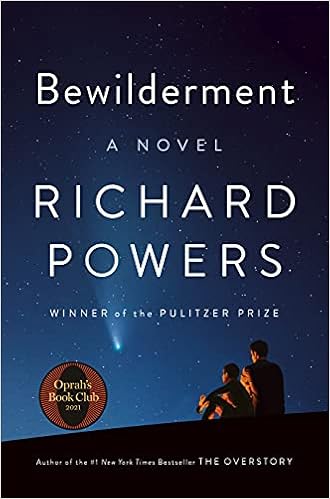
Bewildered

Richard Powers has been skirting the edges of genre for years. He has exhibited the talent of consistently defying category while producing work that can, with a slight shift of perspective, be read as solidly within certain categories.

The question has always been—what category?

He has written about atomic physics, A.I., terrorism, biodiversity, virtual reality, genetic engineering, all convincingly and with a commitment to consequence found primarily in science fiction of the first water.

Now he has put science fiction itself front and center in a new novel that powerfully blends the soul of a family with the science of cosmology, neurology, and ecology and the sense of wonder that comes from imagining new worlds. Bewilderment is a profound examination of colliding worlds, both personal, global, and epistemological.

Bewilderment: A Novel: Powers, Richard: 9780393881141: Amazon.com: Books

Theo Byrne is an astrobiologist. His work requires him to imaginatively hypothesize about extrasolar planetary ecologies as part of the search for new worlds. He is plugged into the community involved with finding and identifying exoplanets and advocating for further research.

His son, Robin, nine going on ten, is, broadly speaking, a special needs kid who is both brilliant and troubled. They share a love of ecologies and a commitment to the natural world enhanced by Theo’s late wife, Alyssa, who had been a dedicated eco-warrior running a non-profit and advancing legislation in an attempt to save the ecosystem. Her ghost haunts them both, inspires them, and in some ways tortures them, especially Theo, who feels he has never risen to the level of commitment she felt.

The story is set in an alternate reality in a United States that is sliding toward autocracy, threatening Theo’s work and, ultimately, Robin’s chance for the stability he needs to be effective pursuing his passions.

All the elements of a dystopian thriller are in place, but that is not where Powers takes us. The apparatus of government is left in place and the characters struggle with it in familiar (though uncomfortable) ways. There is no revolution being planned or carried out, at least not on the page. But it sets the stage for an ongoing background dialogue about the nature of science in conflict with ideologies.

The primary story is Theo trying to provide the best possible life for Robin and it is as heartfelt and affecting as one could want. Theo is in many ways out of his depth, treading water, and fighting to keep an unsympathetic world at bay while he works to get Robin through to a place where he can function in that world.

The science fiction comes in unexpectedly and wonderfully in Theo and Robin’s relationship. Theo is a longtime fan. He mentions that he still has over 2000 science fiction paperbacks and that he was inspired to pursue science (like so many scientists and engineers) by reading SF. But the best part is how he and Robin, as part of their nightly ritual before bedtime, will go visit a planet. Theo constructs one and they travel to it. These sections are beautifully-imagined and clearly drawn from decades of science fiction. This alone justifies the genre as among the most human forms of creation.

This is not the only aspect of the novel which depends on the tools of science fiction. There is an experimental neuroscience program, there is work on a new orbital telescope (to be positioned near Saturn) to enable unprecedented views of exoplanets, there is a whole worldview in play involving a defense of science and imagination.

Powers is an artist and the work at hand reads as an eloquent study of people in conflict with the world and their own souls. It revolves around the gravity well of love and the ties of the past even as we strive to progress.

Genre has long appeared to be a sort of antithesis to what some regard as “genuine” literature, despite examples of works which function comfortably within genre conventions which no one takes as any kind of handicap. Writers like Richard Powers demonstrate the absurdity of such balkanization. But he also shows the importance of taking your starting assumptions seriously, unlike those writers who, intentionally or otherwise, lock themselves into a category of their own creation by a lack of attention to the aspects of their projects which they seem to feel do not require as much (or any) respect.

Bewilderment is a literary novel that also happens to be science fiction. And a love story. And a political drama. By paying equal attention to each element and treating them seriously, he shows both that what is otherwise “mere” genre can achieve powerful, vital humanistic effect that centers on the journey of the mind and heart through a world contoured by dreams, hopes, and the realities of an imagination unafraid to go to new worlds.

Recurrence and Renewal

William Gibson’s new novel, Agency, is a sequel to his superb The Peripheral, which is arguably one of the best of three or four time travel novels ever written.  Here he continues with several of the same characters, still exploring the peculiarities of the Stubs, and it is clear now that the matter at hand is alternate solutions to a set of problems faced in the present world.

Wilf Netherton, Ainsley Lowbeer, Ash, and Rainey intervene in a new stub that is on the brink of nuclear war. As the narrative unfolds, it become evident that this is not Our World. The 2016 presidential election did not go the way ours did, for one thing.

But the changes seem minor as far as they go.

At a certain point, though, none of these distinctions matter, because Gibson has tapped into the truth that we all live in our own stubs. Reality is comprised of an enormous amount of shared background, but details vary across a variety of platforms—social, economic, cultural, educational, political, informational, geographical, and temperamental.

By separating them out as if they were physically distinct realities, Gibson permits an examination of the elements that comprise distinctive characteristics—with the possibility of corrective interference. In the case of the first novel, the stub was based on aspects of rural, post-agrarian southern culture. In this new novel, it is very much West Coast venture capitalist techie.

Verity has just been hired by a company called Tulpagenics to beta test an interactive piece of eyewear. Immediately, Gibson is playing a long game through naming. Verity, which is linked to truth, to verify, to, ultimately, reality, and Tulpa, a concept of spiritualism coming from the Tibetan sprulpa, meaning “emanation” or “manifestation.”

It seems simple enough. Verity, though, apparently has been chosen because she has been successfully avoiding media attention after her breakup with a billionaire entrepreneur named Stetson, who generally drew the attention of all the popular sources of celebrity quasi-news. Verity has been sleeping on the couch of a friend named Joe-Eddy, who in his own way is a highly resourceful independent…something. Her ability to stay invisible seems important to Tulpagenics for this field test.

The glasses, though…she becomes quickly acquainted with Eunice, who turns out to be an AI program of fairly unique characteristics. They begin to build rapport. In fact, Eunice becomes so important to Verity that—

Enter Wilf Netherton, Ainsley Lowbeer, and Connor from the last novel. The stubs, using the same sort of informational technology Lowbeer and Netherton avail themselves of, can interact. To remind, Connor is a veteran given purpose in The Peripheral as an operative who then becomes the chief of security (bodyguard) of his friend-elected-president, Leon. Connor is remarkable at remote operations—drones—and is enlisted here to assist Verity and Eunice to avoid capture and death at the behest of the parent company of Tulpagenics, Cursion.  (Cursion roughly means “running, to run.”)

This stub is edging close to nuclear war. Lowbeer and company are intent on bringing it back from that edge. Eunice may be instrumental to that. It is hinted at—strongly—that while the stubs are not part of the “main” continuum, events in them have an effect. Of course, there’s some question raised as to whether the London of 2136 is the main continuum, but that’s a question to be answered (perhaps) later.

Gibson’s narrative approach is fascinating. A series of otherwise ordinary-seeming actions around key moments of invention that accumulate to a climax that, in hindsight, feels right and inevitable but still comes as a surprise. Occasionally it seems that if you take any given paragraph out and examine it, there’s not much in it, but the wavefront generated in context is inexorable.  He has always presented as a “simple” writer, but this is a serious misjudgment.  And the long game he always indulges impresses in ways we least expect.

But one thing he is completely engaged with is the idea of emergent properties of intelligence. In Neuromancer the end-game was the creation-emergence of a fully autonomous A.I. In each of his fictive creations, there is this fascination and examination of what might loosely be termed Singularites (they aren’t, but the road leading to them feels the same), and in this current work he’s playing across continua while dealing with the same suite of notions about A.I. and pivot points and paradigm shifts.

It’s not that he’s writing about the same idea. It’s that the idea is so massively encompassing that one can almost say everything is about it.

In this formulation, the Singularity can be used to label any moment where enough different threads and forces converge to leverage a pronounced conceptual change. Before this moment, we knew the world one way. After it, we see things differently.

He achieved this revelation to great effect in his previous trilogy, which was not science fiction so much as science fiction-al.  It was entirely set in our present world, with only changes in emphasis about the technology and the ways in which it manifests and is manipulated, yielding a portrait of a paradigm shift in process.  He seems to be plowing the same fields in this present work, only from a determinedly SFnal position, that of a species of time travel which is based on the communication of information across continua. The effect, interestingly, is similar to what one might experience traveling from one segment of our global society to another, with the attendant culture shocks and privileged dispositions in play.

In this, Gibson shows himself to be one of the sharpest observers we have, whose work is subversively relevant. He understands how all this “development” impacts and has a genius for dramatizing emergent properties while spinning a fascinating yarn.


The Myopeia of the Lit Club

“There could be an opening of a mental space for novelists to explore this future, not in terms of travelling at 10 times the speed of light in anti-gravity boots, but in actually looking at the human dilemmas of being close up to something that you know to be artificial but which thinks like you. If a machine seems like a human or you can’t tell the difference, then you’d jolly well better start thinking about whether it has responsibilities and rights and all the rest.”

I read that with perplexed bemusement. It was said in an interview by one Ian McEwan, who has published a novel about artificial intelligence and somehow feels he is the first to discover that this thing has serious implications for people to be expressed through literature. Thus he now joins a long line of literary snobs who have “borrowed” the trappings of science fiction even as they take a dump on the genre. I would say they misunderstand it, but that presumes they have read any. What seems more likely is they’ve seen some movies, talked to some people, maybe listened to a lecture or two about the genre, and then decided “Well, if these unwashed hacks can do this, I can do it ten times better and make it actual, you know, art.”

We’ve been subjected to this kind of elitism for decades. It has now become laughable. The only reason it irks now is when someone like McEwan doubles down and makes assertions about a field he clearly doesn’t know the first thing about. Not even Margaret Atwood, back when she was loudly asserting she did not write “scifi”, was so dismissive.

The literati have been abusing science fiction for as long as it has been an identifiable thing. Even before, really, if you count the drubbing Henry James gave H.G. Wells about how he was wasting his talents on irrelevancies. And to be perfectly fair, a great deal of what has been published under that label has been less than great.  But then, per Sturgeon’s Law, 90% of everything is less than great.

(Theodore Sturgeon, Mr. McEwan—a science fiction writer you ought to check out. He wrote about love in more ways than one might believe possible. Possibly one of the best writers of the 20th Century, but he wrote in a genre that received the casual disregard of those who thought they knew what it was without having learned what it was.)

McEwan believes he has stumbled on something unique in his new book, Machines Like Us, namely the effects of true artificial intelligence on human beings and civilization. One of the earliest incarnations, however, that talk about the problem in something like modern terms is a story called A Logic Named Joe, published by Murray Leinster in 1946.

1946. Many notable examples of A.I./human interaction followed, one quite famous example being Do Androids Dream of Electric Sheep, published in 1968 by Philip K. Dick.  (If those of you in the Lit Club with Mr. McEwan don’t recognize that title, maybe you saw the movie somewhat based on it, Blade Runner.)  Many. Hal-9000 in the film 2001: A Space Odyssey; Mike the lunar computer in Heinlein’s The Moon Is A Harsh Mistress; all the machine intelligences populating Iain M. Banks’ Culture novels; D.F. Jones’ Colossus, published in 1966.

One could go on. So, nothing new. And to then suggest that none of these examples dealt with how such constructs might affect people and the world is to profess either an unwillingness to read them or an inability to understand what “affect” might mean in this case, or both. McEwan’s dismissive remarks suggest he thinks no science fiction writer has ever worked with the ethical and emotional ramifications.

I am annoyed by this for a number of reasons, not least of which is the assumption of wisdom and the myopic view represented.

I have always thought that people who are dismissive toward SF have a problem imagining the world as someday being fundamentally different. By that I mean, things will so change that they, if they were instantly transported into that future, will be unable to function. Things will be radically different, not only technologically but culturally and therefore even the givens of human interaction will seem alien.

That is the meat, bone, and gristle of science fiction and I would like someone to tell me how that it not “dealing with the effects of technology on human problems.”

Like others in this vein, McEwan fixes on some of the tropes—spaceships and so forth—without bothering about how this, too, might have an effect on the people involved.

Recently, the Guardian published an  article  that revealed many readers assuming science fiction is not “serious” when certain words appear. They dismiss it a priori with the inclusion of words like “airlock” or “trajectory” or “warp drive” or suchlike, because they automatically assume it’s for kids. Which explains why SF is so poorly regarded, but it does not explain what may be going on in the minds of these people.

Mention has been made of Kurt Vonnegut Jr. who very aggressively disavowed his relationship with science fiction. His interest was almost entirely financial. At the time he was publishing, having SF on the spine of a book almost guaranteed fewer sales, and he didn’t want critics telling people he wrote science fiction lest he lose market-share. (Personally, I think he wrote rather sloppily. I know it’s supposed to be satire and I don’t care. He did not write particularly good science fiction, probably because he was worried all the time that people might think it was.)  Margaret Atwood tried to distance herself from it at first, probably for the same reason, but then realized that we had entered a period where SF did not mean anything sales-wise. So she owned it. Emily St. John Mandel wrote a quite good post-apocalyptic novel, did due diligence with ramifications, and produced a laudable science fiction novel—only she doesn’t believe it is. Well, her privilege, but sorry, it is.

This last may be from the kind of ignorance foisted upon MFA students by so-called “masters” like McEwan. They live in the world dreamed-of by science fiction writers, the motifs surrounding them emerge from SF, the things they look forward to doing in the next 20, 30, 40 years will be more and more the stuff of Golden Age dreams found in fragments in yellowing issues of Astounding SF, Amazing, Galaxy, and Fantasy & Science Fiction, offered up by writers like Asimov, Heinlein, Clarke, and Van Vogt, and yet believe when they write about that future they are among the first and that what they write is not exactly like what they have not read.

Not read because some people they admire have also not read it and having not read it presume to dismiss it.

The impact of changing technologies on human beings has been the driver of science fiction since the beginning. To not recognize that in such a way that one assumes one will be first to do it is purest ignorance. It means either you do not know what has gone before or what has gone before is work you do not understand.

Because that change you’re trying to talk about manifests in the best of that work as real and it is not change you know how to comprehend. It frightens in the worst way possible, that of being inconceivable. (“My poor Krel…they could hardly know what was killing them.”)

I am unlikely to read McEwan’s new novel, even though I was initially interested. Having read his ill-informed opinion of science fiction, I have a hard time imagining he will have done anything better than what was done decades ago. He will have reinvented certain wheels without realizing that the car to which they’ve long been attached has in fact left the garage and is in the process of acquiring an antigravity drive.

And if you don’t think that will have a very profound effect on people that will be thoroughly addressed by many writers you still probably won’t read…


2018 and Reading Lists

I saw a great many lists in social media this past year. “One Hundred Books to Read Before You Die,” “Only a Genius Has Read 10 of These,” “The Best SF Books Ever.” Clickbait, certainly, but some of them were amusing and even added some titles to my Must Find list.

By and large, such things are amusing at best, rarely instructional, and often mind-numbingly dumb. Especially those derived from on-line polls, where instead  A Book, whole series end up included, and no one is vetting for obvious errors.  (Shakespeare did not write novels.) Not to say lists aren’t useful. One was published—as a real paper book—this year that I find really interesting.  1000 Books To Read Before You Die, by James Mustich. Part of a series of books with the same general idea. What sets this apart is that the books included really are remarkable and the list comes with excellent precis and commentary about why you should read them, plus ancillary articles on the authors and their other work. In other words, this would be a good text to use to create course work for literature. (Before you ask, I’ve read around 250 of them.  There are many I’ve never even heard of. Anyone working their way through this would be very well read by the end.)

All this prompted me to wonder—again—why we read in the first place. Harold Bloom has probably addressed this question as much if not more than anyone else and he warned that we should never presume to read for Self Improvement (at least not in a moral sense) mainly because, I assume, we can point to some rather well-versed monsters who clearly benefited not at all from extensive reading. But then he will argue that self-improvement is one of the chief by-products of deep reading. He sees it as a side-effect, though, because—again, I assume—you have to develop to a certain degree before you can decode what books offer. To me, it’s kind of a chicken-and-egg question because the two go along in lockstep so often.

But self-improvement comes to people who rarely read and others who read widely and extensively and find no lessons or edification in it and in the end I suppose it’s what you read as much as how well you read it.

As a practical note, since this has come to my attention as a Real Thing, no one—no one—should presume to be a writer unless they love reading and do a lot of it. I’ve encountered several people with pretensions to write novels who never read anything. Firstly, what motivates them if they don’t like books? Fame? Money? Secondly, they have no grasp of the mechanics, much less the purpose, of writing a novel. I have seen the attempts. They do not get it. At all. But arrogantly assume it’s no big deal. This wouldn’t be a problem but for the ease of self-publishing. Before you think to commit something to paper (or electrons) find out what it is you’re attempting. Read, lest you inflict on others your vacuous incapacity for empathy, art, meaning….or, I assume, the hard work.

Mr. Bloom aside, I do believe deep, regular, and diverse reading improves. The exposure to ideas alone has an effect. Reading requires that we open parts of ourselves to new understandings. There have been numerous studies to indicate that the capacity for empathy alone is enlarged through engagement with characters not of our own group and being vulnerable to change is certainly an aspect of engagement.

I’ve been reading for as long as I can remember.  Books have simply always been there. I can’t imagine a world without them could possibly be worth living in. If that’s a species of chauvinism, so be it.

2018 was a good year for self-improvement, if any was to be had.

I became acquainted for the first time with MFK Fisher. I’ve known of her for decades, but I don’t read food writing. She was more than that and in the course of researching a novel, I read her Map of Another Town, which is about her time in Provençe in the mid-20th Century. Loving portraits of two towns, one of them Aix-en-Provençe, which was the town I wanted to research. Other than a sense of atmosphere and smidgen of history, it did not give me what I wanted, but perhaps what I needed. She was a fine, fine writer, and I recommend it.

As well, in the same vein, I read Maria Fairweather’s biography of Madame De Staël, which, along with the much older Herrold biography, gave me pretty much all I needed in terms of when and where and with whom.

Memoir is another genre I do not read often, but I found a delightful one.  Daniel Mendelsohn’s An Odyssey. It recounts the author’s year when his father audited his course on Homer’s work. Moving, thorough, with some surprise revelations about Homer as well as the frustrations of paths not chosen.

This was also a year for reading things I should have read decades ago. In this case, That Hideous Strength, by C.S. Lewis. Ostensibly the third volume of his so-called Space Trilogy, which began with Out of the Silent Planet (recommended unreservedly) and continued with Perelandra (cannot recommend). I kept bouncing off this third volume, probably because I’d had such a disappointing experience with the second, but I sat myself down this year and plowed through. I’m glad I did. The book is about the struggle between genuine progress and sham progress and how, because the latter can look so appealing, we hand over our moral capacity to people who have no comprehension of what it means to be humanly caring. There are some marvelous scenes in it, and although I didn’t find the underlying True King stuff to my taste (as with much of Lewis, he tried to make everything about the Return of some pure King ala Christ) it was a fine examination of how we lose things without knowing why.

Others in the vein were all rereads. I reread Roger Zelazny’s Lord of Light, Neal Stephenson’s The Diamond Age, Conan Doyle’s A Study In Scarlet, and Pat Cadigan’a Dirty Work. I do not reread, mainly because I read slowly and I have so much to yet read that taking the time to reread seems…

Well, I’m wrong about that.  I don’t know if it’s going to change, but I read Jo Walton’s An Informal History of the Hugo Awards, which is wonderful, a great trip through a history of science fiction that I recall a good part of as a series of encounters with new books. This really is worth a read, because she not only goes over the books that made the ballot (including the Nebula ballot, when that began) but discusses what else was published at the time that might have made the lists instead. It’s surprising and informative and a pleasure, but the talk about how many times she and others reread a given book made me squirm rather self-consciously.

But this reading out loud thing we’ve embarked on has been a joy. We have indulged primarily in Kerry Greenwood’s Miss Fisher Murder Mysteries series and have dramatized our way through all but two of them now. They are fun, a bit daring, well-researched, and easy to read aloud—unless you’re trying to do the accents properly, which is impossible but I try. Set in Australia in the 1920s, Miss Phryne Fisher is a very modern woman with a knack for solving crimes. We saw the tv series first, which is a delight of adaptation.

One set of books I wish we had done this way is Martha Wells’ Murderbot series, published in four brief volumes by Tor.com. They are told from the viewpoint of a security robot/cyborg who/that has hacked its own governor module. It is independent, can make its own decisions. What does it do? Downloads entertainment media to watch. Of course, it gets drawn into protecting a group of humans which leads into investigating corporate malfeasance which leads into more nasty stuff, which is all an annoying distraction from its programs. These are terrific and I was sorry to put the last one down.

In my humble opinion we are possibly in the midst of a new vitality in science fiction. I’m seeing fantasy writers suddenly turning out SF—and very good SF—a reverse of the situation for the last few decades.  Mary Robinette Kowal’s Lady Astronaut novels, The Calculating Stars and The Fated Sky are excellent. Good SF, a great central character, an alternate history scenario that makes perfect sense, and done with rigor and humor to leaven the grim main storyline.

My friend Daryl Gregory published Spoonbenders last year and I can’t recommend it enough for anyone looking for the indefinable. I’ve been telling people that it’s a combination of the X-Files and The Sting. Daryl writes humor with the best of them, which can be especially effective nestled within a serious plot.

Other speculative fiction delights:  Six Wakes by Mur Lafferty (one of the better locked-room mysteries, nested within a fascinating SFnal conceit); The Fifth Season, N.K. Jemisin’s tour-de-force which kicked off a few years of drama within the SF/F community; The Strange Bird by Jeff Vandermeer; Binti, by Nnedi Okorafor; and the short but affecting Time Was by Ian McDonald.

One of the best SF novels I had the immense pleasure of reading was John Kessel’s The Moon and the Other, which is an examination of utopic constructs. Set on the moon, it follows the vicissitudes of a feminist enclave vying for independence on a believably fraught luna colonized by a number of competing systems. The social and personal dynamics are complex and delicately portrayed. I thought it one of the finest novels of its kind I’ve ever read.

Not science fiction per se but inescapably SFnal was Alec Nevala-Lee’s excellent biography of John W. Campbell Jr. Astounding. For anyone wishing to understand the formative years of this thing called science fiction (and here I mean what we mean when we point at something—say, Star Trek or Arrival—and say the words, not the academically problematic ur texts that might establish prior examples and possible launch points), this is a must-read. Many myths and legends surround this man, this magazine, these writers, and Nevala-Lee does a surpassing fine job of revealing the facts and placing all these people in context.

I also read, for the first time, Malka Older’s Infomocracy.  I will read the rest of the trilogy based on this novel, which is a page-turning political exegesis on alternative democratic systems and their possible pitfalls.

Finally, Charlie Jane Ander’s forthcoming The City In The Middle of the Night. Excellent. It releases in February.  This is a major novel by a major talent. I’ll do a fuller review later.

A smattering of other SF works:

Netherspace by Lane & Foster; The Sky Is Yours by Chandler Klang Smith; Tomorrow by Damian Dibben; The City of Lost Fortunes by Bryan Camp; The Million by Karl Schroeder; Avengers of the Moon by Allen Steele; Noumenon by Marina Lostetter.  All recommended.

I read Charles C. Mann’s Wizard and Prophet, which is a science biography of Norman Borlaug and William Vogt, the two men who pretty much defined the conflict between two schools of thought about environment and sustainability in the 20th Century. Borlaug was the developer of super grains, applying technological approaches to increased yields to feed more people, while Vogt was an ardent believer in austerity and cutting back and reducing populations. What might have been achieved had these two men somehow found it possible to work together we will never know. Vogt identified Borlaug as an enemy almost from the minute they met and history has been as it is.

Stephen Pinker’s Enlightenment Now is a weighty argument on behalf of the Enlightenment as a foundation for going forward. It is a hopeful book, anodyne for the fraught political times in which we live, if a bit more optimistic than might be creditable. Set it against Tim Marshall’s Prisoners of Geography and realities balance the optimism.

I’m finding a forceful new set of voices in support of scientific rationalism and a concern over facts muscling its way back onto the main stage of public discourse. We have labored in a soup of vacuous postmodern hand-waving for the last four decades so that now the very moral relativism decried by the Right as liberal softheadedness is now used by the Right to claim victory against Reason and Progress. Perhaps this move from fantasy back to science fiction is an indicator that people are growing tired of mystical pabulum and want something concrete to hold onto.

Maybe.

In any case,  these are some of the books that caught my attention this year. We’ll see what 2019 brings.


The Bother of Voices and Love’s Trials

Telepathy. One of the several traditional tropes of science fiction.  The 19th Century saw stories featuring psychic powers, including some mind-reading, and the idea marched along into the 20th Century and even gained a brief bit of potential legitimacy with the work of Joseph Banks Rhine who attempted to substantiate claims of second sight, mental communication, and so forth and set the template for “scientific” study of suspected mental powers.

While his methodology ultimately proved flawed and the research became tainted, the idea never faded from science fiction (and even informed some very real Cold War research) and marched forward to the present.

Connie Willis has now entered the lists with Crosstalk. Briddey Flannigan works for Commspan, a phone company that sees itself in direct competition with Apple. They are sweating the new roll-out of a phone they have yet to develop. Sweating it because Apple is about to roll their new iPhone out and it may mean the end of Commspan.

While this high-tension, company-wide migraine headache is developing, Briddey falls in love with Trent Worth, one of the senior staff on the development team. He has convinced her to get an EED, surgery that somehow allows two people to sense directly their emotional commitment to each other.

The problem for Briddey is that she wants to keep it a secret—from her coworkers, certainly, but mainly from her family, which is comprised of some of the most meddlesome people in fiction, from Aunt Oona with her obsession with Ireland and matchmaking all the younger women to “foine Irish lads,” to Maeve, the youngest, who is meddlesome only insofar as she wants to keep her hyperalert obsessive mother out of her life.

Running around trying to get done what the two lovers want to get done without anyone knowing about it drives the first third of the book. Her family suspects and tries to talk her out of even thinking about it. One coworker, software engineer and resident eccentric C. B. Schwarz, also tries to warn her off of having the procedure, and his is the most bizarre intervention—until later, when the full set of ramifications become clear.

This is trademark Willis screwball comedy.  She has been working this field successfully for decades and she can be very, very good at it.

Now enters the questions of personal taste that bedevil any reviewer.  I have almost without exception loved everything I have ever read by Willis. I found Crosstalk difficult to enjoy.

To begin with, it depends on a premise I have never found enjoyable, that of the unspoken or unaccepted truth—that someone wishes to be left alone. Briddey knows her family so well, she knows exactly how they will react and cannot abide it, and yet she will not tell them. Will not set boundaries, will not hang up, will not, after presumably years of this, explain herself. I have never found it convincing, the argument that This Is Family, You Can’t Do That.  Nonsense. With family it should not only be doable, it may be a requirement for it to remain a family. The same with her coworkers, who have even less right to know private things about than her family presumes, and yet her chief mode of coping is avoidance rather than a firm statement.

This is common in popular fiction.  Most sitcoms could not exist without it.  The inability of human beings to tell each other what they want, what they will tolerate, what they intend is the font from which a wealth of bad-joke, strained humor, idiot plotting flows. While it is true there are people who fall into this kind of behavior, in real life it is not funny, and can lead to tragedy.  It is also threadbare.

So why would someone as reliably brilliant as Connie Willis employ it?

Well, she is making a point about communications. Communications overload, information saturation, and the problems of ever more easy access to each other. “Getting away from it all” is becoming a grail quest in an ever more harried and detail rich world that seems obsessed with providing more of the same. I remember the speech from Inherit The Wind where Henry Drummond tells the jury “progress has never been a bargain. You have to pay for it. Sometimes I think there’s a man who sits behind a counter and says ‘Alright, you can have a telephone, but you lose privacy and the charm of distance.'”  Briddey and Trent work for a telecommunications company that is trying to bind people ever closer together and make it less likely to be “out of touch.”

Meanwhile C. B. Schwarz, down in the basement of the corporation, wants to introduce apps to their phones that will reestablish distance. Call interrupts, voluntary blackouts, and other things that will make it harder for people to call each other.

In Briddey’s family poor Maeve is tormented by a mother who wants ever more access to the private world of her daughter because she’s convinced the child is developing in some horrible, unnatural way, which drives Maeve crazy and prompts her to be creative in her methods for blocking her mother.

On all sides, Briddey is hemmed in by examples of ungoverned communications access.

So why would she for a minute consider having an operation, no matter how benign, that will give Trent the kind of access that seems the antithesis of what she would prefer in her life so far?

Trent is smooth, handsome, everyone thinks he’s a great catch (except Briddey’s Aunt Oona), and she falls for him hard. Perhaps she believes that with him there will be refuge from all the rest. (There is a moment when she fantasizes about shutting the door in the faces of her meddling family to be alone with her husband.)

And there is C. B. Schwarz relentlessly telling her that the operation is a bad idea.

Naturally, there are complications. What was supposed to be an enhanced empathic connection blossoms into full-blown telepathy.  Only it’s not Trent with whom she is communicating but C. B.

In classic screwball style, this becomes a massive juggling act to keep all the parties in separate boxes until reality can be sorted out.

Which leads to my second problem with the premise.  Telepathy.

As portrayed here, this is not even a subtle form, but the old idea of conversational telepathy, where it is reduced to speech, only without the need of vocal chords or even proximity.  For Briddey, it’s one more set of intrusions, only this time she can’t even close the door on them, at least not at first.

To save this from the clichéd, Willis introduces corporate nastiness of a particularly cold-blooded kind. She is continuing to make a larger point with it and I will not spoil it here. Along the way, though, she trots out a number of theories about telepathy and disassembles them adroitly, even hauling Dr. Rhine out for a renewed drubbing. The bottom line, though, is that the necessary safeguards to maintain sanity require a level of screening that make telepathy all but useless—except for the purposes of dramatizing how Too Much can be made even worse.  (We are after all playing with direct interface with computers, which could arguably lead to a kind of telepathy, though that’s not what it’s being developed for.)

The problem with telepathy is the same one with telekinesis:  cool idea, but what good is it from an evolutionary standpoint?  It would, in fact, be a burden to survival in that it would be the worst kind of distraction.  As for telekinesis, why would we evolve muscle and bone capable of moving things if we could do it with our brains? Well, in fact, we do move things with our brains, by sending instructions to our bodies. That was the route evolution took, not the one where some latent supermind ability developed unknown to its owners just waiting for a modern era wherein exhibiting such abilities would not automatically get one killed by the frightened people without it.

But even if we posit an ability to read minds, what kind of Sapir-Whorf contortion do we have to make to assume it would use language instead of whole-package data-dumps?

(In fairness, Willis does give us more of that as the story progresses, but there is still a certain formality to it all, constrained by the need to have bodies in a room speaking to each other, even in a supposedly self-created mental space.)

But of course, that would not serve the purposes of the romantic comedy Willis has given us.  And it is.  A romantic comedy.

I am not the audience for this novel. Having said that, however, I can stand back and appreciate the masterful juggling going on here. Willis is telling us about the ramifications and pitfalls of too much communications.  In a world where technologies to enhance communication are extremely marketable, a bit of caution regarding how much we want and with whom is not amiss. And even an ability to read minds would not guarantee safety from the intentions of some of those minds.