Crossovers

Cross-genre experimentation often produces interesting failures, less often brilliant chimeras.  The novelty seems to open up possibilities.  Steampunk has been one of the most successful in recent years, but it seems to be wearing thin as too much of it tends to be old-fashioned occult or mystery, rather Sherlockian (or more Wilkie Collins) in essence with a thread of SFnal gadget-geekery running throughout.  Often it’s just a new suit of clothes disguising an old set of bones.

One of the things that has rarely been successful but is perhaps the oldest of these mix-and-match tropes is the attempt to blend science fiction and fantasy.  Try as we might, it usually ends up being demonstrably one or the other merely borrowing the trappings of its often unwilling partner.  Roger Zelazny was perhaps the most sucessful at it, but he managed it by bravura sleight-of-hand, or wordcraft, rather than through genuine alchemical mergers.  What we generally find are stories that set the fantasy conceits at odds with science, in a kind of battleground plot where one or the other must prove superior or “right” in some epistemological sense.  Poul Anderson wrote one called Operation Chaos (and a few sequels) that attempted it by a clever deployment of magical “universes” as essentially parallel universes of higher or lower energy states, but in the end it was science fiction in the way it treated the conceits.  The thematic utility of fantasy was sublimated to the SFnal conceptualizing.

The problem is that fantasy, dealing as it does with physical propositions of how the universe operates which run counter to our understanding of the same concepts, develops thematic conceits which have very little if anything to do with the concerns found in science fiction.  They are, at base, about different things.  Attempting to assert that those two worlds (never mind world views) can plausibly coexist and have anything to say together which cannot be said better by one or the other usually ends up as special pleading or simply a fashion statement.

(Example?  The big one is Star Wars, despite Lucas’s belated attempt to shoehorn any kind of science fictional justifications into Episodes 1,2, and 3, which is a full court quest fantasy dressed up like science fiction.  The machinery, the technology, the science never avails against magic, which is portrayed as both physically superior and in fact the true moral battleground.  It’s a fantasy, not a blending of the two.)

All that said, it was only a matter of time before a genuinely successful hybrid would appear. Artists keep working at something long enough, eventually that which one generation says cannot be done, will be done.

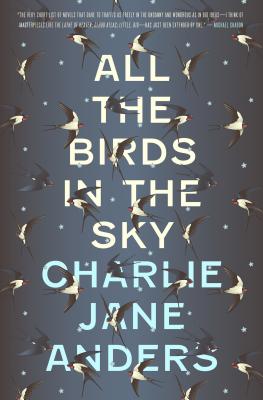
Quite happily, I discovered this success in a thoroughly enjoyable novel by Charlie Jane Anders All The Birds In The Sky .    9780765379948

Briefly, Laurence and Patricia are outcasts. Their parents, who are shown as polar opposites of each other, fail to “get” them, and their attempts to “correct” what they see as bad trends or unhealthy characteristics in their children end badly around. Likewise at school, where they meet and become friends out of desperation (they’ll actually talk to each other), their lives are untenable because their peers also do not understand them.  It becomes, at one point, life-threatening for them to hang out together.

Added to this is the appearance of a trained assassin from a secret society who has identified them as the nexus of eventual social collapse and global catastrophe.  His Order does not permit the killing of minors, though, so he is limited to ruining their lives and attempting to keep them apart.

What is special about them is…

Patricia is an emergent witch.  She discovers early on that she can speak to animals, but it may be an hallucination (it’s not).  Her older sister, who spies on her, makes matters worse by secretly recording Patricia in some of her more extreme attempts at revisiting her chance discovery of “powers” and releasing it on social media.

Laurence is an emergent technical genius who sets about building a self-aware AI in the closet of his room.  His parents, who are in most ways failures, see his obsession with staying indoors, reading obsessively, and attempting to gain admission to a science school as unhealthy and insist on outdoors programs and forced social interaction.  They have no clue that everything is against this.

Patricia and Laurence are eventually driven apart and grow up to make lives in their separate spheres, both successfully.  They re-encounter each other and fall into an alliance to save the Earth, which is in the late stages of environmental collapse.  Each in their own way must address this problem and here is where it gets interesting.

As if all the rest isn’t already interesting enough.  Anders has painted fulsome portraits of the outsiders we all knew (or, in some instances, were) with sympathy and understanding that avoids pity and makes for satisfying character study.  Laurence and Patricia could easily have become archetypes, and certainly in some ways they are, but here they are simply people we may well know, and even wish to know.  And the relationship she builds between them is complex and resonant in surprising ways.  In a novel already repleat with strengths, this is a major achievement.

How she makes the merger of magic and science work is also by way of character.  Laurence and Patricia are both in dialogue with the universe.  They use different languages, elicit different responses, but in the end it turns out to be the same universe.  Anders suggests that we still don’t have a firm grasp of how manifold and multifaceted that universe is, but in the end it is all a conversation. Multilingual, to be sure, and compiled of palimpsests sometimes hard to identify.  What is required is an appreciation of the wider concept.

What makes this a successful blending—merging, really—of usually antipathetic concepts is that dialogue and the acknowledgment in the end that both views make for a greater understanding.  The solutions—if any are to be found—come from the combined strengths of the divergent views.  Laurence and Patricia, depending on each other, coming to know that here there is genuine friendship, love, acceptance, and a willingness to understand the other side, make for better answers than they do apart.

I do not wish to spoil the myriad of dialectical twists and turns salted throughout.  Anders has not given us a set solutions, but as series of antiphonal arguments leading to a place where a wider view may be achieved.  Throughout she plays with the tropes, the themes, the assumptions, connects them to human concerns, and manages something greater than the sum of its traditionally antagonistic parts.

Highly recommended.


Emerson

Okay, this is hard.  Very hard.

Keith Emerson is dead.  Apparently from a self-inflicted gunshot wound. He was 71.

That in itself is difficult to square with the pictures in my mind of the epic artist of the heyday of one of the greatest musical outfits of the 20th Century.

It’s tempting to get into the justifications for Keith Emerson’s place as a composer and performer, what his music meant for rock, for classical, for a generation of people who found in his work an uncompromising dedication to a particular aesthetic and a level of quality found in few pop acts. Indeed, to even use that term—pop act—seems to diminish the breadth of the ambition he displayed throughout his career.

Post Sgt Pepper’s, rock music—what then without much hesitation or embarrassment was termed pop music, in the sense of it being “populist” as opposed to “elitist” and embodying an idea that popularity and depth were not mutually exclusive—went into a decade-long period of experiment and innovative “reaching” unparalleled since Romantic music shouldered aside Baroque, or when Be-bop and Cool displaced Swing in jazz.  The “three-chords-and-bridge” format that had dominated rock’n’roll, built often around fatuously insipid lyric content and attempts to mask the underlying restiveness with whitebread presentations, gave way to genuine musical innovation and serious compositional challenges. Strumming guitars and 4/4 backbeat proved insufficient in this ecology, even while they served as the basis for forays into multiple key changes and experimental time signatures.  Blues transmogrified into psychedelia and hard rock and a multiplicity of forms that took on meanings apart from their origins even while labels failed to define what was being attempted.

Keith Emerson began as an aspiring jazz pianist and emerged as every bit the “classicist” composers like Copland, Barber, or Bernstein were.  First in The Nice, which began life as a backing band, and then in Emerson, Lake & Palmer he put out music that tore at expectations and demanded an attention to content unusual in the rock idiom.  Sitting through any of the first five albums from ELP, you simply did not know where Emerson was taking you, but it was expansive, exciting, challenging, and in many ways other-worldly.  For me, this was the soundtrack of the future I wanted to inhabit, the sound that went with the science fiction I was reading.

More, though, it was also a bridge with a past I imagine a great many of his fans did not know, a musical archive encoded in the templates of a new music.  There was Bartok, Sibelius, Bach, Copland, Bernstein.  There, too, were echoes of Art Tatum, Duke Ellington, Jellyroll Morton, Dave Brubeck.  Emerson took the past, blent it into a melange of sound aimed at the part of the mind that hungered for the future.

The first concert I ever attended was The Nice. 1967.  I’d heard those albums, that keyboard sound, and then found out about the show, and the first and only time I ever snuck out of my house I went and saw this guy in leather pants and knee-high boots playing multiple keyboards (no synthesizers at the time) and while I have since forgotten the details the impression was amazing.  It sank into my brain and remained, so a few years later, when I finally came upon the wealth that has since been called Progressive Rock it was with instant recognition.

I’ve seen ELP six times.

I could go on about what it is in the music that is so important, but I’ll leave that for other, better equipped commentators.  The subsequent backlash against ELP and all of progressive rock that came into vogue with the advent of Punk and then New Wave is only so much mosquito-noise of people with no patience, no sense of history, and who believe the only function of music is biokinetic.  ELP is pompous and overblown?  Well, so was Beethoven, much of Tchaikovsky, and certainly Mozart was arrogant.  Yet the music does not fade, does not desiccate or dissolve with repeated listenings. Rather, if attention is paid, there is always more.  Such music is not pompous but expansive and it requires a willingness to leave a certain provincialism behind, something many people are unwilling to do or uncomfortable in experiencing.

Keith Emerson opened the possibilities for taking the idioms of rock music and applying them to greater effect and leaving behind work that could be considered in the same breath as Brahms or Grieg or, certainly the composer who most reminds me of Emerson, Aaron Copland.  Emerson was the composer at the center of my life’s musical aesthetic.

He damaged his right hand decades ago.  He suffered a degenerative nerve condition as a result.  There had been operations, he had worked hard to overcome it, but in recent years videos of his performances showed an increasing difficulty in playing.  The last I had seen, he was learning how to conduct since playing was becoming perhaps problematic.  Any look at him performing, though, shows us a man in love with the physical act of making music.  That he might not be able to do that must have weighed heavily.  He was always all about the music. Take that away and you lose what he was.

No one can presume to know what he felt in his last days.  But by all means, go back and listen—really listen—to the music he left behind.  Genius is too slippery and rarefied a term, but for me it applies.  He created a space for amazing sounds and he should be celebrated even as he is mourned.

I’m going to go listen to Tarkus now.  That tough armadillo has left us.  But the music…the music is forever.

In Review

2015 is done and I have read what I read.  It was a year fraught with turmoil in science fiction, a year prompting reassessments, a year when required reading competed with reading for pleasure, and the time constraints of working on a new novel (two, in fact) impeded chipping away at my to-be-read pile, which mounds higher.

As in the past, I count only books I have read cover to cover here.  If I added in total pages of unfinished reading, I’m probably up with my usual volume (somewhere around 90 books), but that would be a cheat.  That said, I read 50 books in 2015.

One thing I concluded, both from what I read and the upheaval in the background about what is or is not worthy science fiction, is that the decades long pseudowar between mainstream and genre is over.  Skirmishes will continue to be fought here and there, certain elements will refuse to yield or concede, but by and large the evidence suggests that, on the part of the literary writers at least SF has made its point. A couple of examples:

Station Eleven by Emily St. John Mandel is science fiction.  In fact, after talking it over for nearly a year since I read it, it seems to me to be Heinleinesque.  Better written, the characters less exemplars than real people, but in basic conceit and plot, this is a Heinlein novel. It has all the elements—survivors, a plucky heroine, a global catastrophe forcing those who remain to learn quickly a whole suite of new skills, and an ongoing discussion throughout about what is of value and ought to be preserved.  It is a superbly written work and that alone made the identification difficult.  Heinlein, at his best, could be as good as anyone in any genre, but to see the form raised to this level shows both his virtues and his weaknesses.  The population of the Earth is reduced buy a superflu.  The novel flashes back and forth around the life of a kind of patriarch whose biological and artistic progeny struggle in a post-technological world to both survive and preserve the best of that former world.  The novel prompts questions, challenges preconceptions, and draws us in.  It was not marketed as science fiction and it has continued to sell very well.  It is science fiction and no one has batted an eye.

The Water Knife by Paolo Bacigalupi.  An ecological thriller, an examination of a different kind of breakdown, a different kind of survival, peopled by characters as real as can be.  In a decade this will be historical fiction, probably, but it is SF and also mainstream and also uncategorizable.  Exceptional.

Straddling the boundary is Jeff Vandermeer’s Annihilation, which is a curiosity.  It proceeds like a straightforward “survey mission” novel—specialists set down upon an alien world and struggling to unravel its mysteries before said world kills them.  Only in this case the “alien” world in a patch of reclaimed wilderness somewhere along the eastern seaboard, probably north Florida, that is undergoing some strange transformations due to an experiment gone wrong.  There are touches of zombie fiction, government conspiracy, and even Lovecraftian uber-malignancy evoked, but the story, as told by The Biologist, feels more meta than any of those suggest.  the landscape works to inform the soul-wrenching recognitions and evolutions within the Biologist as she works to understand what is going on in the aptly named Area X.  Vandermeer has created a work bordering on genius here by virtue of externalizing and foregrounding mystical revelation as ecological transmutation, but as you read you can’t tease the meta passages from the plot in any clear way, so the experience, when you give yourself over to it, is wholly immersive.

So what I’m seeing—in many more titles still on my TBR pile—is the embrace of science fiction by what was formerly an ambivalent cadre of artists who are using it to ends traditionally ignored by main-body SF.

In the other direction, the infusion of literary concerns, which necessarily drag real-world issues in with them, into genre writing has prompted a squeal of protest from those who wish to keep their starships pure, their aliens obvious, and their weapons decisive.  “Good writing” is still a poorly understood quality by too many in the genres (by no means a problem exclusive to SF, but because of the nature of SF a problem which yields far more obvious failures) and the clinging to an aesthetic attributed to the so-called Golden Age and exemplified by writers probably more often revered than actually read (and therefore misperceived in intent) has exacerbated the old antagonisms and a final flaring up of fires dying to ash.  The clunky sentence is a hallmark of much of this, more likely as consequence rather than intent, and the cliched scenario becomes more obviously so as the whole point of what we mean by “literary” in its most useful mode is overlooked or, perhaps, willfully ignored in a fit of defensive refusal to pay attention to what matters, namely the truth of human experience and the profitable examination of, for want of a better word, the Soul.

Where the cross-fertilization of mainstream and genre has been successfully accomplished, we’ve been seeing novels and stories of marvelous effect.  We have been seeing them all along and in the past such examples were readily offered as proof that SF wass “just as good” as anything published as mainstream.  I’ve always felt that being “just ad good” was selling our potential short, but the work has to rise to the challenge, and there always have been such works.

Among such that I read this past year were a few from that rich past, mainly for the reading group I host at work.  The Two of Them by Joanna Russ; Extra(Ordinary) People, also by Russ; The Doomsday Book by Connie Willis; Mythago Wood by Robert Holdstock; The Sparrow by Mary Doria Russell; and Engine Summer by John Crowley.  In retrospect, there have always been writers writing in the full embrace of science fiction but without any of the stylistic constraints of its pulp origins, and such works remain trenchant and readable and offer surprising commentary still on current questions.

The Sparrow was a highlight. I have known since its publicatin that it was sort of a riff on James Blish’s classic, A Case Of Conscience, but it so much more. Russell’s elegant reversal of the moral question elevates this novel to the top tiers of useful literary works. I have not yet read its sequel, but I am looking forward to it after this treat.

I also reread Harlan Ellison’s Shatterday for the reading group. It’s been a good long while since I did so and I was not disappopinted, although I read many of the stories through a more cynical eye. The opening tale, Jeffty Is Five, remains, for me, one of the most gutwrenching short stories of all time.

Another highpoint this past year was James Morrow’s new novel, Galapagos Regained, a neatly unclassifiable work of speculative history.  I gave it a lengthy review here and recommend a look. This is a superbly done work that deserves more attention than it has received.

I also read Morrow’s amusing novella, The Madonna and the Starship, which runs a delightful gamne via Fifties television and alien visitors who come to bestow an award and offer assistance in exterminating the irrational on Earth.  Morrow is acerbic even as he is funny.

Among the most interesting new works of science fiction I red this year is The Three-Body Problem by Cixin Liu, translation by Ken Liu.  This is the first part of a trilogy about alien invasion and resistance as written from a Chinese perspective.  It is an exceptional translation.  It won the Hugo Award, the first, I believe, translation to do so, and certainly the first Asian novel to win.  There is high-end physics, nasty politics, murder, and the conundrums of committed action. The cultural quirks made it even more interesting.

Like almost everyone, it seems, I read The Martian by Andrew Weir. This was great fun and well executed.  My quibble, along with many others, was with the opening gambit to explain the marooning of the astronaut, but I’m content to see it as a mere dramatic choice.  It didn’t preent me from enjoying the rest of the book, which, in the words of the screen adaptation, “scienced the shit out all this” and did so in an accessible and entertaining manner which I applaud.  I couldn’t help seeing it as a newer version of an older film, Robinson Crusoe On Mars, and naturally this one works a bit better.  Hell, we know more, there’s no excuse for bad science, and Mr. Weir that.  He wrote a realistic piece of speculation and followed through admirably.

Another novel that gave a far more “realistic” view of an old, favorite SF trope, is Kim Stanley Robinson’s Aurora.  There is much to love about this book, but it is not lovable.  It’s a clear-eyed look at what an interstellar generation ship would actually be like.  And it is bleak, in terms of the traditions of SF.  Suffice it to say without giving away too much that Robinson fully incorporates entropy into his formula with predictably gloomy results, but for all that it is a thoroughly engaging work.

At the other end of the “hard” SF spectrum is Charles Gannon’s Fire With Fire.  Future interstellar expansion brings humanity into contact with our neighbors.  The resulting tensions drive the novel.  I reviewed it here.

Science fiction is a broad, broad field and has room for a magnificently wide range even on the same subjects.  It even has room, as I noted above, for exceptional style.  One of the most enjoyable reads for me, on that note, was Ian McDonald’s new novel, Luna.  There will be comparisons made to Heinlein’s The Moon Is A Harsh Mistress.  Look for an upcoming review where I will argue that the comparison, while in some ways valid, is superficial.  Anyone who has not read McDonald, treat yourself.  This would be a good one with which to begin.

In a completely different area of the playground, there is Daryl Gregory’s AfterParty, which I found excellent.  It’s about drug abuse and the workings of delusion and murder.  Anything I might say here would spoil it.  Go.  Find it.  Imbibe.

The bulk of my reading, after that and a few other titles, has been scattered.  I found a brand new history of the Group f64, which was the first dedicated group of photographers to push the pure art of the straight photograph.  Ansel Adams, Edward Weston, Imogen Cunningham, several others, in the 20s and 30s established the ground upon which all photography came to be viewed for the rest of the 20th century and even, arguably, into today. Mary Street Alinder, who has previously written a biography of Ansel Adams, did a superb job chronicling this group of prickly independent artist.

I read a history of a superhero, Wonder Woman, and discovered that the story of her creation was even stranger than the character herself.

A new work by journalist Johann Hari, Chasing The Scream, opened my eyes to the thorny issue of the Drug War.

In the wake of seeing the film Interstellar and beginning work on my own novel about (partly) interstellar travel, I dove into Kip Thorne’s Black Holes & Time Warps and had my mind bent in some ways I didn’t think it could be bent.  This has prompted a reengagement with science on this level which is proving difficult, tedious, and yet rewarding.  My mind no longer has the plasticity it once enjoyed.  On the other hand, experience has proven a benefit in that I seem to be absorbing and comprehending at a much deeper level.  We shall see.

Quite a bit of history, much of it unfinished.  In a separate reading group, I’m going through Victor Hugo’s Les Miserables, and reading in the history of the French Revolution, the Republic, its fall, all partly to complete the third novel of my trilogy, but also because the literature available is so rich and surprising that it has become its own pleasure.  It would seem now I’m about to embark on early American history again, anchored by Ron Chernow’s biography of Alexander Hamilton.

There was a new Mary Russell novel this past year, Dreaming Spies, by Laurie R. King.  I discovered a Dan Simmons novel about Holmes which I’d overlooked when it came out, The Fifth Heart, in which he is paired with Henry James, one more in a long line of novels and stories concerning Holmes’ unlikely interaction with historical figures.  Simmons is a terrific writer, but even he tended toward the tedious in this one.  He needs to learn to leave his research in his files.  But it was a unique take on Holmes and he even managed to elicit my sympathy toward James, a writer I find problematic at best, insufferable at worst, and annoying the rest of the time.

So much for the highlights.  Let me end by noting that the Best American series has finally realized that science fiction and fantasy are a real thing and launched one of their annual collections to cover it.  This after both Best Of infographics and comics.  Better late than never, I suppose.  The series editor is John Joseph Adams—difficult to imagine better hands—and this first volume was edited by Joe Hill, which I found interesting to say the least.  Mr. Hill is a horror writer.  Certainly many of the stories have a strong horror element, but over all this is a collection full of marvels, from the writing to the ideas.  I’ll try to keep track of this one in future.

So while not numerically great, 2015 was filled with many very excellent books.  I’m looking forward to 2016.  My stack awaits.

Happy New Year.


…Behind Door Number…

After viewing Ex Machina I sat in a bit of a daze wondering what it was I’d just seen.  Stylish, well-acted, the now-expected seamless special effects, and a story with pretensions to significance.

The next day, I spoke to a good friend about it, who has also written about its flaws, and came to the conclusion that the film is not at all what it seems to want to be. In fact, it may be the perfect demonstration of style over substance.

It would be easy to see the film as a misogynistic attempt to intellectualize adolescent cluelessness, and certainly there is that in it, but perhaps that doesn’t go far enough.  Misanthropic may be more accurate.  It has nothing good to say about anyone or anything.  The chopper pilot may be innocent, he’s just doing his job, but once Caleb lands and approaches the isolated superhouse of his employer, Nathan, sympathy for anything human vanishes and we’re treated to a narrow, pseudo-socratic disquisition on how stupid people can be, even with high I.Q.s and a lot of money.

But it is smooth, it is elegantly filmed, and the acting is convincing, and the soul-searching seems genuine, and the robot is so enticing. It feels superior. It says smart things, makes fascinating assertions, but all in the least engaging manner possible.  Instead of actually dealing with the presumptive subject—strong A.I.—we are treated to a reboot of Frankenstein as The Dating Game.  Bachelor Number One, how do you answer these simple questions from Bachelorette Number nth, and do you get to date her when the show is over?

Nathan is the typically clichéd billionaire genius who, instead of trying to learn how to connect with actual people, builds himself a fortress of solitude and sets about building himself a companion. Of course, since he doesn’t understand people as individuals, he keeps making sexbots that fail to meet his expectations. Partly, he excuses this (to himself) by claiming that he’s only pushing the envelope on A.I. instead of searching for a perfect fuck.

No, he never actually says that, but consider the machines.  All women, all one stereotype or another of gorgeous, and he has fitted them out with sensate genitalia. Since until he ropes Caleb into the equation it’s only him interacting with them, why do this if your claim is an interest in their cognitive and self-awareness abilities?  And the almost throwaway line where he reveals Ava’s sexual capabilities is about as arrogant and dismissive as can be.  He wants to create self-aware machine intelligence than can mimic human but talks about them like a new car model with the latest features.

Okay, so Nathan is an asshole.  Dramatically, he’s supposed to be, he’s Victor Frankenstein, whose arrogance foreshadows his doom. In this instance, the one bit of psychological nuance which could have elevated this story above the level of Weird Science (which, in the end, was a more sophisticated film than this one, despite the comedic aspects) his arrogance leads him to assume a specific “type” for women in general and he manages to create one that lives up to his expectations—she stabs him in the back and runs off.

This, in case anyone missed it, is called sexism: the complete failure to understand how one’s expectations shape circumstances to guarantee a thorough and complete misunderstanding of women as people, and then using that to dictate the terms of all interactions with females.  (Note, one does not have to be a male in order to do this, but that’s a discussion for another time.)

But what about Caleb? He’s a presumptive innocent. Why is he left to starve to death, locked in the prison Nathan has built below ground?

Perhaps not so “innocent.”  He is inserted into the storyline to act, ultimately, as Ava’s rescuer, but he is incapable of rescuing himself from the same set of expectations that Nathan exhibits.  He doesn’t want to set her free, which is kind of undefined given the context, but to have her for himself.  Nathan allows that her “design” was more or less aimed at him, so he could not help but respond in the most predictable fashion, which makes Caleb at best an adolescent who can’t tell the difference between what is and is not human, even when the difference is revealed to him at the outset.  But he’s more than just a toy.  He’s a rival.  He’s a thief.  He’s a liar.

Learning from these two examples, it might not be a surprise that Ava has turned out the way she has.

But “she” would have had to have been programmed to manipulate someone other than Nathan, who, we assume, she cannot manipulate because he knows exactly what she is.  Which then suggests that such programming is inevitable in the simulation of Woman.  That she can’t help but be this way from the first instance of her base code, which means that Woman is an essential something that emerges regardless of circumstance.  But if that’s so, then why is the essential woman inevitably a sexually manipulative sociopath?  Because that’s what Ava is.  The only possible way she could have become that is by way of her initial programming, which is Nathan’s—the technobabble about using his search engine’s datamining as the source of her programming is facile; he would have to select and edit or she would simply be a collection of data with little or no organizing principle—which then would be what he has predetermined defines Woman.

Ava does not even attempt to help her predecessors.

The single facet of all this that puts the lie to Nathan’s superficial explanation as to why he made Ava female is that he could have made Ava Alvin.  Or made Ava ten.  Or—and this would have pushed this rat’s maze of a film out of the simplistic—made Ava homosexual or even transgendered.  Push Ava out of the sex toy model she was clearly designed to be so that interaction with Nathan would produce the personally unexpected.

Even that would be a bit conservative.  There are people who are asexual.  Humans do not all fall into binaries.  Nathan is being disingenuous.  At best, he wanted Caleb to trigger in Ava a desire to choose—between him and Nathan or between either of them and an unknown.  Maybe the chopper pilot.  Or one of the other sexbots.

Or the gray box Nathan insists would have no reason for interaction. The final cop-out.  People interact all the time without knowing each other’s gender.  The initial basis of human interaction itself is not sex but Other.

Instead, we are given a treatise on the challenged expectations of a narcissist with the means to externalize his narcissism and what happens when a competitor narcissist enters the bubble to supplant him.  Had the film been more honest about this, it might have been worth the time spent watching two adult adolescents compete over the rights to a masturbatory fantasy.  Ava could, at a minimum, have schooled them on being adults.

There are moments that stop right at the edge of really interesting, but they are subverted constantly by all the testosterone soaking the scenery.

But it looks so good.  It is done in the serious manner we might wish all science fiction were done in, and there is where the final failure is most apparent.  Because obviously the makers wanted it to be taken seriously.  It’s just that they managed to feed right into the pitfalls of both a Turing test exegesis and the presumed realities of gender relations based on search engine dynamics.  They missed the trees for the forest and painted a sexual fantasy that reinforces stereotypes and says almost nothing about intelligence worth discussing—artificial or human.


Light Goes On

George R. R. Martin has become nearly ubiquitous since the advent of his massive, multi-volumed and cable-networked Song of Ice and Fire, more commonly known as The Game of Thrones (even though that is only the title of the first book in the series).  Before that, he successfully helmed a network television series, Beauty and the Beast, and before that he worked on the excellent reboot of The Twilight Zone in the mid-1980s.

Even before that, however, he was establishing a reputation as a fine writer of speculative fiction and fantasy with a handful of novels and short story collections.  His first novel, Dying Of The Light, published in 1977, demonstrated his strengths and served notice that what would follow would be worth anyone’s time and attention.

Returning to early work like this can sometimes be a dubious exercise.  Writers grow into themselves, rarely doing anything approaching their best work in the beginning.  But sometimes the talent and skill are evident from page one and early work is as polished and significant as anything that comes after.  That appears to be the case with Martin.  Dying Of The Light is work one might expect from mid-career, a deft exploration of complex themes of identity and myth set against a background of rich cross-cultural shifts, all vividly portrayed.

Dirk t’Larien, living in the husk of a life in a city laced with canals, receives an esper jewel from the woman he lost years before.  t’Larien has been wallowing in self-pity and ennui ever since Gwen Delvano left him.  Before parting, they had these jewels made, psychic encodings of their emotional selves, and exchanged them with the promise that when one sent their jewel to the other, the receiver would come at once.  Dirk sent his, years before, and Gwen did not come.  He has mourned her since, mourned himself, and has been slowly crumbling in on himself since.  Now he has received hers, a summons he swore he would honor.

Should he, though?  She did not answer his call, why should he answers hers?

He does.  He has nothing else.  This is the last obligation, the last devotion he has.  Without Gwen, he has nothing.  As he sits in his room, debating what is undebatable, he watches a gondolier drift by in the waning light of day, and in that image we understand the story about to unfold.

This a journey to the underworld, a quest to rescue Eurydice from hell.  That gondolier is Charon and Dirk t’Larien is a phlegmatic Orpheus.  Worlorn, the rogue planet briefly brought back to a kind of life by its passage close to a group of stars on its way out of the galaxy, is a kind of Hades.

Too-close comparisons have the drawback of forcing a reading that limits truth-seeking.  The framework of the Orphic Myths is here, but it is only a framework, because our erstwhile Orpheus is neither a musician nor a particularly attentive lover.  He dwells too much on a past that turns out to be partly mischaracterized, as Gwen, when they are reunited on Worlorn after Dirk responds to her summons, bluntly schools him.

“I did call you. You didn’t come.”

A grim smile.  “Ah, Dirk.  The whisperjewel came in a small box, and taped to it was a note. ‘Please,’ the note said, ‘come back to me now.  I need you, Jenny.’  That was what it said.  I cried and cried.  If you’d only written ‘Gwen,’ if you’d only loved Gwen, me.  But no, it was always Jenny, even afterwards, even then.”

Dirk, during their time together, had created a persona for her which he—playfully, he thought, affectionately—used as a private sign of their love.  But “Jenny,” his alternate Gwen, was not Gwen.  And what Gwen teaches Dirk now, on Worlorn, is the power of names.  When you name a thing, she tells him, it becomes that thing.  Whether he intended it or not, Gwen had been becoming someone for him she was not for herself. She had to leave and when he called the wrong woman back, she had to refuse or surrender.

The novel is replete with this game of names.  The men, the “family” to which Gwen has tied herself, are Kavalars.  Kavalan is a harsh world, one that had been cut off from all the other human colonies by a long, savage war, part of which was conducted on Kavalan and formed them into the tradition-bound, violent society of codes and honor and ritual commitment into which Gwen—because she met Jaan Vikary while he was visiting one of the older, more cultured worlds and fell in love with him—has given herself.  Names mean everything, and yet they mask inaccuracies parading as history, myth as religious practice, race memory as an excuse to remain unchanged.

Vikary wants to change it all.  He is a scholar, something of an oddity among his people, and he has learned the real history of what happened on his world, and understands how that history had been transmuted into myth.  Now that the war is long past and recontact with the older colonies has been made, Kavalan looks like a barbaric, hide-bound world of obsolete ritual.  Vikary sees the necessity of change if his world is to enter as an equal into the fold of human civilization.

But it will be difficult, almost impossible.  Tradition is all the Kavalar have as a source of identity.

Dirk arrives on Worlorn well after the major event that clearly will one day become part of new myths.  The Festival.  When the world was detected and it was understood that its proximity to certain stars would thaw it, allowing a brief window during which it would support life, 14 of the human worlds came and built exemplary cities and held a great festival.  Doomed, to be sure, but a momentary, beautiful gesture, a testament of life against the inevitability of eternal night.  For as Worlorn continues on, it will once more freeze and die.  All the forests transplanted to its surface will perish, the oceans will turn to ice, as will the atmosphere, and these lovely cities will become fossils for the archaeologists of another galaxy to find and puzzle over.  A pointless gesture, in some ways, but a fist in the air and a rude gesture to the gods of entropy.

Gwen is here with her co-spouses because she is, as further resonance with the myth of Eurydice, an ecologist, a woman of the woods, so to speak.  She’s here to study the interactions of all these varieties of never-before combined plant and animal life, even as the world itself is dying.

Yet Dirk is convinced she wants to leave her Kavalar husbands, return with him, try again.  And for a short while it almost seems true.

What plays out subsequently is a contest between tradition, bigotry, and a desire to cast off chains.  Dirk is a catalyst in all this, the necessary ingredient to create the transformations.  In so being, he undergoes his own rebirth, which, after all, is the whole point of journeys through the underworld.

The dying in all this is not so nihilistic and tragic as the lines from Dylan Thomas might suggest.  The light is fading from several people and institutions in this novel, but that is not Martin’s major revelation.  He deftly weaves an understanding of how myth works and how traditions are created and at the same time shows how they become bonds that hold back even while they provide sustenance.  But it is not death at the center of this novel but enlightenment, and the things dying are ancient and near-parasitical distortions.  Misinterpretation, mischaracterization, and misapplications all dies in the full light of truth.  Jaan Vikary is casting light on his own past; Gwen shines new light on Dirk’s incomprehensions; the essence of human is newly revealed by fearless looking.  And even if it is not a wholly successful venture, a new accord is struck by the end, that new ways will at least be sought.

Paradoxically, Dirk, who is largely a cipher throughout the novel, finds the possibility of rebirth in an embrace of a very old and oft misunderstood trait learned from the Kavalars he has come to respect—honor.  In keeping with the game of names Martin plays throughout, Dirk’s name is telling. t’Larien. Larien is a variant of Lawrence, which comes from the Latin  Larentum—place of the laurel leaves.  Laurels usually indicate honors, but it can also be seen as a criticism, as is “resting on one’s laurels.”  This is the case for Dirk in the beginning—and also the case for some of the other Kavalars present on Worlorn.  At the end, Dirk decides it is time to stop living in the past.  It may mean a new name.  Certainly it means a new beginning.  Even as he goes to face a potential death, he has found a new way to live.

A Bit of Comfort and Caution

This is my new blog.  I’ve attached a link to my old one, the Distal Muse, so you can get over here.

Why a second blog?  Simple.  I’d like to put my reviews and literary opinions here, apart from the Muse, which has become more of a hodge podge of commentary over the years.  A site dedicated just to my readings and my thoughts on literature might find a welcome audience among those who could care less what my politics are or my opinions on music or film or people in general or things as they are.

For now, this is a placemarker.   I have work to do in my office and it might be a week or two before I start posting.  In the meantime, you can still check out the Distal Muse.  I will be back.  Try to do this up proper, a real honest-to-goodness lit’rary stopover.

So…welcome.