Simulation and Literary

The question nags, even when it would seem settled (by some, at least): what qualifies a work as “literary”?

In a recent discussion about Justin Cronin’s The Ferryman, the question came up again. It seems to arise mainly in relation to genre fiction, which by those who traffic in such comparisons is decidedly not literary. At least until it is.

But what does that actually mean in terms of the book in your hands?

Always and ever, just as in the assessment of wine, if you’re enjoying it, it’s fine. It can be argued that the best gauge for whether something is “good” or “great” or “literary” is whether it can be read with pleasure multiple times. 

What about a given text would support that?

Let’s assume for the time being that there really is a definable difference between Literary fiction and Genre fiction. Fine. A good starting point to make that distinction would be to ask what the book is about. Following closely on that, what emphasis is placed on how the book addresses its subject.

Before we get too far into the academic, let’s make a distinction right now. In brief, what makes a work Literary rather than Genre? Well, a literary work is about its theme[s] while a genre work is about its tropes. A bit broad perhaps, but a fair starting point.

Which brings us to a primary example of blurred distinctions which both highlights them and dismisses them. Justin Cronin began as a literary writer, then moved into horror, and now science fiction. Of course, the only label one sees on the spines of his books is Fiction and he is marketed with all the presumption that he is a Literary Writer. And yet, Spaceships? Cryogenic suspension? Computer simulation?

The Ferryman is one with such works as Station Eleven, Oryx and Crake, Invisible Things. Novels that are on one level clearly science fiction and yet are received as…not.

The Ferryman is a magisterial novel about a ship on its way from a decimated Earth to a new planet in another solar system, bearing colonists who are asleep in suspension in order to make the century-long voyage. In order to manage the many problems with suspension, they are all tied in to a computer which runs a simulation in which they live otherwise ordinary lives. This is necessary to fend off cognitive decay due to a kind of dream exhaustion. Upon arrival, they will be revived to begin the work of establishing a new colony.

This is classic science fiction. The earliest story in modern SF to suggest the idea is Murrary Leinster’s 1935 Proxima Centauri. Robert A. Heinlein’s  Universe (1941) established the idea as a major theme in SF and many examples have proliferated for decades. A large vessel carrying thousands of people, sometimes with an ecosystem designed to sustain multiple generations, on a voyage of hundreds or thousands of years due to the limits on speed. Among the better examples are Gene Wolfe’s Book of the Long Sun and, more recently, Kim Stanley Robinson’s Aurora

What Cronin adds is the idea of the simulated existence, set in a “real” world, with the wrinkle of regeneration. People age to a point where they must leave their life to be reborn and come back as a new version of themselves sans memories. The ferryman of the title is one who escorts these people to the docks to get on the boat to take them to an island where the regeneration happens.

But not everyone. The support staff, so to speak, the workers who do all the labor, live on another island and do not receive rebirth. It is a class society, in many ways resonant of certain cities of recent memory. The elite run things, enjoy a rich aesthetic life…and rebirth. The workers…well, revolt is brewing. 

Through a good part of the novel all this feels as if it is only the near future and this is a closed community of he moneyed class, shut off from the rest of the world. We’re allowed to imagine all kinds of scenarios that have nothing to do with interstellar travel. This is on Earth. And the dramas of the principle characters are plausibly personal, with enough politics to hint at conspiracy. Cronin does a good job at misdirection here. We keep reading to find out what happened, how this hermetically-sealed society was established, what they’ll do when the peasants, so to speak, finally rise up to dethrone them. This is a tense socio-political situation and the title character, Proctor, a ferryman, is at the heart of it.

Proctor is having problems at home as well. His father has reached the end of this life and Proctor is the one to take him to the ferry, where an unanticipated series of events start an unraveling for Proctor that leads eventually to…

The actual situation, as it is revealed, is satisfyingly surreal and takes us right out of the mimesis of literary immersion and into the science fiction scenario that has been there, all but unnoticed, from the start. With minor quibbles, it is also good science fiction.

But in point of fact, it does not read like genre, not even at the end? Why?

One could say that the writing elevates it, which is a simplistic (and frankly insulting) explanation. The writing is good, but so is the writing by Gene Wolfe or Ursula Le Guin or Octavia Butler, yet they are all firmly defined as science fiction. 

Back to my premise: Literary is about its themes while Genre is about its tropes. While Cronin does a very good job describing his settings and, even at the end, explaining how things work, his focus is very much not on those things. His focus is on the internal workings of his characters. In the end, his characters determine the shape of the world, not the other way around. In the end, they are all solving personal problems, even the overall problem of surviving a dying Earth. In more or less typical SF, the world determines the shape of the character’s internal landscape. It is the human response to those dramatic differences that drives the SF narrative and is equal to or even above the interpersonal elements of the narrative. Cronin even remarks on the tenacity of human unwillingness to change in an exchange toward the end in which it is pointed out that the simulation design shows a sad adherence to a past that ought to be dead. With all the options at their disposal, the architects of the “world” choose to recapitulate a static scenario that should have been dismissed long before.

Moving past the binary here, it is of course too simplistic to categorically claim that Literary fiction is about its themes. There is a juggling act that goes on with any work of fiction that privileges one aspect over another, and depending on the emphasis placed on one or the other, such privilege can push it into a genre model wherein the tropes can emerge as character, the detective’s city as much a character in need of analysis as the detective himself, or, in the case of science fiction, the altered landscape that dictates new responses from the people inhabiting, and in fact, if done well, becoming a character itself. The borders are soft, permeable. A century ago, before marketing categories set much of this in concrete, the standard was how well truth was addressed, how deeply the reader could be immersed, how consistent and resonant were the characters. So it never occurred to publishers to create and follow a distinction that would have removed something life Brave New World from the literary mainstream just because it was set in a place, at a time, with customs alien to current embrace. 

I’m heartened that those who inhabit the old precincts of Literary are now stepping outside those walls and writing works that challenge our definitions. And of course that goes both ways. We may come to a point when those old borders have been beaten into oblivion by all the crossing back and forth.

Clear-Eyed And Informed

One of the quickest ways to end conversations in casual social gatherings is to contradict someone expounding on myth, hearsay, and bad history. You’ve been there; we all have. Someone at some point starts holding forth on some chestnut of popular apprehension and repeats a story that has suffered the manifold revisions of a game of telephone that render the story factless, in service to a line of self-aggrandizing chest-beating at the expense of the truth. Stories many of us take for granted in the first place and, because we’ve never heard or bothered to find out the real story, assume to be accurate. We grow accustomed to thinking about these stories this way and then, when it might matter in ways we never anticipated, we don’t know that they have prepared the ground for us to swallow bigger misconstruals and even outright lies.

Into this, occasionally, steps someone who knows better and points out the flaws in the presentation. A curious thing usually happens. Either the conversation turns away from that topic or everyone gets angry. Not at the one disseminating the broken narrative but at the lone voice that contradicts the nonsense. Such reactions lead eventually one of two interpretations—either that people in general don’t care what the facts are or, adjacent, they like the error-laden chestnut more than the reality.

The reception of the corrective information can have a chilling effect on the one offering the facts. No one likes to be ostracized,

It can be puzzling. What is it about these skewed narratives that people preferred? Well, almost always there is something about them that makes people feel good about themselves—about their patriotism, they beliefs, their affiliations, but mostly about their ignorance. Once we leave school, most of us feel we are done with homework, which no one really liked anyway, and the idea that we may be less knowledgeable than perhaps we need to be just suggests that we need to do more homework. I suspect there’s an unexamined aspect of psychology that says that to be an Adult is to already have all the skills and knowledge we need. More study seems justifiable only if it leads to higher income. Even then, excuses can be made to avoid it.

But the reality is we need always to know more, especially about stories we think we know. The how, why, and wherefore of our history feeds into present issues in ways that, if we are ignorant, can lead to political and social traps.

When reading a first-class historian like Jill Lepore, one becomes aware of how tangled those webs into which we might fall can be. For those of us who may delight in being that one person at the party who will speak fact to ignorance, her books are a delight.

Her latest, The Deadline, is a collection of essays designed to counter the shallow, poorly-understood history that underlies so many of the canards foisted upon us daily as truth. As well, they are a delight to read.

In several books, Lepore has displayed an approach to her subjects that bypasses the various filters with which we view our history, opening side entrances into the underlying realities of which modern myths are formed. She examines the cultural touchstones by which we navigate the pathways of our presumably common identity.

Here, we find a range of essays that cover most of American history, topical subjects, thorny personal issues, memoir, and observations about the nature of knowing—or not knowing—what’s going on. Quite a few pieces are about the business of news itself, covering processes and personalities, and giving us a glimpse of how what we think we know comes to us too often “prepared” so a particular message is put forth, even while it is possible to find out what the other facts are. To that problem, we learn that there is nothing new about “fake news” other than the delivery vectors (and perhaps the speed with which it comes at us) but that even when such distortions seem impossible to counter, somehow we seem not to be fooled for long. That may be changing, though, and Lepore gives us her perspective on that as well.

Essentially, Lepore gives us a clear-eyed view of ourselves and our proclivities, often with the unpleasant but unsurprising conclusion that if we are fooled, it’s because we wish to be. But really there is no excuse for blindly reacting to hormone-spiking jabs at our panic buttons. We just need to know a little better.

As I say, Jill Lepore has become one of my favorite historians. She has a quirky set of interests (she did a marvelous book about the creator of Wonder Woman as well as penning one of the most interesting histories of the United States I’ve read in a long time) and this allows her to approach even the most convoluted subjects in ways that consistently illuminate. Along the way, she lets us know that one of the best ways to not be fooled is to refuse to accept the soundbite, the meme, or the two-minute report as the end of the story. While each may well contain a grain of truth, we have to understand that it’s only a grain and all that went into it is so much more interesting, richer, and liberating.

23

It’s interesting that one of the axioms of retirement is that once entered one will have time to do all the things the day-job obstructed. Like read as much as you like. And like so many such things, it turns out not to be true. The habits of decades are still in force, and while maybe you get more chores done, you find reordering all those deeply-rutted paths more difficult than you thought.

I’m sure in some ways I am reading more, but not the way I’d hoped. I average around 70 books a year, cover-to-cover, with a great deal of spot reading, fragmentary, excerpts, short pieces, dipping into and out of research or sidetrips. I suppose if I did a page count I might find myself in the 150 plus range (total book equivalent), because this past year I did a lot of that, as I’m back at work on a new historical novel and much of my reading is taken up with research, most of which is not whole books.

But other things have also gotten in the way. Well, that’s an ungenerous way to put it. Since my dad’s death, my time spent on mom has gone up considerably—and quite happily—and of course I’m still trying to settle into a new routine.

That said, I read—cover-to-cover—66 books in 2023.

Setting aside the research material, some of which I do include in this tally, quite a lot of it was spent on old novels either read back in my adolescence or for various reasons never read at the time. Catching up, so to speak, on the work that was part of my youthful encounter with, especially, science fiction.

There were a few writers I remember bouncing off of back then. I never quite connected with, for instance, Avram Davidson. I read Rork!, which is a colonial adventure with some curiously subversive takes on the whole idea of imperial encounters; The Island Under The Earth, which I’m still not sure I quite understood, but a sort of mythologically-oriented fantasy; The Phoenix and the Mirror, the first in his loose series about Vergil, again a fantasy (of sorts) and truly magnificently done, a pleasure to read; and A Clash of Star Kings, which could have stood a little more fleshing out, but given the publishing requirements of the time, he delivered a rather fascinating take on the idea that the ancient MesoAmerican “gods” were warring aliens. The pleasant surprise, even with the material I did not quite get, was the beauty of the prose.

I also reread a couple of D.G. Compton novels. Compton died recently, one of those artists one loses touch with and assumes has long since passed away. He published four novels via Terry Carr’s old Ace Special series, the most, I believe, by any single writer, and I know I read them back then (as I read all the Specials because, after all, they were special) but I barely remembered them. They were perhaps too sophisticated for me at the time. But I read Synthajoy and The Silent Multitudes and found both remarkably made narratives about the disjunction between expectation and new technologies or events. His handling of character was quite uncharacteristic of the majority of science fiction of that time (the Sixties) and psychologically fascinating. I will be reading another one for the reading group I host.

Other older titles I read included the complete Cities In Flight by James Blish, which in the end left me a bit disappointed. I thought it began very strongly with the mines of Saturn and the advent of longevity in They Shall Have Stars, but by the last book (chronologically), Triumph of Time, I thought it strained against the limitations of form available at the time. The characters and social milieu did not, in my opinion, match the more cosmological aspects Blish was attempting, but he was never an epic writer in the sense we think of it today. Somewhat more successful was his quasi-fantasy set Black Easter and The Day After Judgment, which dealt with an actual apocalypse and its aftermath. Thematically related to his classic A Case Of Conscience, Blish seemed to have been in his element dealing with the collisions of theology and materialism.

A writer who worked with such themes in quite different ways was Michael Bishop, who also passed away recently. Bishop should, in my opinion, enjoy a much larger and wider reputation than he seems to. At his best, he was compelling and richly engaging. I decided to read those of his early titles I never got around to and with that in mind I read A Little Knowledge and Under Heaven’s Bridge, which he cowrote with Ian Watson. Both examine the impact of aliens on human philosophical concerns, both in different ways. Neither was a great work, but you can see the greatness to come. I also reread his excellent novella Apartheid, Superstrings, and Mordecai Thubana which, among other things, took a hard look at South African apartheid. Published before the collapse of that system, it is an uncomfortable read that deals with police-state mentality and brutality and tragedy of enlightenment within a system designed to snuff it out. It carried unfortunate resonances into today in unexpected ways, which the best fiction will always do.

We read Daphne Du Maurier’s Rebecca aloud. The elegance of her prose allows entree into a psychologically engaging family drama that involves murder and shattered illusions and the demands of expectations based on half-truths and lies. What begins as a rather pedestrian romance becomes inexorably a portrait of dysfunction and questions the sacrifices we make in order to find a place in the world with people we wish to love.

Another read-aloud we did was the superb satire The Master and Margarita by Mikhail Bulgakov. Russian to its core, it was Bulgakov’s last novel, unpublished during his lifetime, and it is a romp. The devil arrives in Moscow, takes over a theater, begins granting wishes, and thoroughly upends daily life for certain people and leaves the state with a puzzle it is incapable of solving. Delightful.

We also read a couple of Willa Cather novels, O, Pioneers! and My Antonia. Cather is among those authors I’d always intended to read but for one reason or another never got to. But I confess, when I was tearing through the so-called “classics” in high school, neither of these would have stayed in my memory very clearly. I’ve had to grow into a state of mind to appreciate them, so it’s just as well I waited. These are the kind of novels kids like me dismissed because “nothing happens.” Which is to say, the careful setting of character in landscape and examining the evolution of them in concert requires a certain interest. Not that I didn’t encounter such work back then and enjoy it, but it would have been the exception. I’ve now reached the point where I look at some of the works I praised as terrific then and have to admit that, really, nothing happens in them, other than a lot of frenetic running around.

However, I also finally opened up a novel whose virtues are so widely extolled that one feels like a literary troglodyte when its charms fail to excite. One Hundred Years Of Solitude by Gabriel Garcia-Marquez. A few years ago I read Love In The Time Of Cholera and quite liked it. This, unfortunately, left me a bit perplexed. It’s not so much that nothing happens, but rather for all that does happen fails to change anything. Except, perhaps, the women. They change. They alone in this vast epic exhibit a capacity for change, for growth, for evolution, but then all of it is constrained to the task of adapting to men, who do not change and whose inability to do so distorts the lives of these women whose marvels and talents we will never see because they are in bondage to a stagnant domesticity. If this were written to suggest a criticism of such male intractability, then it might be something, but I found the narrative guileless in its acceptance that this is how the world is and one cannot alter it.

The older I get, the more I find my sentiments engaged by the women—writers and characters—who struggle to be themselves and stop conforming to long-desiccated expectations. Which is why I look forward these days to the next novel by Becky Chambers (whose The Galaxy and the Ground Within I read this year and found amazing) or Ann Leckie (Translation State, marvelous), or Malka Older (The Mimicking of Known Successes, a novella of remarkable invention)or S.B Divya (Machinehood).

One of the most remarkable novels I have read in a long time was Ray Nayler’s The Mountain In The Sea. Extraordinary visualizations, great characters, and a rich intellectual conceit. I reviewed it here not long ago.

Once again playing catch-up, I read Greg Bear’s last trilogy, War Dogs, killing Titan, and Take Back The Sky. On the surface, military SF, but that’s just the veneer. Beneath is a twisty interstellar puzzle, a clash of civilizations, and questions around the nature of knowledge and how to discern truth is an ever-changing environment. Bear died last year. I have only a handful of his yet to read. However one might have thought of his perspective, he was a boundary-pusher.

Of the nonfiction I read this year, the stand-outs are A Spectre Haunting by China Mieville, a well-considered reassessment of Karl Marx’s Communist Manifesto. While Mieville is sympathetic, he is no sycophant, and this book would be a good bridge into a reasoned examination of Marx and socialism itself. The Rise and Fall of the Dinosaurs by Steve Brusatte, a very good narrative examination of the history of those long ago creatures who somehow have never let go our popular imagination. Empire of Liberty by Gordon S. Wood, a long history of the early republic, one of the Oxford History of the United States entries.

But perhaps the best history read this year was Blood and Ruins by Richard Overy, a history of World War II. Overy casts a wide net, spanning the period between 1931, when he claims the events we now call WWII began, and 1945. He examines the military history, of course, but then he gets into the backgrounds, deeply, and the economics, and then the law, the underpinnings of all the tensions and terrors. He goes well beyond the actual fighting to look at the state of humanity at each stage and provides that ever-so-rare thing, context. It is a brutal read, and very long (I’m guessing a good 300K words) and in the end the book I would presently recommend to anyone who wants one book on the war. He has done an admirable job of maintaining objectivity. Whether he succeeded at that is debatable, but he is not partisan.

The research I’ve been doing has mainly to do with the colonial period of the St. Louis region. Kaskaskia, Cahokia, the Osage. I’m spending a lot of time on minutiae in the constructions of the next Ulysses Granger novel, which I am halfway through a first draft. Some of the books I did not cover here, I have done reviews already on the Proximal Eye.

The pile awaiting my attention is as usual stacked too high, and once in a while I find myself wishing I could recover some of my speed-reading skills from 50 years ago. But I enjoy what I read now and back when I was breezing through texts at 2500 words a minute, I did not. Nor did I retain as much as I’d like. So this suits me. I’m enjoying the meals now.

Have a great 2024, filled with wonderful books. I wish you all good reading.

Languages Of Family

Ann Leckie’s Raadch Universe is one of the most useful conceits in recent science fiction. Not that there aren’t plenty of background templates to choose from—Iain M. Banks’ Culture, C.J. Cherryh’s Alliance//Union, Martha Wells’ Murderbot universe—but Leckie’s stands out in the way the separate polities interpenetrate and shift and establish themselves based on the intrinsic diversities each entity exhibits. There are nonhumans—the Geck, the Rrrrrr, the Presger—and human and parahuman, and they all, even among themselves, have distinct modes of expression and subsequently unique interests.

Translation State is her fifth entry in what has been thus far a consistently fascinating foray into interstellar…well, it’s all there: war, politics, philosophy, sociology. But for me the stand-out interest has been from the beginning personal identity. In this new novel, it is everything. Leckie is exploring what it means to express autonomy and possess agency.

Enae is facing life outside the home she has always known. Maman has died, the family is gathering to sort out who gets what, and Enae learns that there is nothing to inherit. Maman had spent it all. Another family has purchased the home and, for all intents and purposes, the family name to use as a resource in their rise to prominence. Enae has been cut loose.

She has been in thrall to maman, the one kept home to perpetually care for the elder of the house. Constantly criticized and yet provided for, she has lived in a kind of purgatorial condition, without much of a life of her own. Now, seemingly overnight, she must leave the only house she has ever known and find her way to a new life.

She is not tossed out. The new “owners” see to her material resources, but eventually Enae must leave. A new cousin talks with her about options and suggests he can procure her a position in a diplomatic capacity. She accepts. The first task she is given is to try to find a missing person—missing for decades, almost two centuries. No one realistically expects her to find this person or even find out what happened, and Enae is told as much and that as long as she shows an effort, she will retain this new position and be able to do pretty much as she likes.

That is not who she is, though, and she takes the task seriously. Much to everyone’s surprise, Enae makes headway. But the clues she follows embroil her in a political situation involving the Imperial Raadch, the Rrrrrr and Geck, a refugee group, a local polity with a stake in controlling the refugees, and the very mysterious and dangerous Presger.

The Presger have been a presence throughout the Ancillary stories. The only direct contact between them and any other group has always ended in brutal destruction. The Presger eviscerate—ships, beings, systems—for no comprehensible reason. Over time, a hard-established treaty has come about setting precarious boundaries. On the Presser’s part, an entire cadre of Translators was created just for the purpose of communicating with non-Presger entities, and it is the Translators that are the only direct contact anyone has ever had (and survived) with the Presger. The Translators themselves are not Presger.

It was one of them that went missing. During those missing years, it reproduced. And it is the result of that reproduction—Reet—who now is at the center of the diplomatic chaos Enae has precipitated by being thorough in actually trying to solve the mystery.

The Translators insist on recovering Reet, claiming him to be a Translator juvenile who must be brought back into their fold lest others suffer. Reet, however, has been raised as a human by his foster family and that is what he feels he is.

A petition is filed with the Treaty Administration, things become locked for the time being while matters are sorted out, and in that setting Leckie gives us a look into the manifold interpretations of human, nonhuman, AI, and the balancing act between communal necessity and individual choice. Along the way, the lineaments of her rich universe are revealed in ever more intriguing detail.

Leckie deftly raises the stakes as simple situations unfold into more complexity until we are embroiled in an interstellar thriller with terrorists, political brinksmanship, interspecies conflict, and potential war. And yet it remains throughout focused on family.

The central motivation of each character in this is about family. The boundary between that and the body politic is blurred almost to the point of erasure. Which is, of course, the point.

Within this is the question: can you be what you want to be, no matter what? In Reet’s case, genetics (biology) dictates he is not what he has always felt himself to be. The ambiguities of that are well-explored in the course of the novel, whether what he has always felt/believed is defensible in the face of apparently unalterable factors. Secondarily, given the validity of those Other Factors, does he have the right to reject the claims of others on his choices?

This is set against the vagaries and challenges of a treaty intended to keep wildly disparate civilizations out of each other’s way, and however the decision comes down will impact everything going forward.

No pressure.

But the vital interests here are focused down hard on what constitutes family, either biologically or circumstantially, and everyone involved must deal with the ramifications. In their separate ways, each group portrayed is trying to establish the grounds and the methods for familial inclusion and care.

The fey element thrown in is the one group that adamantly disbelieves another one involved actually exists, believing it is a fiction for political leverage.

Science fiction has been shoving alien species up against each other practically since its inception, but of late the emphases on how and the bases of interaction have shifted to examine the place we all live. Leckie has produced a work that explores those possibilities in ways no other genre can.

______________________________________________________________________________

Check out the upcoming event sponsored by Left Bank Books:

https://www.left-bank.com/event/ann-leckie-translation-state-launch-event

Yes and the Negativity of missing the point

As I sit here writing I am listening to Close To The Edge by YES. Those who know me know that this is my band. The way the Beatles made a profound and indelible impression on some people way back when they were still around, YES did so for me. And as time has gone on I have found them to be a source of ever-wonderous musical pleasure. They produced music that at the time fit no category and did things no other musical group was doing.

The same could be said of any number of other groups of the Sixties and Seventies, but they likewise all stood apart in their own ways. Nevertheless, most of them, even the seriously unique examples, could be said to share with other groups certain aspects. With the release of Fragile and then Close To The Edge and then a couple of years later Tales From Topographic Oceans, I can think of no other band that made such distinctive musical artifacts. Compositionally, performatively, lyrically, YES pretty much stands in its own category.

I love what they did.

Fast forward to the present, in the age of everyone sharing and knowing everything about all the things, a period in which personal opinion is intended to rise to the level of profundity and aesthetic wisdom, and the long span of years, albums, and personnel changes which attend such groups with very few exceptions, and we find ourselves in a morass of vituperative spleen-venting by people who want to stamp their taste on the body of work gathered together under the moniker YES. I stumbled on some of this recently and found such short-tempered tantrums one might expect from a group of kindergartners who didn’t get their nap.

“Without Jon Anderson it’s not YES!” “Rabin rescued the band from obscurity!” “It’s not YES without Wakeman/Squire/White/etc!” “They lost their way after _____!” “This album is crap, that album is brilliant!”

Strong opinions necessarily attach to powerful art, but one of the threads that baffled me is the assertion that somehow the current manifestation is an imposter. I can only scratch my head.

As a rhetorical statement of personal assessment, in private conversation, one can accept such pronouncements as at best a starting point for a conversation. There can be nothing definitive about it except from a legal standpoint. (How do I mean? There have been instances of other bands who experienced “clones” established by former members who sought to cash in on the name. The resolution came about in court, establishing who owned the name. Certain dodges have been successful wherein association is achieved without actionable violation of trademark, but this is a matter of music industry contract law and is an odious morass with which we are not interested here.) “That’s not YES,” has been a game played by the disappointed since Drama was released. In that instance, both Jon Anderson and Rick Wakeman had left the band. They were replaced and the result was a new manifestation. Strong opinions at the time indicated the allegiance of fans, but frankly said nothing much about the actual music.

When a few years later YES re-emerged, once more with Jon Anderson at the fore, but without Steve Howe or Rick Wakeman, assessments had to be remade again. Many people accepted this line-up as YES, largely because Jon Anderson was singing with them, and also because an alumni, Tony Kaye, had rejoined, muddying the waters of which line-up might be “purer”, but again this did not say much about the music, which was…different.

The two albums released by this incarnation sounded very little—compositionally—like the band from the Seventies. And Drama, shoved in between, was distinctive as well and fit neither era.

Or did it?

Here is where such pronouncements fall on hard ground, because while the approach was, compositionally, and to a degree performatively, distinct, it was also true that they were all unmistakably YES.

By the time we come to the exceptional one-off of Anderson Bruford Wakeman & Howe, it should have been obvious to anyone that YES had become a collective, a workshop if you will, a unique aesthetic bubble wherein a certain approach to music, with concomitant expectations of musicianship and thematic direction, maintained in such a way that continuity remained regardless of who was actually in the band.

Now, certainly this could have been violated any number of ways. Say, instead of Benoit David or Jon Davison stepping in as lead vocalist, someone like Steve Perry or Steve Tyler had been hired. It hardly bears considering. Certain modes of musicianship have been maintained throughout the now 54 years of the band’s existence.

The fact that through all that time each incarnation is unmistakably YES establishes that what we now have is something that has been a thing in jazz for much longer. These are musicians coming and going in service to a specific aesthetic exploration.

I think it’s a fascinating thing to behold.

If you wish to be a purist about line-ups, then you have to come to terms with the fact that there is no longer a single original member of the band still in it. (Steve Howe joined at their third album, in case anyone needs reminding.) So how does one make any such final pronouncement that “this is not YES” based on personnel? (You may perfectly legitimately claim to have a preferred incarnation; mine will always be the so-called “classic” line-up, but that does not diminish other examples, and the fact is that every incarnation has upheld the musical reason for listening to them and done so magnificently.)

There are albums I listen to more than others, but none of them are “not YES” in any meaningful way.

Perhaps it is my immersion in jazz that has inured me to these sorts of quibbles. The idea of a group being a workshop, with a revolving roster of participants, is nothing unusual to me. We don’t see it so much in rock music. Usually, when a band ends, it’s over. This is as much a business reality as anything else. And we have seen bands that have lost personnel and refused to replace them (Genesis, Moody Blues) and others who have soldiered on even after presumably fatal losses (the Who, Chicago). This, however, is something special, and I believe it has produced some truly interesting results.

It is, after all, That Sound which has drawn me all these years. Indeed, some experiments have been more successful than others, and a couple of the last few albums have been…interesting. But how many bands get an opportunity to completely re-do an album and then have both versions still available? The differences are fascinating.

There are a handful of artists whose work I have purchased over the years no matter what. YES is the first among equals in that. There has always been something worthwhile in each release and rarely retreads. That is what YES has become for me and I think it’s amazing.

There is no cause for the kind of backbiting that comes from what I call the Line-up Wars. That’s childish. (Arguments over who is better at certain things, hey, that’s fine. But that’s not what some people are doing. They’re making it a question of identity and not simply their own.) The music changes, evolves, and it evolves with new blood.

And really, it’s been 54 years. Even without the passing of amazing musicians, time works it’s demands. If they were still trying to do Close To The Edge “again” they would long since have become a moribund gathering of musical fossils. That they keep exploring new territory…that’s why they’re worth listening to.

But perhaps not for the same reason we listened to them 20, 30, 40 years ago.

I remember the tagline from their first tour of which I was aware. “Yes…the most positive word in the English language.” Positive. Somehow, for over five decades, they have continued to create positive momentum.

Reformed Colonizing

In some form or another, the idea of terraforming has run through science fiction for decades. The term was coined by Jack Williamson back in his 1942 story Collision Orbit, which involved the hammerblow of an asteroid impact. Gradually the idea seeped into the general body of science fiction as the problem of actually stumbling on a habitable world to settle became apparent and more intrusive measures were proposed. By the late 1980s it had blossomed into an accepted practice. 

Most of the early examples dealt with Mars. The fascination with colonizing the Red Planet had always been there. After the hoped-for suitability of Mars was thoroughly dashed by actual probes, other solutions informed new stories.

The difficulties are nicely laid out in Kim Stanley Robinson’s Mars Trilogy. The sheer expense of the endeavor rose to daunting prominence. More solutions came to the fore. Nanobots, microfauna, slamming a planet with iceballs (comets). Proposals from the other end of the problem were offered, literally changing the settlers themselves to fit the new environment. (Frederik Pohl’s Man Plus among others.)

Venus offered a different set of problems and possibly the best attempt to dramatize them is Pamela Sargent’s Venus trilogy, which is a generational saga about the terraforming and colonization of Venus. Other worlds in the solar system, as our knowledge of them grew, offered yet more technical problems to overcome and gave settings for many good tales.

Of course, the central ethical problem at the heart of all of them remained largely unaddressed, namely the whole concept of colonization. Science fiction of the exploratory variety took it as given that humanity would expand into a universe assumed to be there for the taking. The possibility of other species already being there provided the fodder for the usual exercise in imperial conflict. (Asimov famously avoided the whole issue by depicting a universe devoid of all other intelligent life but human.)

Whether we should or shouldn’t go forth and colonize is probably a pointless question. We will if we can, because “should have” has never been a factor in dismissing the idea. (Whether we should or shouldn’t go to the expense is a different question, whether as a matter of building the capacity or engaging a conflict for territory.) We will. 

So, the question then becomes how to go about it without being, well, evil. It can be argued that a good deal of the “space opera” after the 1970s has as at least a subtheme this concern, most prominently fueled by the discussions prompted by Star Trek’s Prime Directive. 

Accepting migration and settlement as a given, the ethical themes emerging from questions of how, why, and to what end offer a rich pool of conceptual interest for science fiction. The impulse behind much Golden Age SF and almost all space opera was based on the westward wave of conquest and settlement of the so-called Old West. Similarity of motifs abound. Contrary voices emerged slowly as the ongoing conversation within SF continued till the present time wherein a healthy critique of post-colonialism has come to prominence. The costs are now under examination.

Annalee Newitz has established a reputation as a sharp observer, both in fiction and nonfiction. She applies all her accumulated savvy to her new novel, The Terraformers, which combines several strands of the ideas into one excellent work that begins by setting aside the question “Should we do this?” She takes it as read that we will.

But then she sets up a scenario in which all the consequences and related issues come into play to challenge preconceptions and address responsibilities in clever and amusing ways. 

sask-E is a planet under development by a corporation that eventually intends selling lots to prospective inhabitants. A luxury development, in fact, potentially very profitable. To prepare it, various stages of work must be done to turn it into something suitable, which is a time-consuming job requiring specially adapted populations of workers for each stage.

These populations are intended to die off once their stage of the work is completed, but longterm plans are never so neatly executed.

In the months leading up to the big premier of the new world for prospective buyers, ERT Ranger Destry Thomas follows a trail of clues to an enclave of survivors from the prior era of world-building and discovers that extinction is not inevitable. A thriving city of Homo diversus escaped their intended obsolescence and built a city beneath a volcano. Destry and her colleagues now have a set of decisions to make that set all of their various obligations at odds.

The Rangers are supposed to be nominally independent, observers and enforcers of a set of environmental rules the corporation, Verdance, is required to follow in the remaking of such worlds. The ecology is intended to be pristine and the footprint of colonization kept at a manageable minimum. It’s a delicate balance.

But this, a whole population of sapients who aren’t even supposed to still exist, throws a wrench into the works.

What follows is a generation-spanning struggle between the various factions over who (and in what way) has a right to live on Sask-E. 

Newitz has built a far future universe in which uplift is a feature—we have sentient moose, among other animals—and the ethics of coexistence are threaded throughout. What might in lesser hands have become a confusing mish-mash of characters and situations is here deftly managed to excellent effect. The definition of innate value is the point here and to that end we are given as broad a cast of characters with significantly different needs, wants, and proclivities as one could wish for in a novel that attempts to tackle what one might see as post-post-colonialism. 

Once people are involved…

The exigencies of the corporation and the machinations of its designated agents, even with the initial “good faith” attempt to remake a planet over which no native life has claim, spiral into the abyss of expediency, made worse by the pathologies too-often in play among certain personality types. When “making a profit” and “delivering a product” run directly into questions of innate rights and moral necessity, the resulting wrestling match is instructive.

The Terrfaormers is at base a critique of colonialism, but done in a way more subtle than most by setting up the conditions from the beginning to focus on the regard—or lack thereof—people have for each other, especially when walls between them are erected to allow a set of goals to take precedence over any and all incommensurate circumstances that may—that will—arise.

As in her first novel, Autonomous, Newitz displays a thorough grasp of the interplay between competing issues when Market Forces are confronted by moral imperatives. Throughout, there is attention to compromise too-often absent when the full stage of narrative possibility is reduced to the confines of a soapbox. Instead of a diatribe on do’s and don’ts, we get instead a well-reasoned examination of processes in play. Granted, Newitz has a preferred outcome, but she doesn’t let that get in the way of showing the whole stage.

Besides all this, it is hard not to appreciate a well-imagined and realized flying moose.

The Long and the Short and All Between

Of all the things that make up the borders and textures of our lives, how many do we ever consider doing without and what that might mean? Because anything we do in the least technological, there was a time when we didn’t. Often such times were so long ago we have no cultural (much less personal) memory. We live as if we have always lived a certan way, even when we know better.

Take measurement, for instance. There was surely a first time, when someone, somewhere, thought to mark down something to keep track of how many, how much, how long or short, and thus invented measurement. Since then, measuring has become part of the cultural air. We notice it when we use it, but rarely realize consciously just how ubiquitous it is. Basically, almost everything we do is measured.

“If we could not measure, then we could not observe the world around us; could not experiment and learn…it is a tool for social cohesion and control…[m]easurement has not only made the world we live in, it has made us too.”

Thus James Vincent establishes in the introduction to his history, Beyond Measure, the vital importance of what he then goes on to explore in his excellent overview.

There is a scene in one of the original Star Trek episodes where Nurse Chapel confronts her former paramour, who was presumed lost on an unexplored world and has somehow survived. But he has survived by becoming an android, a machine. He is challenged that he is no longer human and seeks to prove that he is and then runs down a list of possible tests, every single one of which involves measurement of some kind. Somehow being unable to offer a proof that does not involve mathematics of some kind suggests he has lost his essential humanness.

After coming to grips with the proofs offered in Mr. Vincent’s new book, one would be forced to ask “Well how else would he prove it other than by engaging in one of the most fundamentally human creations at hand?”

There is a resistance to accepting definitions of ourselves that involve technologies, as if artifice somehow detracts from our essence. But it is by virtue of those very things that we can recognize such distinctions and make judgments about what may or may not be human—or (especially) whether we should make such judgments.

Vincent explores the history of measurement as a social phenomenon, taking us into some unexpected byways, but with an emphasis on the struggle for standards. The bases on which reliable measures are determined are essential for trade, for the exchange of dependable information, for the very ability to communicate across borders, for, in short, harmony. He presents facts that suggest—strongly—that incommensurate measurements exacerbated if not caused revolutions, wars, the collapse of economies. Getting things “right” is a millennia-old struggle.

But that goal itself can often seem arbitrary. How does one “know” that an inch is an inch, a kilogram a kilogram, a mile a mile, or a light year what it is? Till the last couple of centuries, such questions were central, even if often ignored, but advances in finding presumably irreducible yardsticks, so to speak, have dominated official attempts to establish standards and have entered the quantum age. For the moment, at least, we have ultimate measures against which all other scales might be balanced—the speed of light at one end and Plank’s constant at the other.

We take measurement for granted, most of us, most of the time, but we could not function without it and its application at almost every level, in every niche, of social intercourse.

Beyond Measure is a fascinating read, and takes us into some places we might never know exist. It also prompts questions of limits that are sometimes uncomfortable. How much precision is enough? In the digital age, more so than ever before, this is becoming very personal. We have never really been able to escape from our fellow beings other than by comparison, but these days the metrics that delimit identity are becoming ever more detailed, and much of it would seem irrelevant. But we measure, compulsively, and out of the compulsion emerge possibilities for the kinds of conformity that can feel intrusive, undesirable. Turning our back on it is no solution. Acquainting ourselves better with the how and what and why of our cultural obsession is the reasonable approach. Knowing what to participate in, how, and perhaps recognizing our essential humanness in the numbers, that would seem the more effective—even desirable—approach. This book might be a good place to start.

In Times Long Past…

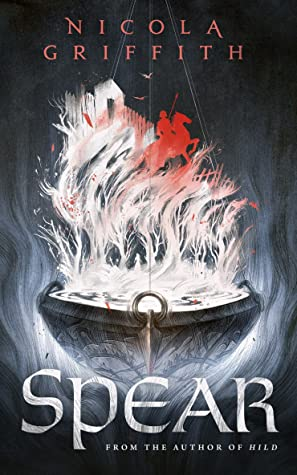
In the afterword to Nicola Griffith’s new novella, Spear, she runs down the lists of source material and permutations around the Legend of King Arthur and the Knights of the Round Table. Or, more precisely, those around Percival, who in many tellings is the more important figure. The king is all very fine, of course, but it was Percival who found the Grail. In some versions, it is Percival who returns Excalibur to the Lake. In still others…

The point being that such stories, myths and legends, are all repurposed tales that meet multiple needs and adapt to the times in which they are (re)told. Tracing them to a single point of origin is not only virtually impossible, but is irrelevant. The purpose of myth is reification.

Among others. But on that point, reification is always tied to the present. Which lends myth its ever-ancient timelessness and relevance.

Which is always one of the fascinating things about it, that timeless-timely utility.

It’s also what makes a good retelling immediately exciting and accessible.

Most (if not all) myths begin in some version of “A hero will be born.” The story then is “from where” “to whom” and “then what?” Perseus is emblematic, and possibly the most visible in significance. The Greeks may not have begun the genre, but they certainly perfected it, and for a long time pretty much owned it. All the Great Heroes of the Aegean and Adriatic region have remarkable beginnings. Often a cave is involved. Some education in the wilderness. Then the confrontation that defines their purpose. They are, essentially, Of Nature, since everything about them is from Outside, “inside” being more or less whatever passed for civilization. (For our purposes, the primal exemplar of this outsider could be Enkidu from the Gilgamesh story.)

The utility of myth cycles is in their adaptability. Repurposing a story to reveal, reify, revise, or otherwise reestablish the scope of meaning is what gives them power across time. The nature of the actors can change, roles might be swapped around, identities modified or even completely recast.

And in some instances, the central hero is changed. Focus moves from one to another, giving us a shift in perspective, a realignment. Something new, something not considered before. And yet, the story remains essentially the same, at least in regards to the events and the goals.

The Arthurian cycle is endlessly adaptable this way. Who is the hero? Arthur? Merlin? Lancelot? Guinevere?

Percival?

All of them, depending on which example you look at, fit the role of Outsider. But the one that is most ideally crafted for that part is Percival.

In Spear, Nicola Griffith gives us a Percival who is perfectly outside. In this iteration, she is Peretur, of “mixed” parentage, raised in the essential cave, schooled by a wise adept, nurtured to become the hero the world needs.

She comes of age, chooses a path, and sets forth from the hidden place of her childhood to journey to Arturus’s court at Caer Leon to join the circle of Companions to the king. She decides, chooses, does battle, grows confident…

This is a hero to cheer for. Her first victory is in learning her true name. Her next is establishing for herself what she is. And then making a place for herself in the world. A place of her choosing.

Quest is also a major element of most myths. Going, struggling to find, fulfilling vows, remaking the world along the way. In this new retelling of this story, there is a quest, though it is not what most of the participants believe it to be. In this way, Griffith shows how the defining character of the goal is not a specific thing but a fulfillment of purpose, and grail at the end is self-knowledge.

Spear is a marvelous reworking of the Arthurian tale. The components are given different origins, different explanations, the settings are deftly placed in what we know of the “real” world, and the nature of what may have been the place and people from which the cycle emerged are treated with the kind of demythologizing care of the historian. There is a texture to this, a fabric of authenticity that gives entree to the world. In the end, such reassessments only add to the power and charm of the story. In so doing, Griffith offers us a variation that reifies overlooked or hidden aspects of what makes the legend important. For us.

Along the way, she gives us a damn good adventure.

In the afterword, there is a tantalizing discussion of sources, variations, and a brief history of the cycles over time. It establishes the long practice of repurposing of which Spear is only the newest example. Which is all well and good, but the best thing about this one is that is opens the possibilities of the story to offer meaning to a wider audience. It is not a tale aimed at Just These People, but for many more not usually considered. Griffith discusses that as well.

Spear is a successful recasting. Even the nature of the Quest at the heart of centuries of Grail stories is given a new raison detre, bringing is from the cosmic to the personal in a touching reveal utterly consistent with Griffith’s purposes and the traditions of the story cycle.

All this aside, it is first and foremost a thoroughly delightful and satisfying work.

Visceral Coding

Few things generate sustained anxiety as much as genetic engineering. Both positive and negative, for the possibilities and the dread. Since Watson and Crick revealed the double helix of DNA, the science has proceeded apace, and we now live in an era wherein “programming” can refer to both computers and our genes.

Jennifer Doudna is a name to conjour with in this transformational time. In 2020 she won the Nobel Prize with Emmanuelle Charpentier for their work on CRISPR cas9. CRISPR has become the label in media stories for a process of “editing” genes with the use of a form of RNA. (Almost no one outside the biochemistry and medical community seems to no what it stands for: Clustered Regularly Interspersed Short Palindromic Repeaters.) Basically minute segments of code in a strand of RNA that repeat and can be used to, effectively, insert modified segments of code into a gene sequence.

What began as “pure” research into the methods by which bacteria defend against viruses became a revolutionary method of dealing with all manner of genetic circumstances, including potential treatments and vaccines for the most recent scourge, COVID-19.

Walter Isaacson’s new biography of Doudna (pronounced DOWD-na), Code Breaker, is also a history of the sometimes chaotic, sometimes life-affirming, often unexpected world of scientific research and its interface with the rest of the world.

Isaacson has given us not only a biography of a remarkable individual, but a look at the often surprising world of research and development. The image of the scientist, austere and removed, still to some extent dominates our imagination. It comes as a surprise (and occasionally something of a betrayal) when we are forced to recognize that scientists are human, just like the rest of us, with all the flaws and foibles to which “ordinary” people are prone. One aspect of the public conception of The Scientist I think requires adjustment is the fact that scientists continue to grow, to mature, to evolve. Too often, it seems that once the Ph.D. is earned, the scientist becomes a static icon, unchanging, and is expected to Know All or at least is frozen into an unchanging assemblage of stereotypes. On some level, this seems to offer comfort—one of the things people tend to be bothered by is an admission of not knowing. Worse still, is a change of mind, which is inevitable in the light of new evidence. But ordinary people can do both. A scientist is not supposed to.

This has led to unrealistic expectations, loss of trust, and the unfortunate “gaming” of science (never mind truth) in public policy. Primarily, this is from a profound lack of understanding on the part of the public. For another, it emerges from the misuse of science as a political talking-point.

Isaacson does an excellent job of taking the reader through the various aspects of a discovery, its initial reception, its development, its transition from pure research to useful tool, and the social and political impact along the way. And along with this, he explains just what that science is.

Jennifer Doudna is central to the unraveling of genetic codes and the inner workings of the templates of life. Basically, she became a nexus for many strands of research, each adding to the overall picture. Her work with French scientist Emmanuelle Charpentier ultimately earned them a shared Nobel Prize.

What they have developed is a tool by which the template for biological forms can be modified. Edited. This offers the possibility eventually of correcting genetic “errors’ that produce diseases like cystic fibrosis, sickle cell anemia, Tay-Sachs, and many others. The drive to “decode” the human genome contained the hope and ambition to one day be able to deal with these things, which are different from pathogenic illnesses. But even in the case of viral and bacterial infections, the ability to address illnesses from at a genetic level offers exciting possibilities—and in fact has been vital to the handling of the COVID-19 outbreaks. The speed and facility with which the scientific and health community have been able to respond is in important ways attributable to Jennifer Doudna’s work.

There is drama, intrigue, fascinating people, and the makings of a good thriller in certain aspects of this story. But the most important thing is the profound humanization of a complex community and the people in and from it. Scientists are not fundamentally different from anyone else. Their interests may seem esoteric and the degree of concentration they bring to their passions may seem other-worldly at times, but in truth what they have is a deeply useless set of tools and the willingness to abide by the rules those tools require for sound use. What must be understood, and often is obscured by the dizzying aspects of the science itself, is their humanity and how they represent, often, the best possibilities of all of us. (Of course there are those who are not as good at what they do as they should be, those who are more concerned with fame or wealth than the work itself, those who are flawed in unfortunate ways—just like any other group of people in any other area of activity—but we should look to the best for our examples and not allow the worst to color our perceptions of the people doing amazing work.)

Finally, understanding something is the best way to stop being afraid of it. At the end of the day, that is the real gift scientists give us—they work to understand things previously hidden and unknown and thereby help the rest of us to stop being afraid.

Bridges, Circles, the Pleasure of Continuing On

As I’ve gotten older, my reading has taken turns I would never have expected. My preferred genre is science fiction, and yet I find the number of SF books I read per year shrinking. Perhaps I’m getting more selective—and it is getting more difficult to choose, what with the wealth of new possibilities—but the total number of books I read per year has not shrunk much. 

I’ve been reading more nonfiction. (I’m a writer, I have to do a certain amount of investigation of the world, of history, of science, so…) But also my consumption of mysteries has increased.

In particular, mystery series.

Decades ago, I would have been working through science fiction series. I cut my teeth on Edgar Rice Burroughs’ Barsoom, Doc Smith’s Lensmen, Asimov’s Foundation novels, the Dorsai, Pern, even L. Sprague DeCamp’s Krishna books. But then I limited it to trilogies and finally, over the past couple of decades, my preference has been for stand-alones in science fiction. I love the field no less than ever, but I don’t have the patience for series anymore.

Mysteries are another matter. In the last couple of decades I have found myself waiting for the next novel in any number of mystery series. Nero Wolfe started it. As a teenager, I was not so interested in sticking with them, but I had read a few. Recently…

Among my favorites are Laurie R. King’s Mary Russell novels; Jacqueline Winspear’s Maisy Dobbs; Kerry Greenwood’s Miss Fisher; Martin Walker’s Chief Bruno; a handful of others.

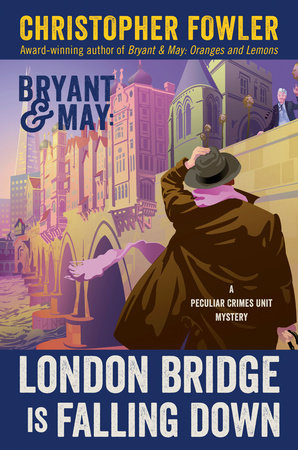
Especially Christopher Fowler’s marvelous Bryant & May series.

As eclectic goes, these are difficult to beat, and as each novel arrives, it seems more and more that Fowler has an end game in mind.

Arthur Bryant and John May are the oldest still-working detectives in the London police system. They should long since have retired, but you realize quickly that they simply have nothing else to do. May, the more grounded of the pair, has pretty much run through what passes for a normal life, and has not been particularly successful at it. Bryant is anything but ordinary and has a dedication to his city that amazes and mystifies those with whom he works. He is a historian, an out-of-box thinker, tenacious, eccentric, and genuinely cares nothing for what other people think of him.

They are the chief detectives in the Peculiar Crimes Unit, an oddball division set up during World War II with a strange remit that lands them in cases that sometimes border on the occult, sometimes conspiracy, sometimes have roots going back centuries.

And the regular police department—the Met—and forces in the Home Office want very much to see them gone. They are unclassifiable. They are occasionally an embarrassment. What keeps them open is a combination of Bryant’s (unnamed) connections in government and their well-above-average success rate.

Bryant and May are circling around 80 and you know this can’t go on much longer, but with each novel their reprieve—for their careers, for the odd assemblage of people who make up the rest of the Unit, for the sheer pleasure of seeing the Suits at Whitehall thwarted—gives another chance to take us through a London by way of criminal investigation not to be found in any other series of which I am aware.

Rabbits are regularly pulled out of aging hats by the end of the novels to lead to one more bizarre outing. The byplay between the partners is delightful, Bryant’s network of informants are among the strangest and most diverse to be found, there is humor, weirdness, and the villains are always unexpected. 

The new one, London Bridge Is Falling Down, opens up a new level in the history of the Unit itself and offers a set of resolutions I did not expect. The remit so often mentioned throughout the series gets a new look and the revelations are more than satisfying. Fowler shows us an aspect of the aftershocks of the War that we have come to expect but in ways that make it fresh and with consequences for the characters that are surprising and terrible. The long story of the Unit is on display, the roots and branches are the target of the crimes, and the resolutions…

There is in this current volume a level of pathos long hinted at and now realized, a sense of inevitability that, while consistent with the  arc of the series, points up the power of fiction to draw us into relationships that genuinely matter.

Among the many pleasures of Bryant and May’s adventures is the pointed critique of bureaucracy, useless officials, and politics-at-the-expense-of-results which all plague our modern era. This should not be mistaken for a blanket condemnation of such systems, for a parallel consideration is how such systems remain necessary even to the rebels and outliers if they wish to be effective. Bryant’s constant complaining about the modern world is not about the basic idea of it but about the ham-fisted way in which so much of it manifests. He does not object to technology as such, only in its apparent ability to separate people from each other. He refuses to Google, preferring to find someone who knows something and talk to them. As lonely as he seems to be—as opposed to the more socially-adept May—he is the one insisting on the human connection, while his partner, who connects often, just as often fails at such connections.

Bryant solves cases obliquely, with apparent side-trips into historical cul-d-sacs and by ways regular police find pointless and, frankly, embarrassing. Among Bryant’s confidantes is a white witch, who manages to regularly point Arthur in a useful direction. 

May, on the other hand, who is fastidious, fashionable, and facile with the very modernizations that seem to frustrate his partner, is the one who grounds the Unit in the world of forms and protocols. He is a traditional cop. 

It is amazing the two of them get along at all.

But as with other long-running series, the heart of it is the friendship. They are partners. Time has joined them in ways neither understands or would wish to change.

London Bridge Is Falling Down takes them back to their early years in unexpected and tragic ways. Things done back then now come out in the open in ways neither could have foreseen. Following the trail of a hapless functionary who thinks he has found a way to extricate himself from the mess that his life has become leads from body to body and the only way to make sense of it all is to go back to the beginnings.

Fowler has brought us around a long circle through the series. One hopes it is not yet closed. Bryant and May ought really to live forever.