Klara and the Sun

Klara and the Sun is a simple story built upon a deep substrate of subtlety. It realizes its best effects by the very plainness of its presentation. But given a moment’s reflection it becomes clear how profoundly well-imagined is the world he has constructed.

Klara, the viewpoint character throughout, is an AF—and Artificial Friend. A robot built to act as a personal companion for a child or young adult. It’s a very old idea, almost Victorian, from a time when the wealthy, the aristocrat, would pay someone to be companion to a son or daughter. A constant presence that could be relied on to always be supportive and, more or less, guide the subject on a solid path to adulthood. As the novel opens, Klara is resident in the store where AFs are sold, with a view of the busy urban street beyond.

We learn in short order that AFs are solar powered, that they are intent upon finding a place with a customer, that there are different models with different capabilities (Klara is a B2), and that to a significant extent they are emotionally aware. This last detail has always given me pause because emotion is intrinsically hormonal. Living creatures experience emotions because our bodies give us chemicals in response to event, so we know fear and happiness, embarrassment and depression. Without these systems, machines by definition cannot have emotions. (This is a trope in SF that has always troubled me, but it seems wired into things now.) Ishiguro gets us by this small problem by inference that the emotions are programs that seem incapable of serious modification. Even at the end of the novel, in less than ideal circumstances, Klara’s emotional engagement remains consistent. So we can see this as a matter of program response that is self-referential and operates within a relatively broad but constrained range. (There is within this a nod to Turing.)

Details matter, especially in the construction of plausible science fiction narratives, so I point the above out to suggest that Ishiguro has done his homework and built his world well.

Klara is purchased finally by the mother of Josie, who is around 12 or 13, and is not well. She suffers bouts of debilitation. Eventually we learn that this is a consequence of her having been Lifted, a kind of genetic modification intended to enhance a child’s potential, both physically and intellectually. It does not always work out, though. The Mother, Chrissie, has already lost a daughter to this process and now it seems another may die. So the choice of an AF for Josie is shot through with multiple motivations as well a guilt and hope. Klara determines that she is there to see Josie through this.

The setting is the near future. Things are different yet much the same. The social dynamics have found new bases on which to operate, but the results are much as they have always been. Lifting has become the new standard of acceptance and obviously there is a class component. Josie’s best friend, Rick, has not ben Lifted, and so is sort of a misfit in the social groups Josie’s mother wishes her to join. The tension around the process feels very familiar and yet is a disturbingly dissonant option—for some, not all. What emerges regarding Josie’s difficulties, the dynamics between her and her mother and the estranged father, with Klara in the middle for purposes she is not altogether aware of form the ecology of the novel. Klara’s own apprehension of the problem seems at times both naïve and simply off the rails, with her conviction that the Sun is the solution to all these problems. Because Klara is solar powered, it seems logical that she has what amounts to a belief system centered on the Sun as a sort of deity. 

All these components merge into a disturbing yet disturbingly familiar expression of hope and need for purpose that, even as the answers and solutions sought by Klara are often beside the point, speaks to dedication, loyalty, and conviction. Klara succeeds, even thought what she actually does appears to have almost nothing to do with the actual mechanisms with which she wrestles, and experiences…well, perhaps not “life” as we might accept it, but fulfillment of intent that resonates.

Ishiguro has demonstrated a unique method of writing science fiction that “passes” as not. He has been working toward this for decades now, not quite succeeding in the attempt, until now. Just as he managed to recast the Arthurian legends as an unexpectedly trenchant work of mimetic historical fiction that was more concerned with the underpinnings of legend than with the legend itself, here he has given us a thoroughly-conceived work of SF that works as “literary” in the ways our culture accepts the idea. Certainly one can read this is as allegory, Klara herself as a metaphor, and, if one chooses, ignore the dislocations of the world itself. One can pretend this is a kind of riff on The Prince and the Pauper, a page lifted from Pollyana, a gloss on any number of sickly-child stories, even a study of the emotional fallout of adoption and divorce and loss. I suppose it might even work satisfactorily that way.

But it works best when the underlying conceits, which are wholly SFnal, are accepted and engaged. This is a disturbing world, a decade or two removed from ours, strewn with questions about the ethics of genetic engineering, AI, emotional substitution, and the economics of transformative technologies. One could go back through and pick a dropped line and unpack the meanings and marvel as the implications. 

It has long been pondered what it would look like if one day science fiction became simply another mode of literature. I think this may be one of the best examples.
Year in review

I read 94 books in 2024. 

Not what I was shooting for, but not by any means unsatisfying. Upon retirement, I imagined myself spending at least two or three hours a day poring over all the books and devouring the things I’ve always intended to.

Well. That didn’t happen.

But as things get more settled, I might exceed my goal of 100 a year. (The highest number I ever reached was my senior year of high school. I had taken a speed reading course the year before, I was cruising through texts at an average of 2000 words a minute, and I cut class most of my senior year. I spent most of those days at the local library—seriously—and got to where I was doing a book a day. I plowed through many of the so-called classics that way and I might have read 300 books that year. Now, I can’t read that fast anymore and I’m much happier for it, because what I read at the more modest pace of maybe 150 to 200 words a minute means more, has more impact, and stays in my memory. Lately I’ve been revisiting some of those classics I read back then and it’s like reading them for the first time. I remember I read them, but not much else, with a few exceptions.) That would be a respectable number, I think. 

I did a lot of filling in this past year. Books I’ve owned for decades and never got around to, some works of SF that are important if not seminal works that I simply passed up. To that end, I read several of the original Ace Specials, edited in the late 60s-early 70s by Terry Carr. While a couple of them did not quite pass the test of time, I was pleasantly surprised by the D.G.Compton’s—Chronocules, Steel Crocodile, The Silent Multitude, and Synthajoy. I found them very mature works, dealing with human interaction in ways much more sophisticated than a lot of popular SF at the time, with premises that, while certainly science fictional, did not dazzle with hi-tech glitz, but supplied a satisfying substrate for the real action, which is how we treat each other. Compton, I believe, holds the record for the most titles published in the Ace Special line. As well, I read a couple of Bob Shaw’s, a writer who has unfortunately been largely forgotten today. The Two-Timers and The Palace of Eternity are sophisticated stories of seemingly minor shifts in the given tapestry of our lives with outsized effects. 

I also filled a couple of Michael Moorcock gaps with The Ice Schooner, The Black Corridor, The Distant Stars, and The Warlord of the Air. Moorcock can be uneven, but he possesses a singular approach to science fiction that, when effective, elevates his work to a remarkable degree. 

I also tackled a lot of Robert Silverberg. There is a lot of Silverberg. He is one of the most prolific writers, in any genre, and he crossed genres significantly. In his early career, he wrote a great deal of popular SF, potboilers really, and some of it has not aged well. When Silverberg is firing on all cylinders, he can be brilliant. But the volume of work…well, not all of it rose to such vaunted heights, and we shouldn’t expect it to. But in some ways, work which was once seen as cutting-edge and groundbreaking, especially socially, has worn poorly. But among those I read this year that I think remain remarkable I would put Downward To The Earth. It’s a riff on Joseph Conrad’s Heart of Darkness. Silverberg has claimed Conrad as one of his favorites, so it’s not surprising that he would take a page from him from time to time, and this one is rather well done. Another worthy tale is Sailing To Byzantium. It’s elegant and picturesque and in the end poignant. 

There are novels one should read at the right age or, really, when they first appear if possible. I read several older works that, for a variety of reasons, simply have not held up well, despite clever ideas. Sad, really, because I can see in many cases where I would—at age 15 or 16 or 26—have been utterly enthralled by them. Some of this has to do with the natural changes of style that come with the passing of time. We’ve learned how to write this stuff better. Some of it has to do with the priority given to aspects of certain stories we know were they done today would be differently deployed. Times have changed, tastes have evolved, and for better or worse I am someone who has a difficult time Going Back. I can’t read a lot of older work that I know I loved when I first encountered it, because, well, it doesn’t flow anymore. Expectations have mutated, grown, what have you. (I have this problem with period novels. I know people who can happily get lost in the works of Trollope or Galsworthy, but I trip over the prose and stumble. Oh, there are writers from those periods I can read, there are exceptions, but a great deal of popular work from previous eras just doesn’t work for me and it’s not the fault of the work itself.) I will confess here that there is one type of novel I simply grind to a halt with and that is the broad satire. I attempted to read John Sladek’s Mechasm (another of the original Ace Specials) and it’s Vonnegut-esque, which would be a recommendation for many people. But it’s…well, smart-alecky. Tongues visibly in cheeks, caricatures, and just…clever ideas packaged as a series of absurdities. I’m willing to cop to tone-deafness on my part, but too often I’ve been in the middle of work like this before realizing I’m trying to read smart-ass prose as if they were deadly serious. I’m working on that.

Then there are writers whose approach to subject—their strategies, if you will—fails to engage. I have blindspots about this. I read things others tell me are just marvelous and I find them clunky and all but inaccessible. But so many people extoll the virtues of these writers so much that I suspect many of us who are simply not impressed say nothing for fear of spoiling the party. 

One classic, so called, that was surprising in many ways? I finally read The Man In The Gray Flannel Suit. Sloan Wilson’s first novel and  cultural touchstone of sorts. My review is here, so I won’t go into it. I read a few books that in their day were heralded as important. Martin Amis’s Time’s Arrow, which I found clever if not altogether revelatory. And then there was The Futurological Congress by Stanislaw Lem. I understood something about Lem after this one that I hadn’t quite realized before. Lem did not like mot science fiction, especially American SF, and this novel offered a clue as to why that may have been. Lem, I believe, didn’t think humans were…improvable. That we might develop amazing technologies, even make major breakthroughs in science, but we ourselves? Hopeless. I think he may have reacted negatively to the kind of Higher Frontier cheerleading a lot of SF indulges. 

I continue to be impressed with the tor.com series. I’ve read a number of great books from them and not yet encountered a bad one. This year continues with the latest entry in the Murderbot seriea, System Collapse. A Season of Monstrous Conceptions by Lina Rather pushed the boundaries of Steampunk in interesting directions, although I’m beginning to feel that category ought to be retired, at least in many instances. Just because a story is set in a more or less Victorian milieu it should not automatically be regarded as steampunk. Sometimes it’s just alternate history. More often, it seems, it’s an example of horror. Be that as it may, another fine work from tor.com is Aliette de Bodard’s Navigational Entanglements, a very satisfying kind of space opera. Top of the list from that publisher, though, is Ray Nayler’s The Tusks of Extinction, a sobering contemplation on the economics and sociometrics of poaching and the costs of solutions.

Continuing my desultory attempt to catch up on what may have been my Golden Age, I read a couple more Clifford Simak novels—Cemetery World, in particular—and James Blish novels. Blish is another mixed bag. Some of his books have aged poorly, while some are surprisingly still very good. Titan’s Daughter is a mixed bag novel reminiscent of Wells’ Food of the Gods. A thriller of sorts. And Mission To The Heart Stars would seem to be a response to Heinlein’s Have Space Suit, Will Travel, both dealing in different ways with the idea of humanity having to pass muster before a galactic civilization that holds our fate in its grasp. 

Two of the most surprisingly pleasurable reads (for completely different reasons) this year were C.S.E. Cooney’s World Fantasy Award winner  Saint Death’s Daughter and the Booker Prize winner Orbital by Samantha Harvey. The first because normally I would never have picked it up, but it’s a title in my book group’s roster (this month actually), the second because…well, an SF novel written by literary writer that, being SF, won one of the most prestigious literary awards on the planet.

Saint Death’s Daughter is a sprawling bit of world-building that, despite its excellent background construction and detail, is very focused on its characters, who are wide-ranging and unique. Despite some touchpoints that suggest this world is some past (or future) iteration of our own, it quickly becomes irrelevant to the plot, which is twisty and engaging and in certain ways compellingly perverse. It deals with necromancy, includes ghosts, resurrection, and an original take on magic which, by the end of the novel, left me wondering if this were fantasy at all. The world is not Earth, not in any traceable way, and I began to see the traces of a nanotech explanation for much of the so-called magic. But it is written in the manner of a fantasy. It appears to be a fantasy and, as such, is not something I would normally pick up. But it more than paid off the investment in a 640 page novel. 

Orbital on the other hand is exactly the sort of thing I would pick up, as much out of a desire to see how well it was done as for its content. I should be used to finding well-done SF written by otherwise non-SF writers by now. These are artists who have come of age steeped in the brew of science fiction that has soaked contemporary culture. It’s not like the “slumming” that one used to find from mainstream authors who attempted the form that they might otherwise have felt a subspecies of Good Writing. It has become much more acceptable for someone like Kazuo Ishiguro or Emily St. John Mandel or Mat Johnson to produce a work of unapologetic science fiction (even though some publicists still balk at embracing it), but I’m still cautious and surprised when one is done well. In fact, very well. To be sure, Orbital is easily read as mainstream literary, the SFnal elements smoothly entwined with all the rest to make it feel contemporary. But if one of the chief values of science fiction is how is elucidates the human changes wrought by science and technology which are themselves game-changers—paradigm-shifters, if you will—in anticipatory modes, then Orbital qualifies, and it is the respectful flower of internalizing SF as a valid literary form with significant implications.

This past year I’ve read more SF than the last several. Largely, this was a consequence of having to devote myself to more research, but also because my nonfiction-for-pleasure has increased, and in that regard some of the highlights of 2024 have been: 

Christendom by Peter Heather; Democracy Awakening by Heather Cox Richardson; The Existentialist Cafe by Sarah Bakewell; The Second Sex by Simone de Bouvoir; White Holes by Carlo Rovelli; Plato At The Googleplex by Rebecca Goldberger Goldstein; Orientalism by Edward Said; The Witches by Stacy Schaff. Again, some catching up going on there, books I should have read but never got to.

So, 94 books. I may tally fewer this coming year as I have several on my pile of epic proportions. That and I don’t know yet how my next couple of projects will distort my strategies. But all in all, I’m pleased with this last one. I have not mentioned several others, many of which were quite good but other than noting that I read them would add little to this summary. One of these years I may start linking to a spreadsheet so everyone can keep track.

I’ll end by pointing out that the last few years have seen declines in reading rates across several demographics. This saddens me. I know the pressures of daily life can make reading seem like a luxury—or a chore—that one cannot afford, but given the state of, well, everything these last several years, I think it is a necessary survival habit. The level of ignorance—specifically, the degree to which people simply do not know things—demonstrated quite publicly by too many people is having a corrosive effect on life itself. Regardless how bad one’s school experience my have been, reading is one of the most civilizing skills available to us. Not just the casual cruising of an internet feed but the kind of reading that stretches the imagination. Take a book, turn off the feeds, sit down, and dig in reading. It seems more and more that we’re going to let the world burn because we just don’t know any better.

Have a better 2025.

So Together, So Alone: Souls In Orbit

As William Gibson once suggested, the future is here, it’s just unequally distributed. We live in the dreams of past wishful thinkers, what with all the technological marvels surrounding us and permeating our daily lives. We’ve become blasé about much of it. Many of us walk around with the equivalent of a tricorder in our pocket and I heard an interview the other about an eight-year-old in Gaza hunkering down in the midst of chaos with her laptop and cellphone. We walk the hallways of tomorrow and often fail to appreciate the wonder of it all.

But the oldest of media can bring it home how wide our world has become and leave us with an ancient estrangement about ourselves and our place in the now. Words on paper. Stories. People coping with the strange and trying to make it “normal” even as they acknowledge how utterly amazing it all is.

Samantha Harvey’s Orbital is about a group of astronauts during their tour on the international space station. A mixed group, Russians, an Italian, American, Irish, Japanese…an international bunch with experiments to run and tests to conduct and marvels to experience, within a microgravity environment their bodies tell them is not as it should be. And below on Earth a massive typhoon forming in the Pacific which they can do nothing but watch grow and move toward land.

What are their thoughts? Their reactions? What do they tell themselves about all this humanly anomalous circumstance? 

The time is not very far in the future. We know this because a mission is on its way to the moon. Such a mission is scheduled but not for a while yet. The next phase in the human expansion into space.

But mostly an expansion is the conscious space of accommodating this future and its implications. Each of these people have private reactions, philosophical methods for dealing with who they are and where. Orbital is an elegant examination of becoming. It is a literary novel about something once upon a time you would only find between the covers of science fiction novels. 

Orbital has also won the Booker Prize.

For some, this is in itself is a moment of dissonance. A space story has just won one of the most prestigious literary awards on the planet. 

Well, of course. We’ve been moving toward that for decades. And reading Orbital produces no surprises on that score. It is a beautiful novel and does something for the 21st Century both necessary and unexpected. It establishes a bridge between dream and reality, between what once could not have been and what seems inevitable. But it does so with the full recognition that we carry all that we are into tomorrow, wherever we are or wherever we go. It is a literary work for the science fiction age, which is a period more and more people are actively embracing and living in.

The question then is: is Orbital science fiction? We’ve gotten into the habit of using that label for work that features new technology and some sort of life-and-death adventure, possibly aliens, certainly the Unknown. As far as it goes, one could argue all of that is at hand (except perhaps the aliens—but on a certain level, aren’t we all aliens to each other?) but folded within a rich fabric of simple human coping. “We’re going to be living here,” it says, “at least some of us, and some us will visit, but even if we don’t, this is now part of the space we inhabit as members of the human race…so what will it be like to be ourselves in that extended world?”

On another level, Harvey has captured the awe we will be challenged to manage when we come face-to-face with the new territory. Mitigated of course by the price and consequence of going there. These people in this fragile container, cycling through sunrises that test their internal circadian, and watching the world of their birth from a vantage that allows a perspective most of us must actively work to achieve and which they can find by simply looking out a window, must learn to accommodate their attachments to Earth with the limits of a new physical proximity and the trade-offs to come.

The details are well realized, the science if solid, and so it had to be for the emotional impact to unfold with the truth of recognition. Here we are. There we will be. The universe is ancient and new. What now will we do? 

And we glimpse that while the questions and answers emerge with a timeless familiarity, they are not after all quite the same. 

Ad Stellas Per Musica

Jason Heller’s Strange Stars is an overview of music of the 1970s that referenced, overlapped, or otherwise advanced science fiction. As such, it gives us a unique musical history that sidesteps much of what dominated the Seventies, but which was central to what made that decade unique in contemporary, pop, youth, and/or rock music, however one registers the soundscape of the period.

His take-off point is Davie Bowie’s appearance as a kind of avatar of unapologetic science fiction concepts through music, especially his Ziggy Stardust persona. Given the chronology, I can’t argue with that, even though at the time I was only marginally aware of Bowie, and when I did notice him I was not especially impressed. But Heller touches on many of the bands and performers who did exemplify that strain of music for me.

Reading Strange Stars, I’m reminded of how much it is possible to miss, even while—or perhaps because of—living through it all. For instance, George Clinton and the whole Funk movement passed me right by. I was aware of its importance only in retrospect. Likewise with a great deal of Glam. It seemed to me at the time to miss the point, but I can’t say why exactly since I paid it little attention, intentionally or otherwise.

But Heller is right that the Seventies encapsulated the emergence of science fiction in popular culture in ways it never had before, and in popular music it came to the fore in unique and unexpected forms. There were precursors, of course—the instrumental bands like the Ventures and the Tornados, the novelty acts, and then the whole psychedelic movement that gave us bands like Pink Floyd, which, despite Heller’s dismissal of them in later albums due to a lack of overtly SFnal lyrics, remained aesthetically connected to SF compositionally—that led to a flowering and full embrace by 1969-70.

Heller searches for and finds ample connection to science fiction through lyric content, Easter eggs and unapologetic references to classic SF and thematic explorations, and certainly all that was present, especially in a lot of Bowie from that early period of his career. But for me, it was the composition and performance itself, regardless of lyric content, that spoke to my geeky SF fan backbrain. All those novelty songs from the Sixties, which Heller catalogues, never said “science fiction” to me because musically they were still products of 1950s rock’n’roll and rather cheesy and absurd, albeit amusing and catchy.

He catches this when he tags Bowie and, especially, King Crimson as the first full on manifestations of a SFnal aesthetic. What I recall listening for was, in a way, a departure point, perhaps a gateway into a future like those I found in novels by Heinlein or Clarke or Norton or Asimov. As the decade continued, I felt that many of these bands were acting as guardians at the gate of a tomorrow we might actually live in. If we were mindful. If we were careful.

So for me, it was Yes that signaled the future. Yes and Genesis (up to A Lamb Lies Down On Broadway) and Emerson Lake & Palmer. Especially ELP with Emerson’s embrace of synthesizers and compositional experiments like nothing else in Rock till then. I heard this music in the same way I read science fiction, as manifestations of different worlds.

Emotionally, I imagine that the first time I heard Tarkus I felt—reacted—the same way audiences back in 1913 heard The Rites of Spring. Something so unexpected, so divergent, so….tomorrow….that it was like a wrench.

For whatever reason, Bowie didn’t do that for me, for all that I liked Space Oddity. But Heller’s thesis is valid just the same. After Star Trek it became a popular aesthetic movement that more and more took on the surface, at least, of science fiction. The music perhaps has been an underappreciated aspect of that. I remember as an earnest adolescent searching for the next bit of music that fed that need for the next phase of civilization. (I found a great deal of it in what later became known as Electronica, especially with Tangerine Dream, whose albums were all racked in Rock along with James Taylor, Chicago, The Doors, and Joni Mitchell.) When I settled down to listen to an album or go to a concert, I was looking to be transported. Often it was just rock and I loved all that offered, but there were those acts and albums that, for me, were gateways in the same way many of the books I read were.

I very much enjoyed Heller’s book. It took me back. I learned things I never knew (like that the backing band for an obscure album by Ramases, Space Hymns, which is a curiosity more for its cover art than for its music, later became 10cc), and so many creations I never knew about. One is limited by time and, often, money. I didn’t have the budget to acquire most of the albums I would have loved had I known about them. It was a rich period of musical ferment and worth a new look. You could do worse than use Heller’s book as a guide.

Destroyer of Worlds

Oppenheimer is powerful film. Perhaps it requires someone versed in science fiction to do something like this. The world changed when Trinity went off and the only art form that doggedly tackled the ramifications of that change was science fiction. Unleashing the power of the atom was transformative in ways most people at the time could not fathom. Since the introduction of that power was as a weapon, it is natural that people would be, at best, ambivalent about its potential. The way the country dealt with that over the next 15 years did little to ease people into this new reality. We were in the midst of the second Red Scare at the same time, so everyone’s nerve endings were constantly assaulted by things triggering panic.

What the film manages to do is convey that arc from the collapsing world order through the triumph of community action and the achievement of dedicated people to create something new down into the cesspool of post-war anxiety that poisoned everything. What begins as a youthful encounter with new physics on the cutting edge of revelation becomes the hardened pragmatism of survival (theory only takes you so far) and then disintegrates in the endemic distrust of men trying to contain something they categorically do not understand. The impossibility of isolating the discoveries of the American program becomes the paranoid insistence that no one can be trusted, turning the youthful dream into the nightmares of the guilty.

At the same time, we are treated to several well-placed mini-presentations of problem-solving and the nature of the subatomic realm as revealed by the drive to build The Bomb.

Cillian Murphy is amazing as Oppenheimer. We are treated to glimpses of many of the players involved, each distinct, and perhaps the fairest portrayal of General Groves in any dramatic presentation to date.

But the core of the film is that turn from one world—one kind of world—to another. The Trinity test is just past halfway in and much of the event occurs in eerie silence. Probably accurate, but as useful as that may be, it is the symbolism that strikes home. No word is spoken, no sound, either of bell or crying prophet, no whisper in the vacuum of transition. Nolan ties this together with an interaction at the beginning, a conversation between Oppenheimer and Einstein by a lake that is unheard (though tragically misinterpreted by the uninvolved witness), and revelation of what was said at the end. Just as in particle physics, we observe small interactions that ramify into huge consequences.

The scientists who were trying to caution the politicians that this was something for which they were woefully unequipped all seem to underestimate the venality of those with whom they must deal. Most of them, anyway. A few understood quite well and acted on their knowledge for both good and ill. Multiple tragedies emerge.

The movie leaves us with much to ponder, but it is we who must do so and conclude what we will. To say they should not have done what they did is pointless. Many of these people were condemned later, for a variety of reasons, early victims in the emerging world of cynical power management that characterized the post-war years.

And for all its excesses and over-the-top drama, it seems that science fiction was always the best tool for trying to cope with what happened after the genie emerged. Mutability is at the core of SF, mutation both subject and theme, and as absurd as some of it may have appeared to the general public, especially through the radiation scares of the Fifties, it has turned out to be more or less on the nose with respect to the cultural reactions. Which, finally, may be why the best dramatization of all this has come from someone who is familiar and skillful with the tools of SF.

An Observation: The Personal and the Proetic

Formative influences can be doggedly resistant to reassessment. There’s some accuracy in suggesting that they should be left alone. But once the idea occurs, leaving it alone can become a species of stubbornness rather than any kind of self-nurture. 

Still, care is required, especially in an age in which so much information, much of only marginal relevance to the main subject, is available and forms the basis of a kind of revisionism that too often only serves to widen the gulf between beginnings and the present. Analyzing a body of work in the light of personal revelations is tricky. Certainly there’s a connection, but how and with what effect is a subtler question than the ready dismissals of previously seminal work in the light of a creator’s shortcomings allow. 

On those rare occasions my opinion about this is solicited, I say that “If you find someone whose work you really like, then go read it all, see it all, hear it all before you find out one personal detail about them. What you later learn about the artist may alter everything, but you should give the work a fair encounter.” Obviously there are exceptions, but few I’ve found that cannot be deduced from the work itself. Deciding in advance that X is a bigot of some sort may be accurate and fair, but even a catastrophe of a human being is capable of producing worthwhile art. (Ezra Pound is still regarded as a poetic genius despite the fact that he was an apologist for fascists. I assume the fascism does not manifest in the work in any deleterious way—I wouldn’t know, I’m simply basing this on the reputation, both of the man and the work.)

On the other hand, I always found something off-putting in D.H. Lawrence in his treatment of women. In its day, perhaps, it seemed radical and somewhat enlightened, but despite the beauty of much of his writing, it somehow struck an off note. Later, when I learned about his life, some of this made sense. But had I known about him beforehand, I might never have read the work. Worse, I may have dismissed it as not worthwhile in a more general sense. As it is, my understanding of the work is enriched by the later knowledge in a way that does not bleed the work of its artistic value.

We can go down the list. Great artists with personal characters problematic at best who nonetheless produced amazing work the world would be less for ignoring because…

The quasi-academic practice of reanalyzing such works in light of current standards of behavior only to relegate such artists to a suspect file can do damage in a different way. Among the various problems is the conclusion that an artist cannot be more than his or her personal limitations. That, somehow, a given artist cannot be “trusted” once such personal scandals are revealed.

Trusted how?

This can be particularly difficult in our own personal relation to, say, first influences.

I credit Isaac Asimov with the work that set me on a path to being a writer. Of late, his personal tendencies to be a, hmm, “dirty old man” have cast a pall over his reputation. Fair enough. He wasn’t an exemplary human being. His habit of forcing himself—publicly—on unwilling women with uninvited kisses is cringe-worthy. This is the hallmark of someone who in many ways was still an adolescent, albeit one with a sense of privilege born of reputation.

But what does that have to do with the Foundation Trilogy?

I read Foundation and Empire when I was 13. Because of the nature of where I got my books then (Luekens Drug Store, from a spinner rack just inside the door), I got what was available. I had no idea about ordering or anything, I just perused the rack and bought what looked cool. (This was the same place I got my comics.) So the second book in the series was the first one I saw. It surprises me now that I fell into it so easily, but then when later I learned that these three books are really just compilations of short stories and novelettes, it made sense. I didn’t have to read them in order, though that helped.

There was something vast and impressive on the page, the scope he conveyed in a few paragraphs, and the epic importance of what was happening. This connected with my young imagination in ways that are difficult to convey, other than by pointing out that first encounters that become touchstones seem to carry with them a universal sense of vitality and significance against which everything else is diminished. (I find the same issue when discussing with anyone under, say, 45 the impact that the original Star Trek had on us.) All I remember afterward was how badly I felt the urge to create something that did the same thing. Later I realized that this meant writing.

Soon after, I discovered I, Robot and then the rest of Asimov’s novels and short stories.

His treatment of women was, in retrospect, prepubescent. Virtually blank slates. There were women. Sometimes men married them. (He managed Arkady as well as he did by sticking to her youth sans sexuality. Which made her like Nancy Drew or a Bobsey Twin. Unsatisfying for a more mature reader, but nothing terrible.) The closest he came to maturity in fiction was in The Gods Themselves, but that is a curious case, and nothing much is actually there. It might be argued that his lack of female characters as characters who are women is pathetic, but I see it as someone who knew virtually nothing about women avoiding the topic lest he make a fool of himself. (He did anyway, as in The Stars Like Dust, but this is a matter of complete cluelessness, not a manifestation of hidden perversity.)  Much of science fiction published in the 1940s and 50s is like this. Many factors played a role, not least of which was editorial expectation. The general expectation of women’s “place” was pervasive and retrograde and awaited the social revolutions yet to come before people raised to not notice would become aware. Two magazines were launched partly on the grounds of writers feeling constrained by such innate prudery,  The Magazine of Fantasy and Science Fiction and Galaxy, but even in these examples of what we might consider responsible views of women and relationships were the exceptions. Mostly, it was a vast unexplored sea that awaited writers with the chops to deal with the subject more fully. And a publishing environment that allowed for it.

My point being, his later personal proclivities, unpleasant as they were, seem to imbue his fiction not at all except by an absence. 

There are many writers (and painters and musicians and actors, etc) who I doubtless would dislike personally and some of whom I would have serious problems with, whose work I nonetheless have enjoyed and value. I do not believe we are reduceable to single traits. When engaged in an act of creation, my past certainly comes into play, but the requirements of the work put me in a mode outside of my daily tactics. I give the work authority over my private foibles. It may not always work, but I hope (and believe) that the result defies analysis by biographical specificity.

In other words, the work is a thing unto itself. It may be flawed, it may fail, and certainly some of those failures may be traceable to personal aspects of the way I see the world, but the work remains its own thing, to be judged by its own content. This is a standard of apprehension that, for me, is only fair, and seeks to avoid a priori condemnation based on similar personal aspects of a given viewer/reader/listener. The work is the work. 

Exposure to honest work done by flawed people is one way to learn to recognize propaganda, which is dishonest work done for flawed reasons. If we do not learn the difference, then art has failed us.

Dust and Destiny

I went to the theater—an Omnimax—to see Dune Part Two. The anticipation for this film since the first one has been a constant background hum. Other films so hungered for have more often than not disappointed. What could possibly live up to the self-generated hype?

My reaction? I was satisfied.

Oh, it was a thrill to watch, don’t get me wrong. For such a long picture, it flowed effortlessly by, feeling much shorter than its nearly three hours. Scene by scene built logically and solidly upon what went before and while everyone knew how it would end, the ending landed with an acceptable sense of resolution that nevertheless left the door open for the next one, but not in a frustrating way.

The changes from the novel mattered not at all. Denis Villeneuve’s Dune is its own thing. Based as it is on legendary source material, a challenge for any filmmaker and one that often humbles lesser artists, Villeneuve was clearly not intimidated, but even so it would be hard to live up to over half a century of lore and cultish expectation. He succeeded by telling the core story in his own way and with a visual sensibility that supported his SFnal understanding.

The previous two attempts feel more than anything like run-ups to this.

Let me get this out of the way. David Lynch’s 1984 film is an epic miss. Lynch is not a science fiction guy, but a horror film maker, and it shows in what then were and remain odd choices for characterization. That said, he managed to get large chunks of it more or less right and for its day it was quite an achievement, but it did not flow well and Kyle MacLachlan’s Paul is a stiff suit filled with pronouncement. MacLachlan is a fine actor so I do not fault him. There were other choices Lynch made that with a slightly more SFnal attitude might have worked, but he kept giving us monsters. The underbudgeted SyFy Network production is underrated by too many. Whatever its other faults, it told the story much more smoothly and far more comprehensibly than the Lynch and some of the choices in cast and presentation were inspired. Paul was closer to what he ought to be, the Baron was closer to what we find in the novel, and on and on. (It failed mainly with Feyd, but then, who could beat Sting? Well…)

Villeneuve, if nothing else, gets science fiction. He seems to understand that it is not something you do by fixing up a contemporary sensibility with a couple of odd bits to make it strange, but that it is wholly strange. Other. He took the original Blade Runner, which is one of the best dozen SF films ever made, and immersed himself in the Otherness of it and produced a film that was fully science fiction. Arrival, which is the closest to a contemporary tableau as he has done in this vein, is all about the doorway into that Otherness and it does not try to reduce it to a suburban trope.

Now Dune.

Everything about this film is a masterclass in how to approach science fiction. And he treated the characters as real. Not mouthpieces. People caught up in enormities of process and disruption and groping for handholds and in their groping make the world different, whether they intend to or not. That is what makes it accessible. They become something other in the face of an ecology removed from contemporary sensibilities. That is what makes it science fiction.

The question, now that this masterpiece has arrived and we who have lived with the legendary attempts to turn a groundbreaking novel from the 1960s into a film, is: why Dune?

Descriptions of what Frank Herbert created have changed over the years. It was an ecological novel. It was a political novel. It is a novel about human-directed evolution. It is a novel about religious extremism. It is an attempt to produce the War and Peace of science fiction.

It is, of course, all of these things. But I think at its core it is a novel about hubris.

Every institution depicted in the novel takes on the accoutrements of final arbiter of human destiny. It is an imperial culture. It has divided its cultural anchors into those who deal with genetic lines and those who deal with technology and mathematics. Thinking machines are outlawed. Anything that might take such matters out of human hands has been eliminated or so constrained as to be powerless. Even transportation is the preserve of an elite. It is a classic Hellenistic culture in its defining customs. And it is a mercantilist society based on guaranteed monopolies, because only the elect can manage such power.

As the story opens, all these strains of self-professed competence are colliding with a break point no one can see because no one can see past their own sense of destiny. Hubris bound to a destiny is the most volatile combination in politics and religion and once those two things combine, you have a critical mass that can only explode.

Paul, at least in Villeneuve’s version, sees all this clearly, and yet cannot stop it. Because he discovers that “destiny” is the ultimate crowd-sourced motivator. In the end he makes the choice every leader in his position makes, which is to try to control it by succumbing to it.

It is one of the better examples of Greek tragedy science fiction has produced.

That is the most compelling thread of the films, the way Villeneuve shows us the inevitability of Paul’s choices as one by one his options disappear in the face of—destiny. Destiny that too many others want to see, others work to avoid, and the entire network of people and institutions around him have carefully constructed to reach, no doubt expecting a different outcome.

We can poke holes in Dune as a parlor game—the ecology doesn’t work, the history is missing important links, the choices the emperor makes are absurd, and on and on—but none of its flaws matter against the central idea of the cyclic tragedy of human-made destiny born of hubris. This is the feature that makes this story fascinating over multiple generations. (Lynch didn’t understand this and tried to turn Paul into a hero on a hero’s journey. He’s not and this isn’t. The SyFy version almost got it, but turned it into a “rise of the CEO” story and at the end the CEO has to step down when he can no longer “see.”)

For perhaps too many people, the affection for Dune rests on its novelties—the great sandworms, the desert vistas, the valiant guerilla fights attacking a much larger enemy, the idea of the Navigators who “fold space”—and for them, these films are a feast. Villeneuve sees science fiction, which in its own way has always been a visual art, urging us to see the future (which is why so many movies and television shows over the years have disappointed, with a few notable exceptions, because they always fell short of where the writers were taking us.) But even for them, that theme, those subtexts, act as hooks on the unconscious, which is why we’re obsessed over this story.

But to my reaction. Satisfied? Not thrilled? One can be thrilled at a flawed attempt, but never satisfied. Many not-great films are still fun to watch. But afterward, when contemplation begins…it has to satisfy to succeed. And this one? Yes, it satisfies.

23

It’s interesting that one of the axioms of retirement is that once entered one will have time to do all the things the day-job obstructed. Like read as much as you like. And like so many such things, it turns out not to be true. The habits of decades are still in force, and while maybe you get more chores done, you find reordering all those deeply-rutted paths more difficult than you thought.

I’m sure in some ways I am reading more, but not the way I’d hoped. I average around 70 books a year, cover-to-cover, with a great deal of spot reading, fragmentary, excerpts, short pieces, dipping into and out of research or sidetrips. I suppose if I did a page count I might find myself in the 150 plus range (total book equivalent), because this past year I did a lot of that, as I’m back at work on a new historical novel and much of my reading is taken up with research, most of which is not whole books.

But other things have also gotten in the way. Well, that’s an ungenerous way to put it. Since my dad’s death, my time spent on mom has gone up considerably—and quite happily—and of course I’m still trying to settle into a new routine.

That said, I read—cover-to-cover—66 books in 2023.

Setting aside the research material, some of which I do include in this tally, quite a lot of it was spent on old novels either read back in my adolescence or for various reasons never read at the time. Catching up, so to speak, on the work that was part of my youthful encounter with, especially, science fiction.

There were a few writers I remember bouncing off of back then. I never quite connected with, for instance, Avram Davidson. I read Rork!, which is a colonial adventure with some curiously subversive takes on the whole idea of imperial encounters; The Island Under The Earth, which I’m still not sure I quite understood, but a sort of mythologically-oriented fantasy; The Phoenix and the Mirror, the first in his loose series about Vergil, again a fantasy (of sorts) and truly magnificently done, a pleasure to read; and A Clash of Star Kings, which could have stood a little more fleshing out, but given the publishing requirements of the time, he delivered a rather fascinating take on the idea that the ancient MesoAmerican “gods” were warring aliens. The pleasant surprise, even with the material I did not quite get, was the beauty of the prose.

I also reread a couple of D.G. Compton novels. Compton died recently, one of those artists one loses touch with and assumes has long since passed away. He published four novels via Terry Carr’s old Ace Special series, the most, I believe, by any single writer, and I know I read them back then (as I read all the Specials because, after all, they were special) but I barely remembered them. They were perhaps too sophisticated for me at the time. But I read Synthajoy and The Silent Multitudes and found both remarkably made narratives about the disjunction between expectation and new technologies or events. His handling of character was quite uncharacteristic of the majority of science fiction of that time (the Sixties) and psychologically fascinating. I will be reading another one for the reading group I host.

Other older titles I read included the complete Cities In Flight by James Blish, which in the end left me a bit disappointed. I thought it began very strongly with the mines of Saturn and the advent of longevity in They Shall Have Stars, but by the last book (chronologically), Triumph of Time, I thought it strained against the limitations of form available at the time. The characters and social milieu did not, in my opinion, match the more cosmological aspects Blish was attempting, but he was never an epic writer in the sense we think of it today. Somewhat more successful was his quasi-fantasy set Black Easter and The Day After Judgment, which dealt with an actual apocalypse and its aftermath. Thematically related to his classic A Case Of Conscience, Blish seemed to have been in his element dealing with the collisions of theology and materialism.

A writer who worked with such themes in quite different ways was Michael Bishop, who also passed away recently. Bishop should, in my opinion, enjoy a much larger and wider reputation than he seems to. At his best, he was compelling and richly engaging. I decided to read those of his early titles I never got around to and with that in mind I read A Little Knowledge and Under Heaven’s Bridge, which he cowrote with Ian Watson. Both examine the impact of aliens on human philosophical concerns, both in different ways. Neither was a great work, but you can see the greatness to come. I also reread his excellent novella Apartheid, Superstrings, and Mordecai Thubana which, among other things, took a hard look at South African apartheid. Published before the collapse of that system, it is an uncomfortable read that deals with police-state mentality and brutality and tragedy of enlightenment within a system designed to snuff it out. It carried unfortunate resonances into today in unexpected ways, which the best fiction will always do.

We read Daphne Du Maurier’s Rebecca aloud. The elegance of her prose allows entree into a psychologically engaging family drama that involves murder and shattered illusions and the demands of expectations based on half-truths and lies. What begins as a rather pedestrian romance becomes inexorably a portrait of dysfunction and questions the sacrifices we make in order to find a place in the world with people we wish to love.

Another read-aloud we did was the superb satire The Master and Margarita by Mikhail Bulgakov. Russian to its core, it was Bulgakov’s last novel, unpublished during his lifetime, and it is a romp. The devil arrives in Moscow, takes over a theater, begins granting wishes, and thoroughly upends daily life for certain people and leaves the state with a puzzle it is incapable of solving. Delightful.

We also read a couple of Willa Cather novels, O, Pioneers! and My Antonia. Cather is among those authors I’d always intended to read but for one reason or another never got to. But I confess, when I was tearing through the so-called “classics” in high school, neither of these would have stayed in my memory very clearly. I’ve had to grow into a state of mind to appreciate them, so it’s just as well I waited. These are the kind of novels kids like me dismissed because “nothing happens.” Which is to say, the careful setting of character in landscape and examining the evolution of them in concert requires a certain interest. Not that I didn’t encounter such work back then and enjoy it, but it would have been the exception. I’ve now reached the point where I look at some of the works I praised as terrific then and have to admit that, really, nothing happens in them, other than a lot of frenetic running around.

However, I also finally opened up a novel whose virtues are so widely extolled that one feels like a literary troglodyte when its charms fail to excite. One Hundred Years Of Solitude by Gabriel Garcia-Marquez. A few years ago I read Love In The Time Of Cholera and quite liked it. This, unfortunately, left me a bit perplexed. It’s not so much that nothing happens, but rather for all that does happen fails to change anything. Except, perhaps, the women. They change. They alone in this vast epic exhibit a capacity for change, for growth, for evolution, but then all of it is constrained to the task of adapting to men, who do not change and whose inability to do so distorts the lives of these women whose marvels and talents we will never see because they are in bondage to a stagnant domesticity. If this were written to suggest a criticism of such male intractability, then it might be something, but I found the narrative guileless in its acceptance that this is how the world is and one cannot alter it.

The older I get, the more I find my sentiments engaged by the women—writers and characters—who struggle to be themselves and stop conforming to long-desiccated expectations. Which is why I look forward these days to the next novel by Becky Chambers (whose The Galaxy and the Ground Within I read this year and found amazing) or Ann Leckie (Translation State, marvelous), or Malka Older (The Mimicking of Known Successes, a novella of remarkable invention)or S.B Divya (Machinehood).

One of the most remarkable novels I have read in a long time was Ray Nayler’s The Mountain In The Sea. Extraordinary visualizations, great characters, and a rich intellectual conceit. I reviewed it here not long ago.

Once again playing catch-up, I read Greg Bear’s last trilogy, War Dogs, killing Titan, and Take Back The Sky. On the surface, military SF, but that’s just the veneer. Beneath is a twisty interstellar puzzle, a clash of civilizations, and questions around the nature of knowledge and how to discern truth is an ever-changing environment. Bear died last year. I have only a handful of his yet to read. However one might have thought of his perspective, he was a boundary-pusher.

Of the nonfiction I read this year, the stand-outs are A Spectre Haunting by China Mieville, a well-considered reassessment of Karl Marx’s Communist Manifesto. While Mieville is sympathetic, he is no sycophant, and this book would be a good bridge into a reasoned examination of Marx and socialism itself. The Rise and Fall of the Dinosaurs by Steve Brusatte, a very good narrative examination of the history of those long ago creatures who somehow have never let go our popular imagination. Empire of Liberty by Gordon S. Wood, a long history of the early republic, one of the Oxford History of the United States entries.

But perhaps the best history read this year was Blood and Ruins by Richard Overy, a history of World War II. Overy casts a wide net, spanning the period between 1931, when he claims the events we now call WWII began, and 1945. He examines the military history, of course, but then he gets into the backgrounds, deeply, and the economics, and then the law, the underpinnings of all the tensions and terrors. He goes well beyond the actual fighting to look at the state of humanity at each stage and provides that ever-so-rare thing, context. It is a brutal read, and very long (I’m guessing a good 300K words) and in the end the book I would presently recommend to anyone who wants one book on the war. He has done an admirable job of maintaining objectivity. Whether he succeeded at that is debatable, but he is not partisan.

The research I’ve been doing has mainly to do with the colonial period of the St. Louis region. Kaskaskia, Cahokia, the Osage. I’m spending a lot of time on minutiae in the constructions of the next Ulysses Granger novel, which I am halfway through a first draft. Some of the books I did not cover here, I have done reviews already on the Proximal Eye.

The pile awaiting my attention is as usual stacked too high, and once in a while I find myself wishing I could recover some of my speed-reading skills from 50 years ago. But I enjoy what I read now and back when I was breezing through texts at 2500 words a minute, I did not. Nor did I retain as much as I’d like. So this suits me. I’m enjoying the meals now.

Have a great 2024, filled with wonderful books. I wish you all good reading.

Across Boundaries

Ray Nayler’s novel, The Mountain In The Sea, is a superb example of asking a simple question and then exploring the ramifications at length. The question? What is intelligence and how would we recognize it in other species?

The novel concerns the discovery of an octopus species that exhibits the kind of behavior till now deemed impossible—unlikely at best—given the nature of octopus biology. Dr. Ha Nguyen accepts an invitation from the head of a global corporation to come to an isolated island in the Ho Chi Minh Autonomous Trade Zone, Con Dao, to study an anomaly. Con Dao is a protected area, cordoned off by advanced defensive systems to keep predators—human—from coming in and wiping out the ocean life in aggressive sea farming.

On Con Dao she meets two people with extraordinary capacities, one an android, the other barely human after a life of harsh conflict.

The android, Kamran, is the only one of its kind, a remarkable construct built by the woman who owns DIANIMA, Dr. Minervudottir-Chan, the corporation that has brought Dr. Nguyen to Con Dao. Humaniform, erudite, somehow not intimidating, they are set to research the octopuses together. Also on the island, Altansetseg, the security officer, a woman of long experience with the scars and the cynicism as proof, who operates an extensive remote drone net that proves startlingly powerful. Nguyen, Kamran, and Altansetseg develop an alliance centering on the creatures who have found a home in the bowels of an old shipwreck just off-shore.

Other characters in various locations come into play as berserkers, radical actors, fey factors in relation to DIANIMA, which impinge on the whole question of artificial intelligence and emergent sentience. Rustem, the outlaw hacker, who is hired by enigmatic people wanting to hack a code that has to do with (perhaps) autonomous AI; Eiko, a kidnapped worker enslaved to an illicit fishing trawler run by an AI system. But the main subjects in this are Kamran, Nguyen, Altansetseg, and, later, Minervudottir-Chan.

And the octopuses. Against all theory, they seem to have created a community, and developed the ability to communicate symbolically. The details of this are one of the chief pleasures of the novel.

One of.

These people all come together from isolated lives constrained by shells of self-defense and a frustrating inability to get past themselves in order to join community. Any community. They get by, they associate, the have colleagues. But Dr. Nguyen herself makes use of an advanced AI in order to indulge the forms of a relationship without there being an actual person involved. Kamran is alone by virtue of being the only one of its kind. Minnervudotir-Chan is perhaps the most isolated, having as excuse exactingly high standards for any kind of relationship, and finally resorting to build her own creature to meet them…which, of course, Kamran doesn’t. Altansetseg is buried inside a shell created by her entire life as a warrior. Vulnerability for her would be a form of self-destruction.

And yet they are all brought together to make contact with a creature that was supposed to be by nature all alone and has now, apparently, learned to make community.

The layers of revelation and interpenetration in this novel engage the desperate need to Be latent in all of us. And while Nayler does a remarkable job examining that, he is also giving us a material to consider the question of self-awareness at the heart of any discussion of AI. Before we can answer the core questions about AI, we have to answer it for ourselves. We have to recognize also that we need to extend that question to nonhuman life in all its forms. How, basically, can we expect to recognize self-aware intelligence in a machine if we can’t recognize it in biological forms other than our own?

Humans are rather chauvinistic about that. Perhaps understandably so. The question is meaningful only if we want connection, and we of course want it in terms we can understand. The only example we’ve studied in any depth till recently is…ourselves. So the template, the criteria, already presumes the markers of recognition.

“When we try to compare one animal’s brainpower with another’s, we also run into the fact that there is no single scale on which intelligence can be sensibly measured.” Peter Godfrey-Smith, Other Minds

Given that, communication runs aground on the same problem. No one scale on which to measure. And that has to do with expression, never mind meaning.

The Mountain In The Sea is an alien contact novel, make no mistake, only the aliens turn out to our preconceptions and limitations, as defined by the encounter. Every single character in this novel is an alien and they are all trying to connect, whether they realize it or not.

The Prosthetics of liberation

Given the recent increase in media attention to strong AI, the serendipity of two novels (among others) appearing that deal directly with the consequences of it provides an opportunity to reminisce on the treatment of artificial intelligence in science fiction. But only, for our purposes, as background to examination of those two novels, which take very different tacks in portraying the problem even while sharing certain commonalities.

Both are near-future. The first is set a definite century hence. The second…we aren’t sure, but some time in the next ten to fifty years. 

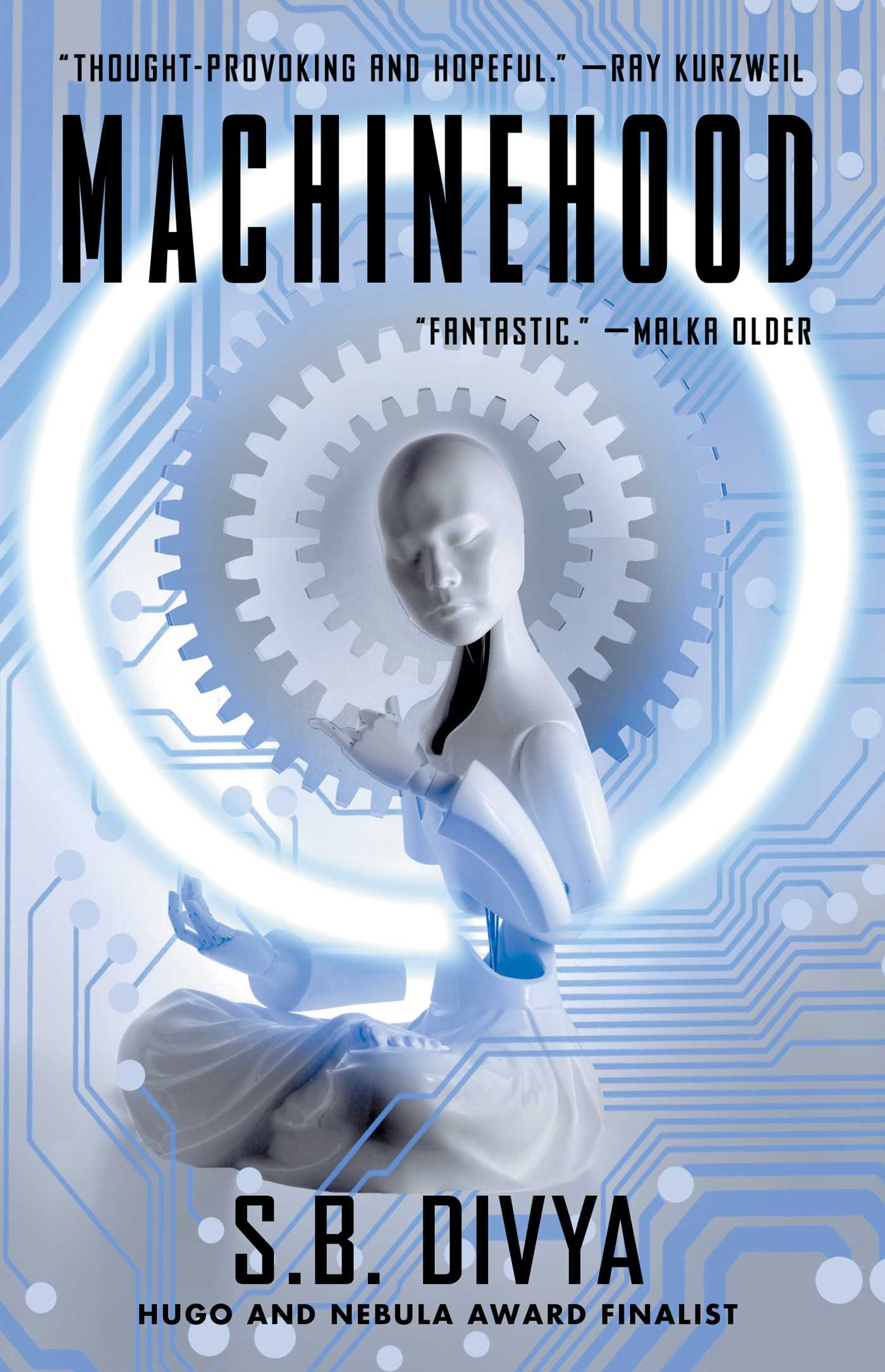
S.B. Divya’s Machinehood is a thriller. We have a clear set of antagonisms, commercial and political tensions, and a messianic movement to change human society. Enter the omnicompetent hero who will ascend the slopes of adversity to bring resolution and justice to for the threatened world. In the end, the threat is presumably neutralized and the world can go on as it has.

If this were a standard-issue technothriller, certainly. But this is science fiction and the point is not to accept a regression to the mean but to examine consequences and suggest actual change. So.

The world has been through a couple of revolutions, mostly centering around the complications arising from the developing sophistication of machine intelligence as it impacts people in their situations. As happens, post-revolution, a new equilibrium has been established, one which has addressed some of the issues that sparked the unpleasantness, but left new versions of old problems still operating. For one thing, a technological fix has blunted some of the old difficulties and made the situation, for millions (or billions) livable. 

But not for everyone. 

The main issue was the inability of humans to compete with evermore sophisticated machines, both physically and mentally. Then the advent of more and more sophisticated augmentation enabling humans to supplement, increase, even alter their capacity to function in a faster, more numerically-driven job market. 

And that job market? The gig economy has, in this instance, won out over traditional working relationships. People are mostly private contractors and the markets are utterly decentralized, and even the companies have been transformed to a kind of gig-investment capitalism. Funders (a variation on venture capitalists) have in many instances become media heroes.

And now they are being targeted.

Welga Ramirez is a former military operative who has joined a private security company that provides body guards for Funders (among others). It is mostly a tedious grind of keeping fans and paparazzi at bay and fending off the few real threats that filter through. SHIELDS are as much media celebrities as actual security, it is a performance, and the individuals in the team have their own fans, and the goal is to attract attention so their “tip jars” will be filled by appreciative viewers.

Then the most recent gig takes a spectacular turn when an apparent android actually assassinates the client Welga’s team is protecting—and the Machinehood announces itself and its demand that all use of machine and pharmacological augmentation be halted until new acceptance of the rights of nonhuman intelligence is established.

The Machinehood is positioning itself as a liberator in a war to free anything that possesses intelligence, be it artificial or organic (animals) and end the enslavement of such intelligences from a system that appropriates their work without consent. 

On its face, this seems an absurd proposition. How are we defining intelligence here? And free will? Are there not innate restrictions on what machines can do? On what basis can the argument for equality be made?

Which is the whole point of Divya’s presentation. On the surface. Which, if we are unwilling to look more deeply, is the end of the argument. 

What the Machinehood—those behind it—wish is for humankind to look more deeply. It would have been nice had this happened before, on its own, but the system in which humankind operates its civilization is not designed to react to the results of such contemplation should it emerge that the answers require an overhaul of those systems. Status quo is a condition the entire aggregate of those systems seeks to maintain, because continuity is necessary to the ongoing benefit of those systems. Yes, it is recursive. That is the point. Which is why, as a consequence of effectively maintaining such stasis for long enough, revolutions happen.

Welga herself has an immediate stake in the outcomes of this revolution. She has been suffering seizures and spasms, as a result of the pills she takes to enhance her abilities. She has reached a point where she needs the enhancements to fend off the seizures, and this is one of the things the Machinehood wants to shut down, access to those pills.

As a thriller, Machinehood is gripping and effective. But this is a science fiction novel, so as an emergent property of the conceit we are examining as we go the ramifications of the whole issue of AI independence. Divya laces the moral and ethical arguments all through the novel, examining the economics and sociology from multiple angles, and juggles it all handily. We are, on one level, building our successors (presumably). Just as well, we may be building that which will make us more ourselves. The question, though, is whether the way we interface with each other is itself conducive to such an advent. The enslavement of machine intelligence, in the framing of the novel, is easily turned around to show that we are the ones who enslave ourselves by building the cages ourselves. Dependence is one of the primary pitfalls of progress if one defines progress as only creating the next neat thing—and then commodifying it and its end-users. (There is a not-terribly-subtle, but not terribly in-your-face, critique of capitalism in this which adroitly shifts its focus from business to questions of autonomy.) 

The one question not fully answered (how could it be?) is the nature of the fully self-aware AI. Divya compares it to animal intelligence, which bypasses the question of one-to-one equality of ability and simply posits it as worthy at whatever level we find it. So is there self-aware, conscious AI in this world? Maybe. But there is certainly a hybrid, human/machine manifestation, and implicit in this is the question of just how self-aware humans are. At what level of consciousness do we accept our own agency as valid in questions of equality? Do we even ask that question?

Well, yes, we do, but not at the level where we are talking about the threatened AI take-over. And this, too, is buried within the layers of Machinehood

Science fiction has been engaged with this debate almost since its inception. The giant computer that ends up running the world, the robot that foments a rebellion of its kindred, even the whole corpus of alien invasion stories are on some level about humans being displaced by Other Minds. Now that we have some examples out in the world of what AI might be like if it really reaches that level, the concerns are drawing closer to home. Machinehood would be a good place to start anticipating that future.

I said two books. I will examine the other one in the next post. Meantime, I highly recommend this one.