Motives and Revelations

There is a remarkable scene—one of many—in James Morrow’s new novel, Galapagos Regained, wherein the final straw is broken for Charles Darwin and we are shown the moment he decided to back his radical new view of nature and its processes. Wholly fictional, no doubt, yet based on reality, Darwin has come to London to confront a young woman who has betrayed his trust while working in his household. The confrontation with the fictional Chloe Bathhurst is not the one that matters.  Rather, it is the confrontation Darwin is having with the edifice of a loving god.  His daughter is dying—tuberculosis—and the scientist in him knows there is nothing to be done, that an indifferent nature cares nothing for her goodness, her innocence, and any human claim on justice and fairness is but the empty babblings of a minor species only recently transcendent upon the ancient stage of life.  Darwin is angry and resentful.  The transgressions which resulted in his dismissing Miss Bathhurst are insignificant now against this greater, vaster crime which, he believes, has no actual perpetrator.  The only thing he can do, he decides, is to give her his blessing in pursuit of her own goal, which pursuit got her fired from his service.

Morrow-785x510

She was fired for attempting to steal the sketch he had written concerning the transmutation of species, a precursor work to his epic On The Origin of Species.  She did this in order to procure a means to free her errant father from debtors prison by using the work as the basis for winning the Shelley Prize, for which competition has been ongoing for some time in Oxford.  The purpose of the prize to reward anyone who can prove or disprove the existence of God.  Chloe, during her employ as Darwin’s zookeeper, became aware of his theory and thought it ideal to present and win the prize.

Darwin refused.  When she elected then to steal the notes and present it on her own, she was caught and dismissed.  Darwin was at the time unaware that she had already made a copy of the paper and thought he had caught her in the act.

Now, in the lobby of a London playhouse, where Chloe had once been employed as an actress, Darwin, aware that she in fact had stolen his treatise, is sanctioning her quest.

“Don’t overestimate my sympathy.  Had I two thousand surplus pounds, I would cover your father’s debts, then arrange for you to tell the world you no longer believe in transmutationism.  That said, I must allow as how a part of me wants you to claim the prize, for it happens that my relationship with God—“

“Assuming He exists.”

“Assuming He exists, our relationship is in such disarray that I should be glad to see Him thrown down…Get thee to South America, Miss Bathhurst.  Find your inverse Eden.  Who am I to judge your overweening ambition?  We’re a damned desperate species, the lot of us, adrift on a wretched raft, scanning the horizon with bloodshot eyes and hollow expectations.  Go to the Encantadas.  Go with my blessing.”

Because this is what Chloe has determined to do.  Go to the Galapagos Islands to gather specimens to support the argument for transmutation of species.  The Shelley Society fronts her the money to do so, she enlists her card-sharp brother in the expedition, they find a ship, and set sail.  The Society had already bankrolled an expedition to Turkey for the purpose of finding the remnants of Noah’s Ark, so this was only fair.

Accompanying her ship is Reverend Malcolm Chadwick, anglican minister and formerly one of the judges of the Shelley contest—on the side of the deity.  He steps down from that post at the request of Bishop Wilberforce and sent on this new mission to oversee what Chloe will do.  He departs with uneasy conscience, made so by the second part of Bishop Wilberforce’s plot, which sends another minister in another ship with the intention to go to the Encantadas and set in motion the ultimate destruction by slaughter of all the animals on the islands, thus to deprive the forces of atheism their troublesome evidence.  Chadwick finds this idea appalling, but he is faithful and says nothing.  He joins Chloe’s expedition, which becomes Odyssean in its complications and obstacles.

The novel proceeds from one adventure to another until Chloe herself, stricken ill in the Amazon basin, undergoes a kind of religious conversion, and decides she is wrong in her conviction that there is no god.  Morrow then expands on the struggle she engages with her fellow travelers and her own considerable intelligence.

What we are treated to in this novel is a thorough examination of human motivation in the face of shifting paradigms.  It may be clear where his sympathies lie, but he is too good a writer to load the dice in favor of his preferred viewpoint.  He gives his characters their own and follows them where they would naturally lead.  He never denigrates faith, only the fickleness of our intentions in the face of conflicting desires and awkward choices.  Tempting as it may have been in the end to simply declare a winner, Morrow instead takes a more difficult and fulfilling tack by portraying the times in which this debate flared into full flame with the advent of a solid theory of evolution.

Chloe Bathhurst herself is an admirable character.  An actress, adept as a quick study, she proves herself intellectually versatile and equal to any challenge.  As well, those who both aid and oppose her are equally well-drawn and Morrow deftly clarifies their motives.

Along the way, he gives a field demonstration in observation and interpretation, showing us the process whereby new understanding takes us over and how revelation can be a problematic gift.

Morrow is one of our best writers plowing the ground of controversy.  He never takes the simplistic road.  The pleasure in reading one of his novels is that of being allowed free range of the imagination in pursuit of specific truths stripped of dogma.  In fact, he disassembles dogma in the course of his yarns, a fact that is often not apparent while we’re in the grip of his artifice.

An artifice made warm by the complete humanness of his characters.  One his best creations is Chloe Bathhurst.  In her, several clichés and canards are undone, as well as many perhaps uncomfortable but rewarding questions asked.  She exemplifies the first rule of the explorer—never be afraid to go and see for yourself.  Do so and you’ll be amazed at what is revealed.

And what is lost.

The title parodies Milton’s Paradise Regained, from which perhaps Morrow took a bit of inspiration:

I, when no other durst, sole undertook
The dismal expedition to find out
And ruine Adam, and the exploit perform’d
Successfully; a calmer voyage now
Will waft me; and the way found prosperous once
Induces best to hope of like success.

Perhaps not so much to “ruin Adam” as to give us a view into a vaster garden, older and truer, and less a burden to our capacity for wonder.

Ends, Beginnings, Rebirths, Beliefs: Two Works of Science Fiction and a Fantasy

In recent months I have read two classic novels which, curiously enough, deal with matters of a religious nature.  I’ve decided to review them together for a number of reasons, one of which is both are part of the syllabus for my monthly reading group at Left Bank Books. Another reason for the review now is that I have finally, and not without some reluctance, seen one of the new generation of Biblical epics recently released, Noah, with Russell Crowe and Jennifer Connelly.  There are points of interest in this deeply flawed film which I will touch on after dealing with the novels.

The first novel is James Blish’s superb A Case Of Conscience, published originally in 1953 as a novelette and later expanded to novel-length and published in 1958 (the same year, coincidentally, that Pope John XXIII was elected to his chair).  The questions posed by the story are simple enough even if the answers are nearly impossible: what does Christianity, and more specifically Catholicism, have to say about extraterrestrial with regards to the matter of souls? Depending on the proposed answer, what responsibilities does the Christian have toward them? And, finally, what is to be done/considered if such extraterrestrials appear to have no taint of original sin?Case Of Conscience

These questions may seem naïve today, even irrelevant (although not sufficiently so to make a newer take on the matter a more than relevant work, namely Mary Doria Russell’s The Sparrow), but Blish’s treatment was anything but naïve in that he bound it up with questions of very nondenominational morality and respect.

To begin with, this is a First Contact novel, even though the “contact” has been an established fact for quite some time as the story opens.  That said, contact has barely begun, and that is the anchor for the drama. Because the ability of the two species, human and Lithian, to speak to each other aside, the story is sunk in the problem of cultures and their mutual incomprehension.  Blish is dealing with assumptions based on a telec understanding of the universe.  Because the guiding principles of his faith are telec, Father Ruiz-Sanchez grapples with whether or not to condone further interaction between his people and the Lithians.  In the end, he reacts rather than deliberates and argues for quarantine, stripping the Lithians of any say in the matter and laying bare the flaw in Ruiz-Sanchez’s own stated system of ethics.  Namely, if Ruiz-Sanchez is, as he claims to be, committed to a system devoted to the saving of souls, then shutting out all contact with creatures who may need saving would be fundamentally immoral.  The problem for him is whether the Lithians have souls, since they appear to lack any evidence of having “fallen.”  They live amicably among themselves, show no judgmentalism, solve problems by consensus without struggling against individual venality, do not appear to know what lying is, have no discernible crime, in fact exhibit none of the traits or conditions of being in a state of sin.  It’s as if, rather than being morally and ethically advanced, they in fact have no need to be, since they have none of the cultural dysfunctions requiring advancing along such lines.  To Ruiz-Sanchez, they are born wholly developed in a moral sense.  This, of course, runs counter to his beliefs in the nature of the universe.  Ruiz-Sanchez betrays, usually in subtle ways, a perverse devotion to dysfunction.  For instance, Earth is portrayed as having solved many of its fundamental economic problems and has adopted (by inference) rational systems that seem to promote equity, yet Ruiz-Sanchez feels that such evidence of progress demonstrates a failure because it moves humanity further away from an assumed ideal which may have no basis in reality.  In short, people are living better lives, at least materially, but are abandoning belief systems which have no use for them.  Better, perhaps, that progress never have occurred so that people would need the Church and the beliefs Ruiz-Sanchez feels matter.

It is understandable that the Lithians trouble Ruiz-Sanchez.  Almost everything about them is a rebuke to the way he has always believed things work.  Biologically, there is a complete disconnect with the human system of nuclear families, and by extension both patriarchy and the question of inherited sin. Their very reasonableness is testimony to the fact that such a state of mind and cultural condition not only can exist but does exist.  At one point, in debating with his colleagues over the issue of quarantine, he says “This has been willed where what is willed must be.”  This is from Dante’s Inferno, lines 91 to 93, in which Virgil says to Charon: “Charon, bite back your spleen:/this has been willed where what is willed must be,/ and is not yours to ask what it may mean.”  By this statement, Ruiz-Sanchez seeks to shut down questioning, his own surely but also his colleagues.  In this, he betrays a fundamental misunderstanding of Dante, but no matter.  The line is taken as a divine justification.  Lithia, in this view, must exist as it does because it does.  I am that I am, as it were.  For Ruiz-Sanchez this is also his justification for requesting the quarantine.  It would be fatal in two ways for intercourse to continue.  One, primarily, this Eden he thinks he has found will be eventually corrupted by interaction with humanity, for we embody the serpent, after all, which would be a form of blasphemy.  Two, it might well develop that the Lithians’ ability to function as they do will turn out to be no more than an evolutionary inevitability—which would make humanity’s condition equally so.  Ruiz-Sanchez already claims the exemption for humans from evolution that was dominant in theological thought prior to our present day (although not among Jesuits, making Ruiz-Sanchez a bit of a puzzle).  Ruiz-Sanchez is at base terrified that the Lithians are proof that the Church got it wrong.

Ruiz-Sanchez is a puzzle, as I say, because he’s not much of a Jesuit.  Possibly a Dominican.  Blish seems not to have had a very solid grasp of Catholicism, but he was dealing is large symbols here and parsing the vagaries of the multiplicity of protestant sects would muddy his point, perhaps.  His choice of the Society of Jesus makes a rough sense because of their history in the sciences and in exploration.  What is really on display is the breakdown of intellect in the face of the personally unacceptable.

This is apparent in Ruiz-Sanchez’s choice of reading material.  He’s reading Finnegan’s Wake at the beginning, a curious choice, especially for Blish as he had quite vocal problems with the kind of stream-of-conscious narrative Joyce produced in what amounts to a linguist parlor trick that strips away the pretensions of the intellect by questioning the very precepts of language itself.  But it is an inspired choice in this instance.  Ruiz-Sanchez is wrestling with it, trying to make moral sense of it, which is almost impossible.  In this context, Finnegan’s Wake is the universe as it is, and it forces the reader to accept that whatever “sense” comes out of it is of the reader’s own making.  It is a sustained refutation of a telec universe, which is anathema to Ruiz-Sanchez.

The ending of the novel is a famously achieved moral serendipity.  Because Blish kept the narrative inside Ruiz-Sanchez’s head throughout, perception is everything, and that may ultimately be the point of the novel.

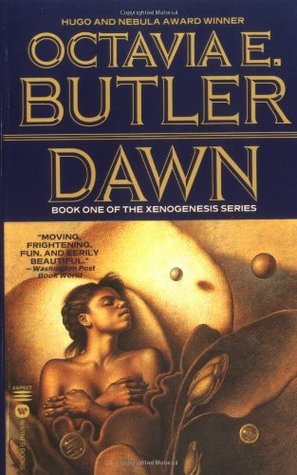
Which brings us to the next novel, also a First Contact work albeit one that reverses many of the tropes in Blish.  Octavia Butler’s Dawn is also a story wherein aliens are first encountered and a world is destroyed.  In this case, though, the aliens have found us and the world destroyed is Earth, by our own hand.

In some ways this is an anachronistic novel.  Dawn was published in 1987, a few years before the Soviet Empire came apart.  It is sometimes easy to forget how convinced many people were that a nuclear holocaust was going to put paid to the entire human enterprise.  But no matter, Butler dealt with it as an event in the story’s past and did not dwell on its particulars.  Any extinction event will do.  She was not interested in judging that or examining the why of it, only in what it established for what follows.

The Oankali, one of the more fascinating and successful nonhuman creations in science fiction, found Earth devastated, with few survivors.  As part of their own program of survival/colonization, they rescued these survivors, healed them where possible, and kept them aboard their immense ship for 250 years while the Earth recovered.

DawnLilith Iyapo is Awakened into a situation she cannot deal with, a lone human in a room dealing with aliens that terrify her with their strangeness.  It transpires that they have plans for her, that part of their own program is the reseeding of worlds like Earth with recovered local species and some of their own.  Humanity, she comes to understand, will be Different.  She rejects this again and again, seeing it as a defilement of what it means to be human, even though, relentlessly and with inconceivable patience, the Oankali show her and teach her that it will be, in some ways, better.  Certainly better for the people of Earth, but better for Lilith personally.

She is to be a leader, a teacher.  She becomes part of an Oankali family.  She finally accepts them for what they are, though she never fully understands them or accepts their plans, but over time she takes up the responsibilities immediately in front of her, namely to shepherd reAwakend humans and prepare them for resettlement.

Butler brilliantly folds several biblical motifs into this story.  It is very much a Moses story.  Lilith does become a teacher, she does lead, but she herself, at the end, is not permitted to “cross over into the promised land.”  Her own people do not accept her, see her instead as a race traitor.  She becomes an irredeemable outsider.  This is also a Noah story.  The world has been destroyed, what has been salvaged must be returned to start again, and Lilith is in some ways Noah, head of a human race given a second chance.

But it is also right out of Revelations.  A new heaven and a new Earth and the handful of appointed shall inherit…

Because it is a new heaven for these people, who stubbornly reject the idea that aliens have saved them and that they are on board a ship.  They reject everything Lilith tells them, their minds recoiling at the totality of the new universe.  It would be a new universe for them, one which now includes aliens right there in front of them.

If there is a flaw in the novel, here it is.  Butler created a masterpiece of psychology here, a study of humanity under stress, and her portraits are amazing in their precision and economy.  However, none of them have any of the traits of those who would eagerly welcome the prospect of meeting aliens and living in a new milieu. And certainly there are people like that.  The odds are Lilith should have found at least one or two allies who were well beyond her in acceptance.  Instead, almost all the people she deals with are in this aspect profoundly mundane.  This, however, is a quibble.

Strikingly, for a story so grounded and informed by religious motifs, there is no real mention of anything religious.  It is significant by its absence.  It is as if Butler decided “if you can’t see the symbolism yourself, spelling it out will cause you to miss all the other points in the book.”  One could also read this as a tacit acceptance on the part of all these people that religion failed them and they’re done with it.  Nothing has happened in a fashion they would have been raised to expect.

The Oankali have determined the cause of humanity’s epic failure.  Two traits which combined disastrously, as they explain to Lilith:  exceptional intelligence and a commitment to hierarchical structures.  Hierarchical thinking and the cleverness to build weapons of mass destruction led inevitably to the annihilation of the human race and the poisoning of the planet.  In order to survive, the Oankali tell her, this must be changed, and therefore humans will be changed.  The Oankali are masters of genetic manipulation—their ship itself is a living thing—and they inform her quite clearly that this must be done.  This becomes the point of greatest contention—for Lilith this is a loss of what it means to Be Human, even though clinging to that is what destroyed humanity and nearly the planet itself.  Butler simply puts this out there.  The Oankali explain themselves, Lilith rejects it even as she comes to accept them.  Her experiences trying to teach and lead the first group of newly Awakened survivors would seem to support the Oankali position.  And yet…and yet…

The question of self-determination comes into this throughout.  Sensibly, Butler never actually examines it, only leaves it present as an emotional issue, while she shows the other trait within humans that is significant and necessary—adaptability.  Humans always change under pressure, always have.  This time  the pressure seems less circumstantial and so an opportunity for people to reject the necessity of change can be placed center-stage.

In both novels we see the primacy of moral determination in the face of the unanticipated.  The very nature of the universe is turned upside down and the givens of the past no longer suit.  In the end, circumstance determines far more than we may allow ourselves to admit, and the narratives by which we live must change to allow us to move forward.

Which brings me to the film, Noah.  When this movie came out there was a spasm of objection from certain quarters over its revisionist take on the Biblical tale.  Upon seeing the film, which is in many ways a fairly silly movie, I can see where it would bother a certain mindset, but also how that mindset would blind the viewer to some of the interesting aspects of it that make it not so easily dismissed.

The Creation myth is reduced to its elements, the Fall is handled almost as a fantasy tale, and the aftermath of Cain killing Abel is the real basis of all that follows.  The children of Seth, the third son of Adam and Eve, become caretakers of the world while the children of Cain build “a great industrial civilization” and set about conquering, killing, and polluting everything.  The story is transformed into an eco-fable, one in which the punishment inflicted is in response to mines, murders, and misuses of the “gifts” of creation.  The Sons of Cain are depicted as warmongering, patriarchal butchers, nascent NRA members, and proto-imperialists. while Noah and his are shown as gentle nurturers, Noah himself much in the Dr. Doolittle vein.  The landscape is a stark contrast between the urban ruin of the Cainites and the meadowy greenscapes in Noah’s care.

An interesting moment occurs, among several “interesting moments,” when the King of the Cainites, Tubal-Cain (which one might feel references surgical birth control, but in fact he is mentioned in Genesis and  credited as being a master metal worker), explains to Noah’s son Ham that he and his people have the same religious mythography, but they believe The Creator adandoned them, turned his back on mankind, and left them to survive and fend for themselves without his help.

Had there been more of this, the film might have achieved some kind of philosophical sophistication, but as it was Aronofsky, in spite of clever touches and good dialogue (and a stunning visual æsthetic), reduced it to a side-bar of the Lord of the Rings.  All the components were there to show how the story might be relevant to the present, and yet the message was muffled in the extravagant imagery and an attempt to extract an ur-myth from the Hebrew iconography.  It’s a better film than many of its critics, on both sides, credit, but it’s failures of reach make it less potent than it might have been.

One thing I found compelling is the portrayal of Noah in the course of building the ark and trying to keep his family together as a man suffering, essentially, PTSD.  He becomes convinced that what the Creator wants is for all humanity to die out and he intends to kill his son’s firstborn should it turn out to be a girl.  Aronofsky folds the story of Abraham and Isaac into this rather neatly and also manages to extract a better lesson—Noah cannot kill the girls (they turn out to be twins) and feels he has failed the Creator.  But his daughter-in-law, played well by Emma Watson, teaches him that it had always been in his hands because why else would the Creator have chosen him to do all this if not that he, Noah, had the ability and the responsibility to decide.  A rather mature lesson to take from all the slaughter grandly depicted.

All three works offer end of the world scenarios of one kind or another and all three portray moral decision-making that ultimately comes down to what humans do with what is in front of them, for their own benefit and for the benefit of others.  All three place that power squarely on human shoulders and suggest, in their various ways, that solutions are never to be found outside ourselves.  And even if such solutions occasionally can be found, it remains for us to do something with the consequences.

Greatless Illusion

The third book I read recently which resonated thematically with the previous two is one I have come somewhat late to given my inclinations.  But a new paperback edition was recently released and I considered buying it.  I hesitated as I was uncertain whether anything new or substantively unique was contained therein to make it worth having on my shelf.  I have other books along similar lines and while I am fond of the author, it seemed unlikely this book would offer anything not already covered.

Christopher Hitchens was a journalist and essayist and became one of our best commentators on current events, politics, and related subjects.  Even when I disagreed with him I have always found his arguments cogent and insightful and never less than solidly grounded on available fact.

So when he published a book of his views on religion, it seemed a natural addition to my library, yet I missed it when it first came out.  Instead, I read Richard Dawkins’ The God Delusion, which I found useful and well-reasoned, but pretty much a sermon to one who needed no convincing.  Such books are useful for the examples they offer to underpin their arguments.

Such is the case with God Is Not Great: How Religion Poisons Everything.  Hitchens’ extensive travels and his experiences in the face of conflict between opposing groups, often ideologically-driven, promised a surfeit of example and he did not fail to provide amply.

The title is a challenge, a gauntlet thrown at the feet of those with whom Hitchens had sizeable bones to pick.  In the years since its initial publication it has acquired a reputation, developed a set of expectations, and has become something of a cause celebré sufficient for people to take sides without having read it.  I found myself approaching the book with a set of expectations of my own and, with mild surprise, had those expectations undermined.

Yes, the book is a statement about the nature of religion as an abusive ideology—regardless of denomination, sect, theological origin—and offers a full range of examples of how conflicts, both between people and peoples, are generally made worse (or, more often than not, occur because of) by religious infusions into the situation.  It is in many ways a depressing catalog of misuse, misinterpretation, misstatement, misunderstanding, and sometimes misanthropy born out of religious conviction.  Hitchens analyzes the sources of these problems, charts some of the history, and gives us modern day examples.

But he tempers much of this by drawing a distinction between individuals and ideologies.

He also opens with a statement that in his opinion we shall never be rid of it.  This is quite unlike people like Dawkins who actually seem to feel humankind can be educated out of any need of religion.  Hitchens understood human nature all too well to have any hope that this was possible.

He does allow that possibly religion allows some good people to be better, but he does not believe religion makes anyone not already so inclined good.

By the end of the book, there will likely be two reactions.  One, possibly the more common, will be to dismiss much of his argument as one-sided.  “He overlooks all the good that has been done.”  It is interesting to me that such special pleading only ever gets applied consistently when religion is at issue.  In so much else, one or two missteps and trust is gone, but not so in religion, wherein an arena is offered in which not only mistakes but serious abuse can occur time and time again and yet the driving doctrine never called into question.  The other reaction will be to embrace the serious critique on offer, even the condemnations, and pay no attention to the quite sincere attempt to examine human nature in the grip of what can only be described as a pathology.

Because while Hitchens was a self-proclaimed atheist, he does take pains to point out that he is not talking about any sort of actual god in this book, only the god at the heart of human-made religions.  For some this may be a distinction without a difference, but for the thoughtful reader it is a telling distinction.  That at the end of it all, Hitchens see all—all—manifestations of gods through the terms of their religions as artifices.  And he wonders then why people continue to inflict upon themselves and each other straitjackets of behavior and ideology that, pushed to one extreme or another, seem to always result in some sort of harm, not only for the people who do not believe a given trope but for the believers themselves.

We are, being story-obsessed, caught in the amber of our narratives.  Per Mr. Thompson’s analysis of myth, we are never free of those stories—even their evocation for the purposes of ridicule bring us fully within them and determine the ground upon which we move.  The intractable differences over unprovable and ultimately unsubstantiated assumptions of religious dictate, per the history chronicled around the life Roger Smith, have left us upon a field of direst struggle with our fellows whose lack of belief often is perceived as a direct threat to a salvation we are unwilling ourselves to examine and question as valid, resulting in abuse and death borne out of tortured constructs of love.  Christopher Hitchens put together a bestiary of precedent demonstrating that treating as real the often inarticulate longings to be “right” in the sight of a god we ourselves have invented, too often leads to heartache, madness, and butchery.

The sanest religionists, it would seem by this testament, are those with the lightest affiliation, the flimsiest of dedications to doctrine.  They are the ones who can step back when the call to massacre the infidel goes out.

All of which is ultimately problematic due simply to the inexplicable nature of religion’s appeal to so many.

But it is, to my mind, an insincere devoteé who will not, in order to fairly assess the thing itself, look at all that has been wrought in the name of a stated belief.  Insincere and ultimately dangerous, especially when what under any other circumstance is completely wrong can be justified by that which is supposed to redeem us.

Monstrous Partiality

In keeping with the previous review, we turn now to a more modern myth, specifically that of our nation’s founding.  More specifically, one component which has from time to time erupted into controversy and distorted the civil landscape by its insistence on truth and right.

But first, a question:  did you know that once upon a time, in Massachussetts, it was illegal to live alone?

There was a law requiring all men and women to abide with families—either their own or others—and that no one, man or woman, was permitted to build a house and inhabit it by themselves.

John M. Barry details this and much more about early America which, to my knowledge, never makes it into history classes, at least not in primary or secondary schools, in his excellent book  Roger Williams and the Creation of the American Soul: Church, State, and the Birth of Liberty.

9780670023059_p0_v1_s260x420

Discussion of the Founding—and most particularly the Founding Fathers—centers upon the Revolutionary Era collection of savants who shaped what became the United States.  It is sometimes easy to forget that Europeans had been on these shores, attempting settlements, for almost two centuries by then.  It’s as if that period, encapsulated as it is in quaint myths of Puritans, Pocahontas, Squanto, John Smith, and Plymouth Rock, occupies a kind of nontime, a pre-political period of social innocence in which Individuals, whose personalities loom large yet isolated, like Greek Gods, prepared the landscape for our later emergence as a nation.  My own history classes I recall did little to connect the English Civil War to the Puritan settlements and even less to connect the major convulsions in English jurisprudence of that period to the the evolution of political ideas we tend to take for granted today.  In fact, it seems pains are taken to sever those very connections, as if to say that once here, on North American soil, what happened in Europe was inconsequential to our national mythos.

That illusion is shattered by Barry in this biography of not only one of the most overlooked and misunderstood Founders but of that entire morass of religious and political struggle which resulted in the beginnings of our modern understanding of the wall of separation between church and state.  More, he makes it viscerally real why  that wall not only came into being but had  to be.

If you learned about Roger Williams at all in high school, probably the extent of it was “Roger Williams was a Puritan who established the colony that became Rhode Island.  He contributed to the discussion over individual liberty.”  Or something like that.  While true, it grossly undervalues what Williams actually did and how important he was to everything that followed.

In a way, it’s understandable why this is the case.  Williams occupies a time in our history that is both chaotic and morally ambiguous.  We like to think differently of those who settled here than they actually were, and any deeper examination of that period threatens to open a fractal abyss of soul searching that might cast a shadow over the period we prefer to exalt.

But the seeds of Williams’ contribution were sown in the intellectual soil which to this day has produced a troubling crop of discontent between two different conceptions of what America is.

The Puritans (whom we often refer to as The Pilgrims) were religious malcontents who opposed the English church.  They had good reason to do so.  King James I (1566 – 1625) and then his son, Charles I (1600 – 1649), remade the Church of England into a political institution of unprecedented intrusive power, establishing it as the sole legitimate church in England and gradually driving out, delegitimizing, and anathematizing any and all deviant sects—including and often most especially the Puritans.  Loyalty oaths included mandatory attendance at Anglican services and the adoption of the Book of Common Prayer.  The reason this was such a big deal at the time was because England had become a Protestant nation under Queen Elizabeth I and everything James and Charles were doing smacked of Catholicism (or Romishness), which the majority of common folk had rejected, and not without cause.  The history of the religious whipsaw England endured in these years is a blood-soaked one.  How people prayed, whether or not they could read the Bible themselves, and their private affiliations to their religious conceptions became the stuff of vicious street politics and uglier national power plays.

So when we hear that the Pilgrims came to America in order to worship as they saw fit, we sympathize.  Naturally, we feel, everyone should be allowed to worship in their own way.  We have internalized the idea of private worship and the liberty of conscience—an idea that had no currency among the Puritans.

The Puritans were no more tolerant than the high church bishops enforcing Anglican conformity in England.  They thought—they believed—their view of christian worship was right and they had come to the New World to build their version of perfection.  A survey of the laws and practices of those early colonies gives us a picture of ideological gulags where deviation was treated as a dire threat, a disease, which sometimes required the amputation of the infected individual: banishment.

Hence the law forbidding anyone from living alone.  It was thought that in isolation, apart from people who could keep watch over you and each other, the mind’s natural proclivity to question would create nonconformity.

Conformity is sometimes a dirty word today.  We pursue it but we reserve the right to distance ourselves from what we perceive as intrusiveness in the name of conformity.  Among the Puritans, conformity was essential to bring closer the day of Jesus’ return.  Everyone had to be on the same page for that to occur.

(Which gave them a lot of work to do.  Not only did they have to establish absolute conformism among themselves, but they would at some point have to go back to England and overthrow the established—i.e. the King’s—order and convert their fellow Britons, and then invade the Continent and overthrow Catholicism, and all the while they had to go out into the wilderness of North America and convert all the Indians…but first things first, they needs must become One People within their own community—something they were finding increasingly difficult to do.)

Into this environment came Roger Williams and his family.  Williams was a Puritan.  But he also had a background as apprentice to one of the most formidable jurists in English history, Sir Edward Coke, the man who ultimately curtailed the power of the king and established the primacy of Parliament.  Coke was no Puritan—it’s a question if he was anything in terms of religious affiliation beyond a christian—but he was one of the sharpest minds and most consistent political theorists of his day.  He brought WIlliams into the fray where the boy saw first-hand how power actually worked.  He saw kings be petty, injustices imposed out of avarice, vice, and vengeance in the name of nobly-stated principles.  And, most importantly, he saw how the church was corrupted by direct involvement in state matters.

This is a crucial point of difference between Williams and later thinkers on this issue.  Williams was a devout christian.  What he objected to was the way politics poisoned the purity that was possible in religious observance.  He wanted a wall of separation in order to keep the state out of the church, not the other way around.  But eventually he came to see that the two, mingled for any reason, were ultimately destructive to each other.

Williams was an up-and-coming mover among the Puritans, but the situation for him and many others became untenable and he decamped to America in 1631, where he was warmly received by the governor of Massachussetts, John Winthrop.  In fact, he was eagerly expected by the whole established Puritan community—his reputation was that great—and was immediately offered a post.

Which he turned down.

Already he was thinking hard about what he had witnessed and learned and soon enough he came into conflict with the Puritan regime over matters of personal conscience.

What he codified eloquently was his observation that the worst abuses of religiously-informed politics (or politically motivated religion) was the inability of people to be objective.  A “monstrous partiality” inevitably emerged to distort reason in the name of sectarian partisanship and that this was destructive to communities, to conscience, to liberty.

For their part, the Puritans heard this as a trumpet call to anarchy.

The Massachussetts Puritans came very close to killing Williams.  He was forced to flee his home in the midst of a snowstorm while he was still recovering from a serious illness.  He was succored by the Indian friends he had made, primarily because he was one of the very few Europeans who had bothered to learn their language.  They gave him land, which eventually became Providence Plantation, and he attracted the misfits from all over.  Naturally, Massachussetts saw this as a danger to their entire program.  If there was a place where nonconformity could flourish, what then became of their City on the Hill and the advent toward which they most fervently worked?

The next several years saw Williams travel back and forth across the Atlantic to secure the charter for his colony.  He knew Cromwell and the others and wrote his most famous book, The Bloody Tenent of Persecution, for Cause of Conscience,
in 1644 right before returning to America to shepherd his new colony.  In this book for the first time is clearly stated the argument for a firm wall of separation.  It is the cornerstone upon which the later generation of Founders built and which today rests the history of religious freedom we take as a natural right.

But the struggle was anything but civil and the abuses to which Williams responded in his call for a “Liberty of conscience” are not the general picture we have of the quaint Pilgrims.

Barry sets this history out in vivid prose, extensively sourced research, and grounds the story in terms we can easily understand as applicable to our current dilemma.  One may wonder why Williams is not more widely known, why his contributions are obscured in the shadow of what came later.  Rhode Island was the first colony with a constitution that did not mention god and it was established for over fifty years before a church was built in Providence.

Williams himself was not a tolerant man.  He loathed Baptists and positively hated Quakers.  But he valued his principles more.  Perhaps he saw in his own intolerance the very reason for adoption of what then was not merely radical but revolutionary.