Year in review

I read 94 books in 2024. 

Not what I was shooting for, but not by any means unsatisfying. Upon retirement, I imagined myself spending at least two or three hours a day poring over all the books and devouring the things I’ve always intended to.

Well. That didn’t happen.

But as things get more settled, I might exceed my goal of 100 a year. (The highest number I ever reached was my senior year of high school. I had taken a speed reading course the year before, I was cruising through texts at an average of 2000 words a minute, and I cut class most of my senior year. I spent most of those days at the local library—seriously—and got to where I was doing a book a day. I plowed through many of the so-called classics that way and I might have read 300 books that year. Now, I can’t read that fast anymore and I’m much happier for it, because what I read at the more modest pace of maybe 150 to 200 words a minute means more, has more impact, and stays in my memory. Lately I’ve been revisiting some of those classics I read back then and it’s like reading them for the first time. I remember I read them, but not much else, with a few exceptions.) That would be a respectable number, I think. 

I did a lot of filling in this past year. Books I’ve owned for decades and never got around to, some works of SF that are important if not seminal works that I simply passed up. To that end, I read several of the original Ace Specials, edited in the late 60s-early 70s by Terry Carr. While a couple of them did not quite pass the test of time, I was pleasantly surprised by the D.G.Compton’s—Chronocules, Steel Crocodile, The Silent Multitude, and Synthajoy. I found them very mature works, dealing with human interaction in ways much more sophisticated than a lot of popular SF at the time, with premises that, while certainly science fictional, did not dazzle with hi-tech glitz, but supplied a satisfying substrate for the real action, which is how we treat each other. Compton, I believe, holds the record for the most titles published in the Ace Special line. As well, I read a couple of Bob Shaw’s, a writer who has unfortunately been largely forgotten today. The Two-Timers and The Palace of Eternity are sophisticated stories of seemingly minor shifts in the given tapestry of our lives with outsized effects. 

I also filled a couple of Michael Moorcock gaps with The Ice Schooner, The Black Corridor, The Distant Stars, and The Warlord of the Air. Moorcock can be uneven, but he possesses a singular approach to science fiction that, when effective, elevates his work to a remarkable degree. 

I also tackled a lot of Robert Silverberg. There is a lot of Silverberg. He is one of the most prolific writers, in any genre, and he crossed genres significantly. In his early career, he wrote a great deal of popular SF, potboilers really, and some of it has not aged well. When Silverberg is firing on all cylinders, he can be brilliant. But the volume of work…well, not all of it rose to such vaunted heights, and we shouldn’t expect it to. But in some ways, work which was once seen as cutting-edge and groundbreaking, especially socially, has worn poorly. But among those I read this year that I think remain remarkable I would put Downward To The Earth. It’s a riff on Joseph Conrad’s Heart of Darkness. Silverberg has claimed Conrad as one of his favorites, so it’s not surprising that he would take a page from him from time to time, and this one is rather well done. Another worthy tale is Sailing To Byzantium. It’s elegant and picturesque and in the end poignant. 

There are novels one should read at the right age or, really, when they first appear if possible. I read several older works that, for a variety of reasons, simply have not held up well, despite clever ideas. Sad, really, because I can see in many cases where I would—at age 15 or 16 or 26—have been utterly enthralled by them. Some of this has to do with the natural changes of style that come with the passing of time. We’ve learned how to write this stuff better. Some of it has to do with the priority given to aspects of certain stories we know were they done today would be differently deployed. Times have changed, tastes have evolved, and for better or worse I am someone who has a difficult time Going Back. I can’t read a lot of older work that I know I loved when I first encountered it, because, well, it doesn’t flow anymore. Expectations have mutated, grown, what have you. (I have this problem with period novels. I know people who can happily get lost in the works of Trollope or Galsworthy, but I trip over the prose and stumble. Oh, there are writers from those periods I can read, there are exceptions, but a great deal of popular work from previous eras just doesn’t work for me and it’s not the fault of the work itself.) I will confess here that there is one type of novel I simply grind to a halt with and that is the broad satire. I attempted to read John Sladek’s Mechasm (another of the original Ace Specials) and it’s Vonnegut-esque, which would be a recommendation for many people. But it’s…well, smart-alecky. Tongues visibly in cheeks, caricatures, and just…clever ideas packaged as a series of absurdities. I’m willing to cop to tone-deafness on my part, but too often I’ve been in the middle of work like this before realizing I’m trying to read smart-ass prose as if they were deadly serious. I’m working on that.

Then there are writers whose approach to subject—their strategies, if you will—fails to engage. I have blindspots about this. I read things others tell me are just marvelous and I find them clunky and all but inaccessible. But so many people extoll the virtues of these writers so much that I suspect many of us who are simply not impressed say nothing for fear of spoiling the party. 

One classic, so called, that was surprising in many ways? I finally read The Man In The Gray Flannel Suit. Sloan Wilson’s first novel and  cultural touchstone of sorts. My review is here, so I won’t go into it. I read a few books that in their day were heralded as important. Martin Amis’s Time’s Arrow, which I found clever if not altogether revelatory. And then there was The Futurological Congress by Stanislaw Lem. I understood something about Lem after this one that I hadn’t quite realized before. Lem did not like mot science fiction, especially American SF, and this novel offered a clue as to why that may have been. Lem, I believe, didn’t think humans were…improvable. That we might develop amazing technologies, even make major breakthroughs in science, but we ourselves? Hopeless. I think he may have reacted negatively to the kind of Higher Frontier cheerleading a lot of SF indulges. 

I continue to be impressed with the tor.com series. I’ve read a number of great books from them and not yet encountered a bad one. This year continues with the latest entry in the Murderbot seriea, System Collapse. A Season of Monstrous Conceptions by Lina Rather pushed the boundaries of Steampunk in interesting directions, although I’m beginning to feel that category ought to be retired, at least in many instances. Just because a story is set in a more or less Victorian milieu it should not automatically be regarded as steampunk. Sometimes it’s just alternate history. More often, it seems, it’s an example of horror. Be that as it may, another fine work from tor.com is Aliette de Bodard’s Navigational Entanglements, a very satisfying kind of space opera. Top of the list from that publisher, though, is Ray Nayler’s The Tusks of Extinction, a sobering contemplation on the economics and sociometrics of poaching and the costs of solutions.

Continuing my desultory attempt to catch up on what may have been my Golden Age, I read a couple more Clifford Simak novels—Cemetery World, in particular—and James Blish novels. Blish is another mixed bag. Some of his books have aged poorly, while some are surprisingly still very good. Titan’s Daughter is a mixed bag novel reminiscent of Wells’ Food of the Gods. A thriller of sorts. And Mission To The Heart Stars would seem to be a response to Heinlein’s Have Space Suit, Will Travel, both dealing in different ways with the idea of humanity having to pass muster before a galactic civilization that holds our fate in its grasp. 

Two of the most surprisingly pleasurable reads (for completely different reasons) this year were C.S.E. Cooney’s World Fantasy Award winner  Saint Death’s Daughter and the Booker Prize winner Orbital by Samantha Harvey. The first because normally I would never have picked it up, but it’s a title in my book group’s roster (this month actually), the second because…well, an SF novel written by literary writer that, being SF, won one of the most prestigious literary awards on the planet.

Saint Death’s Daughter is a sprawling bit of world-building that, despite its excellent background construction and detail, is very focused on its characters, who are wide-ranging and unique. Despite some touchpoints that suggest this world is some past (or future) iteration of our own, it quickly becomes irrelevant to the plot, which is twisty and engaging and in certain ways compellingly perverse. It deals with necromancy, includes ghosts, resurrection, and an original take on magic which, by the end of the novel, left me wondering if this were fantasy at all. The world is not Earth, not in any traceable way, and I began to see the traces of a nanotech explanation for much of the so-called magic. But it is written in the manner of a fantasy. It appears to be a fantasy and, as such, is not something I would normally pick up. But it more than paid off the investment in a 640 page novel. 

Orbital on the other hand is exactly the sort of thing I would pick up, as much out of a desire to see how well it was done as for its content. I should be used to finding well-done SF written by otherwise non-SF writers by now. These are artists who have come of age steeped in the brew of science fiction that has soaked contemporary culture. It’s not like the “slumming” that one used to find from mainstream authors who attempted the form that they might otherwise have felt a subspecies of Good Writing. It has become much more acceptable for someone like Kazuo Ishiguro or Emily St. John Mandel or Mat Johnson to produce a work of unapologetic science fiction (even though some publicists still balk at embracing it), but I’m still cautious and surprised when one is done well. In fact, very well. To be sure, Orbital is easily read as mainstream literary, the SFnal elements smoothly entwined with all the rest to make it feel contemporary. But if one of the chief values of science fiction is how is elucidates the human changes wrought by science and technology which are themselves game-changers—paradigm-shifters, if you will—in anticipatory modes, then Orbital qualifies, and it is the respectful flower of internalizing SF as a valid literary form with significant implications.

This past year I’ve read more SF than the last several. Largely, this was a consequence of having to devote myself to more research, but also because my nonfiction-for-pleasure has increased, and in that regard some of the highlights of 2024 have been: 

Christendom by Peter Heather; Democracy Awakening by Heather Cox Richardson; The Existentialist Cafe by Sarah Bakewell; The Second Sex by Simone de Bouvoir; White Holes by Carlo Rovelli; Plato At The Googleplex by Rebecca Goldberger Goldstein; Orientalism by Edward Said; The Witches by Stacy Schaff. Again, some catching up going on there, books I should have read but never got to.

So, 94 books. I may tally fewer this coming year as I have several on my pile of epic proportions. That and I don’t know yet how my next couple of projects will distort my strategies. But all in all, I’m pleased with this last one. I have not mentioned several others, many of which were quite good but other than noting that I read them would add little to this summary. One of these years I may start linking to a spreadsheet so everyone can keep track.

I’ll end by pointing out that the last few years have seen declines in reading rates across several demographics. This saddens me. I know the pressures of daily life can make reading seem like a luxury—or a chore—that one cannot afford, but given the state of, well, everything these last several years, I think it is a necessary survival habit. The level of ignorance—specifically, the degree to which people simply do not know things—demonstrated quite publicly by too many people is having a corrosive effect on life itself. Regardless how bad one’s school experience my have been, reading is one of the most civilizing skills available to us. Not just the casual cruising of an internet feed but the kind of reading that stretches the imagination. Take a book, turn off the feeds, sit down, and dig in reading. It seems more and more that we’re going to let the world burn because we just don’t know any better.

Have a better 2025.

23

It’s interesting that one of the axioms of retirement is that once entered one will have time to do all the things the day-job obstructed. Like read as much as you like. And like so many such things, it turns out not to be true. The habits of decades are still in force, and while maybe you get more chores done, you find reordering all those deeply-rutted paths more difficult than you thought.

I’m sure in some ways I am reading more, but not the way I’d hoped. I average around 70 books a year, cover-to-cover, with a great deal of spot reading, fragmentary, excerpts, short pieces, dipping into and out of research or sidetrips. I suppose if I did a page count I might find myself in the 150 plus range (total book equivalent), because this past year I did a lot of that, as I’m back at work on a new historical novel and much of my reading is taken up with research, most of which is not whole books.

But other things have also gotten in the way. Well, that’s an ungenerous way to put it. Since my dad’s death, my time spent on mom has gone up considerably—and quite happily—and of course I’m still trying to settle into a new routine.

That said, I read—cover-to-cover—66 books in 2023.

Setting aside the research material, some of which I do include in this tally, quite a lot of it was spent on old novels either read back in my adolescence or for various reasons never read at the time. Catching up, so to speak, on the work that was part of my youthful encounter with, especially, science fiction.

There were a few writers I remember bouncing off of back then. I never quite connected with, for instance, Avram Davidson. I read Rork!, which is a colonial adventure with some curiously subversive takes on the whole idea of imperial encounters; The Island Under The Earth, which I’m still not sure I quite understood, but a sort of mythologically-oriented fantasy; The Phoenix and the Mirror, the first in his loose series about Vergil, again a fantasy (of sorts) and truly magnificently done, a pleasure to read; and A Clash of Star Kings, which could have stood a little more fleshing out, but given the publishing requirements of the time, he delivered a rather fascinating take on the idea that the ancient MesoAmerican “gods” were warring aliens. The pleasant surprise, even with the material I did not quite get, was the beauty of the prose.

I also reread a couple of D.G. Compton novels. Compton died recently, one of those artists one loses touch with and assumes has long since passed away. He published four novels via Terry Carr’s old Ace Special series, the most, I believe, by any single writer, and I know I read them back then (as I read all the Specials because, after all, they were special) but I barely remembered them. They were perhaps too sophisticated for me at the time. But I read Synthajoy and The Silent Multitudes and found both remarkably made narratives about the disjunction between expectation and new technologies or events. His handling of character was quite uncharacteristic of the majority of science fiction of that time (the Sixties) and psychologically fascinating. I will be reading another one for the reading group I host.

Other older titles I read included the complete Cities In Flight by James Blish, which in the end left me a bit disappointed. I thought it began very strongly with the mines of Saturn and the advent of longevity in They Shall Have Stars, but by the last book (chronologically), Triumph of Time, I thought it strained against the limitations of form available at the time. The characters and social milieu did not, in my opinion, match the more cosmological aspects Blish was attempting, but he was never an epic writer in the sense we think of it today. Somewhat more successful was his quasi-fantasy set Black Easter and The Day After Judgment, which dealt with an actual apocalypse and its aftermath. Thematically related to his classic A Case Of Conscience, Blish seemed to have been in his element dealing with the collisions of theology and materialism.

A writer who worked with such themes in quite different ways was Michael Bishop, who also passed away recently. Bishop should, in my opinion, enjoy a much larger and wider reputation than he seems to. At his best, he was compelling and richly engaging. I decided to read those of his early titles I never got around to and with that in mind I read A Little Knowledge and Under Heaven’s Bridge, which he cowrote with Ian Watson. Both examine the impact of aliens on human philosophical concerns, both in different ways. Neither was a great work, but you can see the greatness to come. I also reread his excellent novella Apartheid, Superstrings, and Mordecai Thubana which, among other things, took a hard look at South African apartheid. Published before the collapse of that system, it is an uncomfortable read that deals with police-state mentality and brutality and tragedy of enlightenment within a system designed to snuff it out. It carried unfortunate resonances into today in unexpected ways, which the best fiction will always do.

We read Daphne Du Maurier’s Rebecca aloud. The elegance of her prose allows entree into a psychologically engaging family drama that involves murder and shattered illusions and the demands of expectations based on half-truths and lies. What begins as a rather pedestrian romance becomes inexorably a portrait of dysfunction and questions the sacrifices we make in order to find a place in the world with people we wish to love.

Another read-aloud we did was the superb satire The Master and Margarita by Mikhail Bulgakov. Russian to its core, it was Bulgakov’s last novel, unpublished during his lifetime, and it is a romp. The devil arrives in Moscow, takes over a theater, begins granting wishes, and thoroughly upends daily life for certain people and leaves the state with a puzzle it is incapable of solving. Delightful.

We also read a couple of Willa Cather novels, O, Pioneers! and My Antonia. Cather is among those authors I’d always intended to read but for one reason or another never got to. But I confess, when I was tearing through the so-called “classics” in high school, neither of these would have stayed in my memory very clearly. I’ve had to grow into a state of mind to appreciate them, so it’s just as well I waited. These are the kind of novels kids like me dismissed because “nothing happens.” Which is to say, the careful setting of character in landscape and examining the evolution of them in concert requires a certain interest. Not that I didn’t encounter such work back then and enjoy it, but it would have been the exception. I’ve now reached the point where I look at some of the works I praised as terrific then and have to admit that, really, nothing happens in them, other than a lot of frenetic running around.

However, I also finally opened up a novel whose virtues are so widely extolled that one feels like a literary troglodyte when its charms fail to excite. One Hundred Years Of Solitude by Gabriel Garcia-Marquez. A few years ago I read Love In The Time Of Cholera and quite liked it. This, unfortunately, left me a bit perplexed. It’s not so much that nothing happens, but rather for all that does happen fails to change anything. Except, perhaps, the women. They change. They alone in this vast epic exhibit a capacity for change, for growth, for evolution, but then all of it is constrained to the task of adapting to men, who do not change and whose inability to do so distorts the lives of these women whose marvels and talents we will never see because they are in bondage to a stagnant domesticity. If this were written to suggest a criticism of such male intractability, then it might be something, but I found the narrative guileless in its acceptance that this is how the world is and one cannot alter it.

The older I get, the more I find my sentiments engaged by the women—writers and characters—who struggle to be themselves and stop conforming to long-desiccated expectations. Which is why I look forward these days to the next novel by Becky Chambers (whose The Galaxy and the Ground Within I read this year and found amazing) or Ann Leckie (Translation State, marvelous), or Malka Older (The Mimicking of Known Successes, a novella of remarkable invention)or S.B Divya (Machinehood).

One of the most remarkable novels I have read in a long time was Ray Nayler’s The Mountain In The Sea. Extraordinary visualizations, great characters, and a rich intellectual conceit. I reviewed it here not long ago.

Once again playing catch-up, I read Greg Bear’s last trilogy, War Dogs, killing Titan, and Take Back The Sky. On the surface, military SF, but that’s just the veneer. Beneath is a twisty interstellar puzzle, a clash of civilizations, and questions around the nature of knowledge and how to discern truth is an ever-changing environment. Bear died last year. I have only a handful of his yet to read. However one might have thought of his perspective, he was a boundary-pusher.

Of the nonfiction I read this year, the stand-outs are A Spectre Haunting by China Mieville, a well-considered reassessment of Karl Marx’s Communist Manifesto. While Mieville is sympathetic, he is no sycophant, and this book would be a good bridge into a reasoned examination of Marx and socialism itself. The Rise and Fall of the Dinosaurs by Steve Brusatte, a very good narrative examination of the history of those long ago creatures who somehow have never let go our popular imagination. Empire of Liberty by Gordon S. Wood, a long history of the early republic, one of the Oxford History of the United States entries.

But perhaps the best history read this year was Blood and Ruins by Richard Overy, a history of World War II. Overy casts a wide net, spanning the period between 1931, when he claims the events we now call WWII began, and 1945. He examines the military history, of course, but then he gets into the backgrounds, deeply, and the economics, and then the law, the underpinnings of all the tensions and terrors. He goes well beyond the actual fighting to look at the state of humanity at each stage and provides that ever-so-rare thing, context. It is a brutal read, and very long (I’m guessing a good 300K words) and in the end the book I would presently recommend to anyone who wants one book on the war. He has done an admirable job of maintaining objectivity. Whether he succeeded at that is debatable, but he is not partisan.

The research I’ve been doing has mainly to do with the colonial period of the St. Louis region. Kaskaskia, Cahokia, the Osage. I’m spending a lot of time on minutiae in the constructions of the next Ulysses Granger novel, which I am halfway through a first draft. Some of the books I did not cover here, I have done reviews already on the Proximal Eye.

The pile awaiting my attention is as usual stacked too high, and once in a while I find myself wishing I could recover some of my speed-reading skills from 50 years ago. But I enjoy what I read now and back when I was breezing through texts at 2500 words a minute, I did not. Nor did I retain as much as I’d like. So this suits me. I’m enjoying the meals now.

Have a great 2024, filled with wonderful books. I wish you all good reading.

The Tangled Paths Of History

I have made no secret over the years of my personal dislikes. Certain tropes in fiction usually fail to engage my interest and in some instances actively dissuade me from reading. Zombies are the top of my list—automatic non-starter—with vampires a close second. I’m not entirely sure why. Originally I avoided them because they were mainstays of horror and I am not a fan, but there have been many uses of them in science fiction and fantasy and I still find them, at best, a waste of good story potential and, at worst, a kind of pollutant to what might otherwise be a good story.

I’m not, as I say, sure why, but since there is so much in the world that does not deal with zombies and vampires that I do enjoy, the puzzle is not important enough for me to fully explore. Too often I think they are cheats, the primary one being that they attempt to set up a character[s] that I find wholly implausible and, ultimately, uninteresting.

That said, as with anything else, there are exceptions. In such cases, I find the framing and context lend a value to the idea that compels. (Laurell K. Hamilton’s Anita Blake does this for a whole catalogue of supernatural manifestations, and since the story is centered on Anita finding her way through all this, the various para-humans-what-have-you add rather than detract. I confess, to date, with the single exception of Daryl Gregory’s Raising Stony Mayhall, I remain unmoved by zombies.)

That said, I still require…something special.

John M. Ford was a Minnesota writer of considerable reputation and ability who passed away too soon and who left behind a body of work which is now being given a new chance. Among his novels is an alternate history which won a World Fantasy Award and has become part of the literary mythos. The Dragon Waiting has been reissued by Tor, as an Essential, and is not to be missed,

And, yes, it has vampires. Even, after a fashion, zombies.

And wizards and even—again, after a fashion—a dragon. It is that “after a fashion” proviso that helps elevate this book above the usual run of Middle Ages-to-Renaissance settings often (too often) used (often badly) in fantasy. This is a solid piece of historical speculation.

I did not know enough about it to realize until this most recent release that it was an alternate history. It jumps off with the survival and success of Justinian I of the Byzantine epoch. Instead of dying when he did, Ford posits another decade and the time and ability to make his quite real gains stick. How then might history unfold? With a Byzantium Triumphant in much of the West as well as the East.

As the novel opens, however, we are in Wales and a young orphan working at an inn in the mountains meets a captive wizard who is being taken to London to be tried and put to death. Hywel helps with the wizard’s escape and goes with him, wanting to learn magic. He is himself heir to a wizard’s potential. With a shocking beginning, he is introduced to the Arts of Magick, which, he learns, always has a cost and usually a steep one.

We then shift to Florence and the court of the Medicis and meet a young physician, a woman, Cynthia Ricci, whose father is also a physician, one attendant upon Lorenzo the Magnificent. Lorenzo is preparing to face an enemy of the worst kind—Byzantium, backing the Duke of MIlan, Sforza, who is also a vampire. Lorenzo is betrayed, her father is killed, and she must flee.

And then north, into Burgundy, and the household of an exiled Greek family still in service to Byzantium but biding its time for a return, possibly to the throne. Young Dimitrios is brought into the Mithraic Mysteries like his father. And then—more betrayal and he finds himself fleeing, having taken another’s identity. He grows up to become a mercenary.

These three come together at another inn where they meet a German engineer, Gregory, who is also a vampire, and circumstances bring them into alliance to work against the machinations of Byzantium.

Vampirism here is treated as a disease and its victims are not helpless killers in service to a relentless hunger. It is, if you will, rationalized into a chronic disorder that in Ford’s hands has political consequences which play out ultimately in England, where the throne is undergoing a fairly rapid change-of-hands during what we would know as the War of the Roses.

I will not go into the plot. The intricacies of invention playing out in this novel yield a satisfying alternate take on how history might have gone given one or two not unbelievable changes, which is one of the principal pleasures of such work. Christianity, for instances, is only one of many religions. The suppressions that dominated Christendom did not happen because of Justinian’s intervention and consolidation of his vision of Rome. Women exercise somewhat more autonomy in this iteration. The cross-currents of empire produce a more interesting mix of cultural expressions.

But it is still an era of cutthroat political maneuvering. Ford’s recastings serve to elucidate the broader streams of change that ran through that entire period.

As to the wizards… there were men who purported to be such then and Ford uses them. We would likely recognize them as charlatans now, glib and deceptive and able to manipulate perceptions just enough to establish reputations and acquire positions. Ford’s attitude toward actual magic is fraught with consequences and high costs and more than once we are told it is better to use trickery than actual magic. There is a sense of magic’s passing from the scene throughout, although it is never explicitly stated, though descriptions of the corruption attendant upon the use of such power offer sobering set pieces of karmic debt collection.

As he points out in an afterward, Richard III of England is used as a handy marker for the end of the Middle Ages and the onset of the Renaissance and so he is used here, but for the end and beginning of ages that were and could be quite different.

Playing with the what-ifs of history is an edifying game, especially when done at this level. Turning the aspects of cultures and conquerors over to see how matters might have been different is another way to appreciate the monstrous and all-to-fragile nature of the past.

Intrusions

The latest eruption of reaction from certain viewers of the new Sandman series on Netflix is another example of a phenomenon that I, in my 20s, would never have thought to indulge: the intrusion of the audience directly into the aesthetic choices of an author. I grew up in a time in which you either liked or did not like something, and if you did not like it you would then go off to find something you did like. What you did not do was presume to publicly dictate to the creators what was wrong with the work as if you had any place in that process.

Professional (and amateur) critics would analyze and examine and write pieces about a given work to explain what does and does not work, but rarely, if ever, would you find a demand that a work be different. Certainly lively discussions among those interested over a given work were common and healthy, but that work would be accepted as presented, to be dissected and studied, liked or disliked, as it stood.

Today it would seem the audiences harbor elements that take it as given that there is a right to tell the creator to rewrite, reconstruct, or otherwise revise a given work, based on the apprehension that said work is “wrong” and should be fixed. Among this group there seems little interest in examining those objectionable aspect to discern the whys of the creator’s choices—and thereby maybe learn something from them—or even the consideration to simply say “this is not for me” and go find something else. This intrusion of a self-assumed participation (which becomes strident, because obviously it ought not and seldom does have any result on the work in question) has become a fixture of the current literary and media zeitgeist.

We see this presently in the splenetic condemnation of so-called Woke aspects in something and an implied—or explicit—demand that they be gotten rid of. It seems not to occur to such tyros that maybe an examination—of self as well as the work (which, in the best of worlds, become one in the same, because that is what the best work does for us)—would be edifying and perhaps personal growth might result. It seems not to occur to them (and others not so vocal about their personal discontents) that the whole purpose of engaging with a work that may challenge preconceptions is to force a bit of self-analysis.

Given that the United States now ranks far down the ratings of literacy in the world today, it would seem that we have a massive group of people who have decided that the literary world, be it in print or film, must conform to their definition of acceptable and allow them the comfort of never getting out of their heads.

This is a level of intrusion I find toxic. Even though it may well be a minority, these days numbers seem not to matter in relation to degree of attention. For the purposes of this essay, let me just speak to the lone individual who, disgusted by Dr Who being a woman or the aspect of two boys or two girls kissing, or the appearance of any minority in a role long-assumed to be the province of white people, reacts with a public display of condemnation and a demand that this not be allowed.

You are to be pitied. You have locked your soul into a box so that it is never touched by anything other than the presumptions chasing each other inside your skull. You do not know how to read (and by that I mean the vicarious immersion through connection with a character and a text that offers something New for consideration; indeed, consideration itself would seem a foreign and hateful thing to you) and you no doubt have caged your empathy in such a way that you flinch at any suggestion that the world is not what you wish it to be. You see something like this (Sandman) and you look forward to being dazzled by the special effects and the novelty of magic and other worldly mysteries, yet any hint of the personal that might challenge your prejudices is unwelcome because what you want is to be wowed, not enlarged. Literature is, at its best, a gateway to parts and places in the world you have not had and might never have direct access to—that is the point.

You do not have the right—nor fortunately, as yet, the authority—to tell a writer he or she should take something out because it disturbs you. Go read/view something else and leave this to those who do appreciate it.

It’s this attitude, this sense of privilege that suggest because you are a fan you own the property and can dictate the landscape, that troubles me. It’s ugly. It’s selfish and small and poisonous. And, as I said, pitiable.

And just an observation…if something bothers you that much, odds are it’s not irrelevant at all. Rather it may be the most relevant thing about it and it would be a good idea to maybe look into that a bit deeper. If it was genuinely gratuitous, it likely would not cause even a minor stir in your psyche.

In Times Long Past…

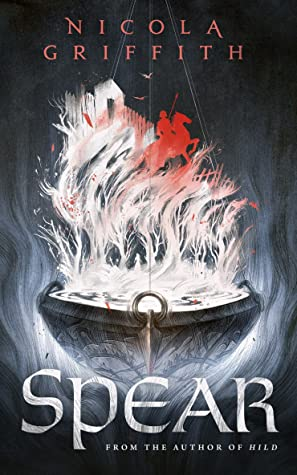
In the afterword to Nicola Griffith’s new novella, Spear, she runs down the lists of source material and permutations around the Legend of King Arthur and the Knights of the Round Table. Or, more precisely, those around Percival, who in many tellings is the more important figure. The king is all very fine, of course, but it was Percival who found the Grail. In some versions, it is Percival who returns Excalibur to the Lake. In still others…

The point being that such stories, myths and legends, are all repurposed tales that meet multiple needs and adapt to the times in which they are (re)told. Tracing them to a single point of origin is not only virtually impossible, but is irrelevant. The purpose of myth is reification.

Among others. But on that point, reification is always tied to the present. Which lends myth its ever-ancient timelessness and relevance.

Which is always one of the fascinating things about it, that timeless-timely utility.

It’s also what makes a good retelling immediately exciting and accessible.

Most (if not all) myths begin in some version of “A hero will be born.” The story then is “from where” “to whom” and “then what?” Perseus is emblematic, and possibly the most visible in significance. The Greeks may not have begun the genre, but they certainly perfected it, and for a long time pretty much owned it. All the Great Heroes of the Aegean and Adriatic region have remarkable beginnings. Often a cave is involved. Some education in the wilderness. Then the confrontation that defines their purpose. They are, essentially, Of Nature, since everything about them is from Outside, “inside” being more or less whatever passed for civilization. (For our purposes, the primal exemplar of this outsider could be Enkidu from the Gilgamesh story.)

The utility of myth cycles is in their adaptability. Repurposing a story to reveal, reify, revise, or otherwise reestablish the scope of meaning is what gives them power across time. The nature of the actors can change, roles might be swapped around, identities modified or even completely recast.

And in some instances, the central hero is changed. Focus moves from one to another, giving us a shift in perspective, a realignment. Something new, something not considered before. And yet, the story remains essentially the same, at least in regards to the events and the goals.

The Arthurian cycle is endlessly adaptable this way. Who is the hero? Arthur? Merlin? Lancelot? Guinevere?

Percival?

All of them, depending on which example you look at, fit the role of Outsider. But the one that is most ideally crafted for that part is Percival.

In Spear, Nicola Griffith gives us a Percival who is perfectly outside. In this iteration, she is Peretur, of “mixed” parentage, raised in the essential cave, schooled by a wise adept, nurtured to become the hero the world needs.

She comes of age, chooses a path, and sets forth from the hidden place of her childhood to journey to Arturus’s court at Caer Leon to join the circle of Companions to the king. She decides, chooses, does battle, grows confident…

This is a hero to cheer for. Her first victory is in learning her true name. Her next is establishing for herself what she is. And then making a place for herself in the world. A place of her choosing.

Quest is also a major element of most myths. Going, struggling to find, fulfilling vows, remaking the world along the way. In this new retelling of this story, there is a quest, though it is not what most of the participants believe it to be. In this way, Griffith shows how the defining character of the goal is not a specific thing but a fulfillment of purpose, and grail at the end is self-knowledge.

Spear is a marvelous reworking of the Arthurian tale. The components are given different origins, different explanations, the settings are deftly placed in what we know of the “real” world, and the nature of what may have been the place and people from which the cycle emerged are treated with the kind of demythologizing care of the historian. There is a texture to this, a fabric of authenticity that gives entree to the world. In the end, such reassessments only add to the power and charm of the story. In so doing, Griffith offers us a variation that reifies overlooked or hidden aspects of what makes the legend important. For us.

Along the way, she gives us a damn good adventure.

In the afterword, there is a tantalizing discussion of sources, variations, and a brief history of the cycles over time. It establishes the long practice of repurposing of which Spear is only the newest example. Which is all well and good, but the best thing about this one is that is opens the possibilities of the story to offer meaning to a wider audience. It is not a tale aimed at Just These People, but for many more not usually considered. Griffith discusses that as well.

Spear is a successful recasting. Even the nature of the Quest at the heart of centuries of Grail stories is given a new raison detre, bringing is from the cosmic to the personal in a touching reveal utterly consistent with Griffith’s purposes and the traditions of the story cycle.

All this aside, it is first and foremost a thoroughly delightful and satisfying work.

Science Fiction, Fantasy, and the Pursuit of Taxonomy

There are some discussions about literary forms which are of use primarily to the academic, the author, and the dedicated taxonimist obsessed with lists and categories and the minutiae that separate one column from another. For the average reader—including deep readers, serious in their immersions into literature—most of this is beside the point, sometimes just a distraction, and occasionally a serious annoyance. Most simply do not care “what” something is—where it slots in on any spreadsheet of literary types—as long as the book at hand works and provides the pleasures they seek.

For the former group, though, these things can matter quite a lot. Tracing the lineage of a form or where a given writer drew inspiration or the cross-referencing of varied texts is a species of archaeology that can enrich understandings of the evolution of literature. Movements, iconoclasts, even the politics of certain writers and groups of writers, the impact specific works have had on whole fields…all this is both real and fascinating for a particular area of study. It should be there for those inclined to ask the kinds of questions addressed. For the writer, such distinctions are relevant for a variety of reasons, starting with the kind of work to be done and how to do it and going on to considerations of market and further to the sorts of broad conversations engaged across published texts. Knowing the deep roots of what one writes can solve problems, make the work itself richer, and give direction to later work.

As for the taxonomist…this kind of thing is part and parcel of bibliographic study. As our archives grow, this becomes more important, lest things are lost. Or misunderstood.

But as I say, for the general reader, all that matters is that the book provides what it has promised. In the main, the obligation of the writer is to provide entertainment, an experience that satisfies whatever requirements the reader may seek to fulfill. As far as the reader is concerned, as long as what is found on the page serves that goal, what goes into creating that page is irrelevant. And like a good magic act, it should not intrude. Granted, there are some readers who enjoy deciphering texts to see how they work, those who feel good about being able to perceive the scaffolding, trace the connections, and catch all the well-incorporated quotes, references, sources, and links. (And too many lit classes based on the assumption that this is the important part of reading.)

Achieving that seemingly effortless immersion, though, is far from simple and work well done requires a knowledge of those behind-the-scenes apparatuses. The architect has to know the skeleton of the building that supports the surface that everyone then sees and uses.

There is interest for the lay reader as well. Not all readers are disinterested. The how of things has an appeal. But for the most part, understanding how something works and what it is intended to accomplish and the way it achieves its goals is primarily in service to the ongoing endeavor to continue to create works that do certain things.

So let me state up front that distinctions between forms and what makes them distinct will make no difference in the case of a given work if people enjoy it. Regarding this current essay, what makes science fiction science fiction will matter little to readers who are loving what they are reading. The ride is all. The play of ideas, the novelty of landscape, the exoticism of the distortions within the story that produce a pleasurable experience are all that count. If you have no interest in how the centipede walks, this is perhaps not worth your time.

As well, most of us have been tortured by lit classes in which the examination, over-directed and flensed of the joy a given text is intended to supply, becomes a kind of reductio ad absurdum in the hands of amateur taxonomists who seem to think the only value to be found in a story is its derivation from and relationship to deep-rooted myths and symbolic board-gaming. “What do you think the author intended/meant by this?” Such questions are certainly valid. I do not suggest they have no place in the creation and reception of a story, only that they are questions that form anchors between the actual creation of the work and, at the other end, the analysis of such creations by those fascinated in all the inner structures that make it a culturally-relevant artifact. For those between the anchors, the resonance of an insider’s familiarity can add a special frisson to the experience, but if the work is done well it is the least important quality.

To be done well, though, would seem to require at least a passing familiarity with those structures. When watching a magician work, the point is to be fascinated and entertained by the effect. Knowing how a trick is done may add an extra layer, but the fact remains that for the purposes of the performance, only the magician needs to know. For it to work well, the magician needs to not only know but fully understand what all that backstage apparatus does. The degree of such understanding can determine the quality of the performance.

So we come to this question of, essentially, genre distinctions. Few other forms seem to have such spill-over for the audience as does science fiction and fantasy. (In music, I can think of debates over distinctions, or at least points of departure—is rock’n’roll blues or was there a split at some point allowing them to be distinct modes? Broadway musicals and opera share certain commonalities, but they are not the same things. Is Ragtime jazz? Valid questions, all of which can be dismissed in the face of “I don’t care, I like it.” But for the creators, such distinctions are much more relevant.)

My own sentiment is that science fiction and fantasy are distinct. There’s overlap of form, motif, and occasionally aesthetic effect, but functionally they are concerned with different things. That it took a good part of the 20th Century to sort this all out, with a great deal of hybrid work being produced that tended to confuse the two (science fantasy? Really? I know what it’s supposed to me, but personally the concept, if not specific works, offends me) but by now, with the actual manifestation of the worlds being proposed in so much of that literature providing ample real world bases by which to assess the function of the two forms, it should be clear that the science fiction discourse has followed a different path than fantasy. At the end of the day, they are not different versions of the same thing.

This is often obscured by examples of the actual work.

My working assumption of science fiction (hereafter simply SF) is that, first and foremost, it is what I call epistemological fiction. This is what grounds it in science. The accuracy of the science in a given story, while certainly desirable, is not critical. Rather, it is the philosophical framework that science comes out of that matters.

The philosophy of science, according to the Oxford Guide to Philosophy, “can be divided into two broad areas: the epistemology of science and the metaphysics of science. The epistemology of science discusses the justifications and objectivity of scientific knowledge. The metaphysics of science discusses philosophically puzzling aspects of the reality uncovered by science.” SF has, generally speaking, indulged the metaphysical aspect for effect, but structurally, as essentially problem-solving fiction, it is the epistemology that has provided the framework. It is the struggle of character to come to terms with a reality understood or amendable to understanding by the tools and criteria of science that underlies the SF endeavor. Characters seeking justifications—explanations—for the problems set for them by the world they move through drive the thematic and plot concerns of SF. The assumption that the world, in such instances, is in fact knowable, manipulable, and therefore “real” in the sense understood by science gives SF the unique effect readers seek.

The broadest distinction that can be made, therefore, from fantasy is simple: fantasy is not at all concerned with such understanding.

No one cares how Gandalf taps into whatever powers he may wield. No one cares how the rings of power work or how Sauron survived death. No one, frankly, cares why that tree blossomed just because a particular man allowed himself to be crowned king. (This is straight out of Arthurian myth, that the health of the country is dependent on the health of the king. Again, no one cares how that mechanism functions.) No one cares about the material justifications of the fantasy milieu because that is not the concern of such stories. Fantasy has other interests.

It is legitimate to ask why such understanding is even important, important enough to draw such broad distinctions between the two genres.

One of the principle benefits of fiction is its utility in permitting the empathetic connection with other lives through vicarious immersion—in character, in landscape, in intellectual and emotional play through alternate scenarios. The mental and emotional scope of the fictive experience allows for a kind of acclimation to situations and intimate experiences with people we will never otherwise encounter.

Until, sometimes, we do.

This is, of course, a byproduct of the primary utility of fiction, which is to entertain. The degree to which one is entertained, however, depends on an ability to empathize and subsume our self into the fictive experience, and this ability increases with exposure. And with that increase, the byproduct becomes more and more central—not by displacing the primary function but by merging with it, so that such increase becomes one with our apprehension of “entertainment.” (Which is why we become bored, over time, with work that once fascinated and delighted when we grow out of it.) At some point we enter a realm of discernment in which the critical understanding of those underlying structures may become important to our pleasure in a given text. At such points certain forms may fade in interest while others become more important, providing the sought-after effects. Distinctions come into play in new and significant ways.

Realizing this may prompt one to ask why.

For the purposes of this essay, the question clarified for me over repeated encounters with the proposition that SF and Fantasy are the same thing. Except in the most superficial ways, they are not, and their differences have to do with the nature of the aforementioned concerns over epistemology. That both forms may utilize the same archetypes from time to time does not alter the fact that those archetypes are used differently because they are based on different assumptions regarding their place in their primary milieus. (Correlation is not Causation.) For one example, the Scientist (as archetype) is not the same as the Wizard (as another archetype). While they are often apprehended as variations of the same thing, their grounding in very different philosophical assumptions could not be more foreign to each other. The world that finds the Scientist plausible, useful, and affective is not the same world in which the Wizard is an essential icon. The Scientist is the lens through which the world may be brought into focus; the Wizard is the conduit of raw power by which the world is maintained. The Scientist is representative of potential change, progress, and understanding; the Wizard is representative of stasis and the infantilization of entire civilizations that are not permitted to evolve beyond him. The Scientist represents expanding knowledge and the capacity to live with it because she understands that knowledge is infinite and nonexclusive; the Wizard perceives knowledge as a finite resource that must be preserved, tended, and kept out of the hands of those not fated to understand it (as he is). The Scientist is a liberator (knowledge wants to be free); the Wizard is a custodian (there are some things man is not meant to know).

We could go on. Both deal with arcana, but the Scientist sees it as part of her work to demystify, while the Wizard seeks a “worthy” apprentice who can be trusted to guard the secret wisdom. I simplify, of course, because both archetypes, to be useful in fiction, must still be human, and humans are polymorphous. My point, though, is that our starting assumptions determine deployment.

(The Wizard generally has no place in our world other than as a point of chaos which must be dealt with. Interestingly, one could put a Scientist in the Wizard’s world to completely different effect, but in both instances, the Wizard would lose relevance.)

Inasmuch as some critics argue that SF is Fantasy (or, less frequently, that Fantasy is SF), it seems the point of departure concerns myths and those aforementioned archetypes.

The archetype in SF is primarily the Scientist, a form nascent throughout history but not truly realized until the 18th Century, and certainly not much featured in our major stories even then. Certainly there is Daedalus and in very rough outline Odysseus is a kind of scientist. A handful scattered here and there, but usually cast in warnings to Not Go There. Faust is the last of the great warnings against science, or at least the “dabbling in things best left alone” motif of science. The difficulty is that for a good deal of that time science was conflated with magic by way of alchemy and as such confined to the secret society mode wherein knowledge was not to be shared and used only at great peril. This aspect attached to the first genuine scientist to be depicted in a major work of fiction, Frankenstein, even as most other elements involved in the story are recognizably material science. It took the rest of the 19th Century for the Scientist to emerge unfettered as a positive archetype and with the 20th Century took his/her place as one of the dominant archetypes of our evolving cultural mythos.

However, with the spread of science and its apprehension as a communal endeavor, one which benefited from greater and greater general participation, the whole embodied mythos began to split off from what had been the dominant form of cultural mythic reservoirs. Science, at base, is democratic.

When I claim that the Scientist is the central archetype in SF, I do not mean that a Ph.D. lab-coated grandee working in a study on arcane problems is the model. I am saying the Scientist as a very human mode of a particular kind of exploration and understanding of the world. A three-year-old playing with blocks is being a scientist. In SF, any character that progresses through a story with the basic assumption that the universe can be understood through the power of intellectual examination is being a scientist, be that character a soldier, a merchant, a pilot, or any of the myriad other forms present in SF (and in most other literature).

Of course other archetypes are present in SF, but more and more they must conform to the presence of the Scientist.

What gave birth to this, as in much else in the modern world, was the Enlightenment. In essence, the Enlightenment declared tradition a quaint holdover from eras wherein most people lived as if nothing would ever change. The components of transformational progress had been assembling for a long time. With the Enlightenment they had reached sufficient complexity, valence, and momentum to dispel the general assumptions of the past and send civilization forward on the wavefront of fundamental discovery that proved far more than mere novelty.

Which gives us the cultural assumption on which SF is based—change is the only constant.

But with change comes a multitude of problematic consequences which have resulted in a world in continual churn in ways it had never experienced before. In both scale and sentiment, what followed the Enlightenment was unprecedented. While change had always attended the ruling precincts throughout history, rarely had it affected the general population in so fundamental a way. (If there is an American story that records this sense of displacement among the general population perfectly, it would be Washington Irving’s Rip Van Winkle, one of the first stories of note to exemplify cognitive dissonance, which would become another primary ingredient of SF.)

The reaction to the Enlightenment—the Romantic Movement—gave credibility to the subsequent disdain for the kind of materialist focus which informed science. One can see it as the social oyster bed of modern Fantasy. It privileged the raw, unstructured encounter of the soul with nature, rebelling against intellectualism that demanded analysis and understanding of underlying principles in favor of a kind of naked immersion in reifying sensation. Wagner would eventually epitomize the primary focus of such sentiments, with the heavy reliance on myth and the idealized past, which would by mid-20th Century become the core aesthetic motif of Fantasy. (Even a work like C.S. Lewis’s Space Trilogy shows the continuum from SF to Fantasy book by book. While Out of the Silent Planet is largely if not wholly SF, by the time we arrive at That Hideous Strength we are wholly in the Fantasy mode, complete with a modern resurrection of Camelot in the form of Ransom-as-Arthur.)

Lewis’s work provides an example of one of the chief distinctions separating SF from Fantasy, one seldom remarked. In the final volume of his Space Trilogy, it becomes clear that this is a work thoroughly anti-bureaucratic. Not anti-bureaucratic in the specific, as in a critique and comparison of bureaucratic examples, but as an ideology opposed to bureaucracy in total.

(Certainly there are SF stories in which bureaucracy is cast as a Bad Thing, an enemy, and the hero’s quest is to block or destroy it, but for the most part even the hero in an SF story cannot function without benefit of the bureaucratic support structure that would have provided all the tools necessary for the hero to know how to fight a bureaucracy, and in the end a different bureaucracy arises, one which presumably works better.)

I have noted in the past that another, though dubious, distinction between Fantasy and SF is in the fact that when asked to name a primary text that more or less encompasses the genre, no such text seems to exist for SF, but there is one for Fantasy. I stipulate that other, older examples may serve as well if not better, but I suggest that The Lord of the Rings serves as a primary exemplar for Fantasy. In its epic sweep it gathered together and subsumed so much previous work and cast a shadow that reaches even to the present. Works are written either accepting this as the principle mode or in opposition to it, but this would appear to be the hallmark. No such work can be found in SF because it is not and has never been reducible to such a mode.

But the purposes of comparison, let us take as an example of SF Isaac Asimov’s Foundation Trilogy. I use that one for the expedient reason that both these works were on the same nomination ballet for Best Series in 1966, the only time till recently a Hugo Award was given for series. We can assume that at the time the nominations were made, an attempt to put forward broadly encompassing examples of what was considered best in SF was being made and Asimov’s was the work chosen. It won that award.

Firstly, the two works are nothing alike, which is to be expected. But the distinguishing features of the two are instructive. Starting with the aforementioned observation that Fantasy is anti-bureaucratic, consider that in LotR, it is the bureaucracies that are at the center of every calamity. Never mind the principle antagonists, take for example the Steward of Gondor, who is about as hide-bound a bureaucrat as one could want, and of course he has made a mess of things and has to go. Aragorn must take over, but in truth, what kind of preparation has he had for running things? He has spent most of the past several decades avoiding any kind of responsibility of an administrative nature and lived as a Ranger. This is an implicit virtue for him. Gandalf’s “order” is nowhere to be seen other than in the form of Saruman, who turns out to be basically an arms merchant. The elves, who might take some kind of lead in the struggle, have given it all up as a bad idea and are leaving, so whatever management skills they might have are about to be absent. The actual heroes of the tale are from the one place in Middle Earth that apparently has no government at all. This, in the great prose and sweep of the book, is put forward to be enough for everything to work fine in the aftermath of the war against Sauron, who is clearly a rather masterful politician (the rings he talked everyone into accepting, the alliances presumably built, etc) and administrator. Granted, he is loosely modeled on Hitler and his aggression reflective of Nazi Germany, which was seen then as the chief example of bureaucratic and technological overreach. At the end, there is only Aragorn, with no hint of an administrative machine. Quite intentionally, as the suggestion running throughout is the ability of peoples to manage themselves without such things.

Move to the Foundation stories and there is no instance in which bureaucracy is not only present but essential, and no one is arguing otherwise. The conflicts are over how things are to be administered, not whether or not they should be. The Empire, the Foundation, and the Second Foundation are each other variations on bureaucratic systems shown throughout the stories to be necessary to civilization. The crisis at the heart of the cycle is the collapse of the Empire, which leaves chaos in its wake. The solution is the expansion of the Foundation, which asserts new and more appropriate forms of administration. And the hidden Second Foundation, a collective of mathematicians, is concerned with the overall administration of the collapse-recovery. The one character that might be construed as anti-bureaucratic is the Mule, who has a singular gift and is shown ultimately as a incapable—a monarch against a collective.

Other significant features distinguishing the forms: The Scientist and the Wizard are completely on display for comparison—Hari Seldon and Gandalf. Seldon works with knowledge that, while difficult, requires no special powers to use, and which is open to all. Gandalf is a member of an arcane order of specially empowered custodians of knowledge kept secret. Gandalf recruits others to work with him, but does not (cannot) share his power, while Seldon recruits otherwise ordinary people to use what he freely offers. Seldon works within a system, Gandalf is above systems (or outside, which functionally within the story is the same thing). The universes depicted are quite different, based on distinct assumptions. There is no one achievement that solves the problems in the Foundation, but a series of adroit adaptations and situational responses collectively leading to less chaos, while in Middle Earth everything depends on Aragorn accepting his place as king (the flowering of the tree symbolizes exactly this) and the destruction of an artifact the purpose of which is to empower the ultimate in evil bureaucracy.

As noted, however, Foundation, while displaying the conditions and requirements of a science fiction work, is not in any way The Exemplary Text, but is only one example of myriad. This is because SF is not concerned with the kind of mythic reification which informs most Fantasy. SF has little use for myth, seeing it usually as a set of prejudices which require examination and, frankly, constraint. SF, as one aspect of the “science” intrinsic to the form, is constructed for the purpose of analyzing and understanding the world, rather than imposing preconceptions designed to validate illusions of destiny. Middle Earth only “works” when all the destiny-driven elements are in their proper place. If they fall out of harmony, things enter an entropic slide. In SF, there is no such condition of harmony.

I take it as stipulated that there are exceptions on both sides of the divide, but they are usually curiously clunky things the chief effect of which is a kind of off-balanced drunkard’s walk that is often accidentally appealing. I mentioned cognitive dissonance in relation to Washington Irving’s Rip Van Winkle, which I regard as a prototypical Fantasy of the kind that recognizes the divide. In the story, Rip, harried by his wife, picks up his rifle to go hunting, encounters what are clearly elves (fairies, leprechauns, “little people”) who invite him to a game of Nine Pins. He is drawn into their party, he drinks too much, and falls asleep, to awaken 20 years later and find the world has changed. The place where he had slept is a kind of bubble attached to the “real” world wherein the rules of time are different. This is a Fantasy realm. As depicted, though, it is apart from and not of “this” world. It is not, in the story, somewhere Rip can return. Fast forward to the novel Little, Big by John Crowley and we see the same idea of an adjunct universe wherein the fading world of Faerie can be found, a bubble universe that keeps shrinking as the modern world encroaches. (Crowley has addressed the transition from the Old World of magic and alchemy to the New World of science and technology often, most especially in his excellent Aegypt Cycle.) The overlap between the two realms is inconsistent, fading, and clearly definitive. In a sense, such stories are a recognition of the changes that followed in the wake of the Enlightenment, and as such are profoundly nostalgic. (Nostalgia imbues subtext in much Fantasy; what else are the Gray Havens but a dream of nostalgia?)

I have taken time to delineate the differences between SF and Fantasy in response to what have become cyclic attempts to define them as somehow the Same Thing. On the surface, and by the most facile of definitional characteristics, they seem to share a great deal and therefore may appear essentially the same. But essentially, in their constructions and presumptions and primary concerns, they are not. They operate differently because their assumptions about the world are apposite—the world as a material realm as well as the structures humans build to operate in the world.

What distinguishes SF from other forms is the way in which the conceits of the setting—the world, if you will—necessitate an examination in order to fully enter into the fictive experience. The differences in that world set it apart from our own in specific ways, ways which permit a distinct reading experience. The way in which this is done sets up an expectation that everything encountered is accessible with the proper tools. In some cases, it is the world we believe we are moving into from the present. In other cases it is a world we might have inhabited given certain alternate choices in our past. But in either case it is a world comprehensible as a habitable place possible by virtue of the mechanisms derived from the philosophical stance called Science. Science itself does not have to be visible on the page, nor does it necessarily have to be science as we presently know it. It only has to be framed in such a way as to validate our present understanding of the universe available to us derived from the practice called Science.

Which brings us back to my initial criteria: SF is epistemological fiction. The narrative power is in the character’s encounter with that new world.

And what about myth? Fantasy is derived from our conception of myth as ur-story, a fundamental narrative that runs through everything. It takes as given that myth is wired into existence as experienced by sapient beings—us—and represents a reservoir of validation and reification that, properly encountered, gives us our identity. While the narrative frames of myth are powerful and SF can certainly utilize them for effect, myth in SF is simply another part of the world that is to be examined and understood. SF, like science, is not concerned with repeating the dictates of a distant shaping force—that is where notions of Destiny and Fate come from—but in putting them on the workbench and taking them apart to see how (and if) they work. (The first step in freeing ourselves from the expectations of unquestioned tradition.) The universe in which such forces are accepted as real outside social structures is not the universe of science or SF. In that way, SF is not about finding new myths for a modern age, but about constantly reevaluating the age and aggressively keeping our options open.

Which is why there is not and probably cannot be a primary SF text. Reassessment like that does not permit things to “settle” into the kind of stasis where one set of meanings above all others can emerge. SF, therefore, is an assertively destabilizing practice. Unlike Fantasy which constantly seeks equilibrium and, ideally, stasis. (Whether this is achieved is unimportant, only that this is the goal.)

Therefore, Science Fiction and Fantasy are distinct practices which overlap in certain aesthetic effects but in the end seek different literary goals and offer, for the careful reader, distinct pleasures.
Strange New Worlds

Fifty-five years ago a television show appeared that changed everything.

it didn’t seem like it at the time. It was clumsy, but for the time it was a marvel of production values. The scripts were occasionally tortured constructs, the characters stiff, the plots absurd. It lasted three seasons, got canceled, and drifted into the twilight zone of fondly-remembered might-have-beens.

Then fandom took over, kept it alive, and eventually it was revived. Not in the way of retreads, as those we see today—reboots that quite often, though with better production values, are not exactly new—but in a resumption. We’ve gotten used to some of this today, what with franchise switching from one network to another, evading cancellation. We’ve even gotten used to quality reboots.

But Star Trek was the first to do all this successfully, in several incarnations.

I recently finished viewing the third season of Star Trek: Discovery and then began a rewatch of the original series. It has become the thing to do to make fun—usually mild fun—of the original, especially Shatner’s over-acting, but also the inconsistency of the universe, the poor special effects, all the flaws that pretty much any television show back then suffered from. And yes, compared to now, the show lacks. But there is a remarkable familial consistency between them. In 1966 Gene Roddenberry helmed a work of fiction that came to exist well outside the confines of the screen. Most of the fare of the day only ever existed during its broadcast window and inside the square of the picture tube. The Federation, in other words, was real.

We’re used to this in written fiction—novels and short stories. World-building that offers the heft and texture of a real place is expected. Television was not like that. The ephemeral nature of the product may have contributed to the attitude that only so much work need be done to make what ended up on the screen serve for a half-hour or hour of viewing. Cancellation was right around the corner. Even those shows with unusual longevity usually relied on the viewers to fill in whatever extended aspects were needed. The Old West was a mythical place most people already believed in. Crime shows only needed the daily news to lend that kind of weight to the stories.

In science fiction is was unprecedented on television. Star Trek offered the kind of substantive world that readers of science fiction had encountered for decades. Despite the awkwardness of some of the episodes, that was the thing that drew many of us. Almost from the first episode, we tuned in to a place different from our world that felt almost as real.

It was a remarkable achievement, one that made possible the best of SF tv that came after. The lesson was hard-learned and it took a few decades, but it was the important element.

As to the rest…Kirk, Spock, and McCoy, the Enterprise, Starfleet—none that would have made any lasting impact without that world.

And about them. They reflected other trios of characters in other shows, most notably (to me, at least, others may have different examples) the principals in Gunsmoke. Matt Dillon, Festus, and Doc. And when you watch, really watch, the acting was superb. It had to be. They were required to convey “belonging” in a world quite alien to ours. Their actions had to seem natural for that context. They had to speak dialogue that would make no sense anywhere else. When McCoy waxes empathetic about the past barbarities of medicine, it conveys several things at once, about the future of medicine, about the sentiment attached to his profession, about the history that has elapsed within the show’s reference between then and now, hence providing actual historical context, not to mention McCoy’s heart and his attitude.

Even Shatner’s performances are less bombastic than the jokes would seem to suggest. The byplay between Kirk and Spock is rather remarkable.

And Nimoy…

One felt it possible to step through the screen and live there, because there would be a There to live in.

Once the franchise was revived, first in the films and then in a new series (Next Generation), the extent of that creation began to manifest more clearly. For 55 years now we have been exploring the Strange New Worlds of that universe. That each new series manages to be as impressive as they are, it becomes even clearer that Star Trek has become a dialogue generator. I mean in the philosophical sense. It puts questions to us that need answers—not for then, not for the 23rd or 24th Centuries, but for Now. The philosophical challenges of the franchise have brought about a massively useful conversation. At the center of it is, perhaps, a simple question that may seem minor: what does it mean to be human? Yes, this is a core question in most if not all drama, but in the case of science fiction it takes on added weight because we find actual representations of different possibilities of Human. And in Star Trek we have a popular forum for that question, asked in that way, in a medium that reaches a much larger audience.

What we learn is that Human has no single, concrete definition—but whatever it is, it seems to be realer than anything else.

Exploring that question…well, that’s the real Five Year Mission, isn’t it? Therein we find the strange new worlds.

Clearly, it has not been, nor cannot be, limited to just five years.

Cinema Versus ‘Theme Parks’

“I don’t see them. I tried, you know? But that’s not cinema.  Honestly, the closest I can think of them, as well made as they are, with actors doing the best they can under the circumstances, is theme parks. It isn’t the cinema of human beings trying to convey emotional, psychological experiences to another human being.”

Martin Scorcese said that in an interview about Marvel superhero movies. The observation has sparked some controversy. A lot of people heard him trashing their favorite form of movie, others—including Francis Ford Coppola—found resonance with his statements.

The part of his statement I disagree with is the part that I hear every time someone from the literary world suggests science fiction is not “real” literature—because it doesn’t deal with humans experiencing authentic emotions in a meaningful context. In its own way, Mr. Scorcese has recast the classic dismissal of science fiction and fantasy in regards to film.

To which I would say, “Care to justify that in terms of cinema as a whole?” It can be argued, I think, that the gangster film on which Scorcese made his reputation is not a milieu about ordinary people having emotional experiences in common with their audience, but about a distinct subset of humanity that distorts itself into an extreme condition to pit itself against the world. Their experience are by definition, at least in cinema, going to be over-the-top, magnified, and at odds with the common. The backgrounds are likewise going to be exaggerated and often surreal, set-pieces to support encounters of violence and passions pared down by adrenaline to caricatures of ordinary daily experience. They “entertain” for precisely those factors that for two hours remove us from our mundane lives and give us entreé into lives we will (hopefully) never take part in. The point of them is to allow a vicarious experience completely out of the ordinary.

They are anchored to us by asking “How would we react in the same circumstances?” and honestly following the thread of answers to what connects these people to us.

But the characters themselves, while often despicable, are extraordinary.

As are the characters of the gunslinger, the private detective, the cop, the soldier, the knight, the barbarian, etc.

It is their extraordinariness that attracts us, holds our attention, and carries us along through unlikely adventures to, one hopes, a satisfying and cathartic conclusion.

How is that any different than what we see in Captain America? Iron Man? Thor?

Oh, they come from the worlds of science and fantasy and wield unusual abilities.

So, once again, because they appear to us in the context of science fictional settings and offer challenges outside historical experience, they are not legitimate cinema…

To an extent, Scorcese has a point. They do offer “theme park” rides. It takes a rather extraordinary film like Winter Soldier or, stepping to a different franchise, Wonder Woman to see the genuine human story beneath the glossy, glitzy, hyper-realized settings, but it’s there. And for those films that fail to deliver that human element, well, it’s not that they aren’t cinema, they’re just bad cinema.

But “cinema” has always indulged the exotic, the novel, the visually unique to achieve what may be argued to be its primary advantage as a medium. The full embrace of the exotic cannot be used to reclassify certain films as “not cinema” because they utilize exactly that potential.

No, this is another version of reaction to a genre distinction because you don’t get it.  It’s the reason several excellent SF films failed to find notice with the Academy for years because they were that “spacey kid stuff.” Now good SF is finally being recognized by the Academy, leaving the position of poorly-regarded declassé genre in need of a new resident, and in this instance Mssrs Scorcese and Coppola elect the big superhero franchises.

Let’s face it—there have always been superhero films. Dirty Harry is a species of superhero, as is Jason Bourne and James Bond. Chuck Norris and Steven Segal have made their share of superhero films. And when you think about it, just about any Western where the hero faces impossible odds and wins is a superhero film. One could go down the list and find just cause to name any number of historical or quasi-historical epics as members of that club. Robin Hood is a superhero. The Lone Gunman story is a species of superhero film. And these all draw from various mythologies that are readily accessible as superhero stories. Hercules, Cuchulain, Gilgamesh, Samson…

Of course these films are cinema. Just as science fiction is literature.

You just have to speak the language.

The Downside of Expanded Participation?

It occurred to me the other day that there is a serious problem with the way audiences and films interact these days. It’s a relatively new problem, one that has grown up with social media, but it has roots in an older aspect of film production, namely the test screening. The idea being that before a general release, a film is shown to select audiences to gauge reactions and tweak the final cut before it is set free into the zeitgeist.  There’s logic to it, certainly, but I’ve always been uncomfortable with it because it’s an attempt to anticipate what should be an honest reaction to a work of art.  I try to imagine Rembrandt showing a painting to a client halfway or two-thirds finished and, depending on the reaction, going back to change it to conform to some inarticulate quibble on the part of someone who has no idea what should be on the canvas. Art, to a large extent, is a gamble, and test screenings are the equivalent of loading the dice or counting cards.

It’s understandable, of course, because a movie is not a painting done by one person, but a hugely expensive collaborative work with investors and questions of market share. But it still bothers me. (What if a test audience had complained that Bogey didn’t get Bergman at the end of Casablanca and the studio went back to change it to suit?)

Today there’s another phenomenon that is related to test audience but is even more invasively surreal. The pre-assessment by fans ahead of release. Sometimes years ahead.

This obsessive speculation has evolved into a form of semi-creative wheel-spinning that mimics a huge test audience, the key difference being that it is “testing” work not yet done. Fanfic seems to be part of this, but only as a minor, and apparently undervalued aspect. We have a large, active community engaged in predetermining what will, should, ought not, and might happen in forthcoming movies. Large enough and active enough that I believe it has affected how those movies are made, possibly unconsciously. The feedback loop is pernicious. The vindictiveness of the test audience can also be so severe as to impact decisions that have yet to be taken up.

The most visible way this has manifest—and this varies from franchise to franchise—is in the “look” of new films, especially in the effects, but also in the selection of cast, location, and choreography. Whether intentional or not, film makers pump things into next productions in an attempt to meet the expectations of this hypercritical superorganism.

This organism constructs alternate narratives, raises possible plot lines, critiques character development, and then, when the finished product fails on some level, engages in the kind of evisceration that cannot but give the creators pause to rethink, check themselves, question (often pointlessly) every choice made to that time.

I’m not sure this process happens at any conscious level, but it seems to mean the Doc Smith approach to bigger, splashier, louder, stranger films, at least in the Marvel and DC universes, and to a lesser extent the related products like Valerian or any given Bruce Willis vehicle of late, is a response to this incessant viral nattering. The anticipatory critical response must get through and affect the people in the main office.

Television has suffered less of this, it seems, because, at least in terms of story, these series suffer less from the kind of crippling second-guessing the motion pictures display.

Before all this near-instantaneous data back-and-forth, studios produced movies, people may have known they were being made, but little else got out to the general public until the trailers announcing upcoming releases. Based on those, you went or didn’t, and the movie was what it was, and you either liked it or didn’t. We were not treated to weekly box-office reports on news broadcasts. The films, with few exceptions, had a two-week first release run at the front line theaters, then moved down the hierarchy for one or two week engagements at smaller chains until they ended up at a tiny local theater, after which they vanished until popping up on tv at some point. You then went to the next and the next and the next. Choice was addressed by the fact that at any one time there might be a dozen new movies coming to the theaters a month. The film was what the producers made it. It was offered, you saw it, you took your response home, that was it.

A lot of the product was mediocre, but often reliably entertaining, and for the most part was made in a way that studios were not threatened with bankruptcy if they failed.  The really great ones came back from time to time or enjoyed extended runs in the theaters.

Fandom evolved and when the age of the internet dawned and the cable industry grew and the on-demand availability of movies was met by videotapes (later DVDs) and now streaming services, the products remained in front of self-selected audiences all the time.

This has changed the way these films are made. Not altogether to the bad, I hasten to add. I believe we’re passing through a kind of golden age of high quality films and certainly exceptional television.

But the budgets, the tendency to ignore better stories that lack the kind of epic myth-stuff of the major franchises, the endless bickering online and subsequently in conversations everywhere, and now this absurd war on what is, for wont of a better term, SJW content…

I can’t help it. Grow up.  So Doctor Who is a woman. Big deal. The character does not belong to you. Instead of chafing that some reification of idealized masculinity in being threatened, try just going with it and see where it takes you. That’s the whole purpose of storytelling! To be remade by narrative and offered a new view! To be challenged out of your day-to-day baseline assumptions!

Star Wars has been ruined by all the SJW crap! Really?

While I can see that discussion groups and this expanded dialogue can be fun and instructive, I think an unintended consequence has been to grant certain (very loud) people a sense of ownership over what is not theirs. The cacophony of anticipatory disappointment actually has a dampening effect on those of us who would simply like to be surprised and delighted all on our own.  There is utility in silence, purpose in the vacuum, a vacuum to be filled by a new film. Box office is (or can be) detrimentally affected by the chattering carps of disillusioned fan critics who are terrified of James Bond becoming black, of Thor being turned into a woman, of the Doctor showing us how gender prejudice applies in our own lives.

I’ve been disappointed with new manifestations of favorite characters in the past, don’t get me wrong. My response has been to turn to something else. Those characters don’t belong to me, I don’t have a right to expect their creators to do what I think they should, and I recognize that probably a whole lot of people are just fine with a new direction. Otherwise sales figures would push them to change it again. it’s the pettiest of sour grapes to try to preload a rejection in advance of actually seeing the product.

I have no numbers to back up my impression, but I think it worth considering that the “my life will end unless the next movie comes out exactly the way I want it” school of anticipatory criticism is having a distorting effect over time, both on the product and on the ability of audiences to simply encounter something “clean” and take a personal and unmitigated response away from it.

Just a thought.

2018 and Reading Lists

I saw a great many lists in social media this past year. “One Hundred Books to Read Before You Die,” “Only a Genius Has Read 10 of These,” “The Best SF Books Ever.” Clickbait, certainly, but some of them were amusing and even added some titles to my Must Find list.

By and large, such things are amusing at best, rarely instructional, and often mind-numbingly dumb. Especially those derived from on-line polls, where instead  A Book, whole series end up included, and no one is vetting for obvious errors.  (Shakespeare did not write novels.) Not to say lists aren’t useful. One was published—as a real paper book—this year that I find really interesting.  1000 Books To Read Before You Die, by James Mustich. Part of a series of books with the same general idea. What sets this apart is that the books included really are remarkable and the list comes with excellent precis and commentary about why you should read them, plus ancillary articles on the authors and their other work. In other words, this would be a good text to use to create course work for literature. (Before you ask, I’ve read around 250 of them.  There are many I’ve never even heard of. Anyone working their way through this would be very well read by the end.)

All this prompted me to wonder—again—why we read in the first place. Harold Bloom has probably addressed this question as much if not more than anyone else and he warned that we should never presume to read for Self Improvement (at least not in a moral sense) mainly because, I assume, we can point to some rather well-versed monsters who clearly benefited not at all from extensive reading. But then he will argue that self-improvement is one of the chief by-products of deep reading. He sees it as a side-effect, though, because—again, I assume—you have to develop to a certain degree before you can decode what books offer. To me, it’s kind of a chicken-and-egg question because the two go along in lockstep so often.

But self-improvement comes to people who rarely read and others who read widely and extensively and find no lessons or edification in it and in the end I suppose it’s what you read as much as how well you read it.

As a practical note, since this has come to my attention as a Real Thing, no one—no one—should presume to be a writer unless they love reading and do a lot of it. I’ve encountered several people with pretensions to write novels who never read anything. Firstly, what motivates them if they don’t like books? Fame? Money? Secondly, they have no grasp of the mechanics, much less the purpose, of writing a novel. I have seen the attempts. They do not get it. At all. But arrogantly assume it’s no big deal. This wouldn’t be a problem but for the ease of self-publishing. Before you think to commit something to paper (or electrons) find out what it is you’re attempting. Read, lest you inflict on others your vacuous incapacity for empathy, art, meaning….or, I assume, the hard work.

Mr. Bloom aside, I do believe deep, regular, and diverse reading improves. The exposure to ideas alone has an effect. Reading requires that we open parts of ourselves to new understandings. There have been numerous studies to indicate that the capacity for empathy alone is enlarged through engagement with characters not of our own group and being vulnerable to change is certainly an aspect of engagement.

I’ve been reading for as long as I can remember.  Books have simply always been there. I can’t imagine a world without them could possibly be worth living in. If that’s a species of chauvinism, so be it.

2018 was a good year for self-improvement, if any was to be had.

I became acquainted for the first time with MFK Fisher. I’ve known of her for decades, but I don’t read food writing. She was more than that and in the course of researching a novel, I read her Map of Another Town, which is about her time in Provençe in the mid-20th Century. Loving portraits of two towns, one of them Aix-en-Provençe, which was the town I wanted to research. Other than a sense of atmosphere and smidgen of history, it did not give me what I wanted, but perhaps what I needed. She was a fine, fine writer, and I recommend it.

As well, in the same vein, I read Maria Fairweather’s biography of Madame De Staël, which, along with the much older Herrold biography, gave me pretty much all I needed in terms of when and where and with whom.

Memoir is another genre I do not read often, but I found a delightful one.  Daniel Mendelsohn’s An Odyssey. It recounts the author’s year when his father audited his course on Homer’s work. Moving, thorough, with some surprise revelations about Homer as well as the frustrations of paths not chosen.

This was also a year for reading things I should have read decades ago. In this case, That Hideous Strength, by C.S. Lewis. Ostensibly the third volume of his so-called Space Trilogy, which began with Out of the Silent Planet (recommended unreservedly) and continued with Perelandra (cannot recommend). I kept bouncing off this third volume, probably because I’d had such a disappointing experience with the second, but I sat myself down this year and plowed through. I’m glad I did. The book is about the struggle between genuine progress and sham progress and how, because the latter can look so appealing, we hand over our moral capacity to people who have no comprehension of what it means to be humanly caring. There are some marvelous scenes in it, and although I didn’t find the underlying True King stuff to my taste (as with much of Lewis, he tried to make everything about the Return of some pure King ala Christ) it was a fine examination of how we lose things without knowing why.

Others in the vein were all rereads. I reread Roger Zelazny’s Lord of Light, Neal Stephenson’s The Diamond Age, Conan Doyle’s A Study In Scarlet, and Pat Cadigan’a Dirty Work. I do not reread, mainly because I read slowly and I have so much to yet read that taking the time to reread seems…

Well, I’m wrong about that.  I don’t know if it’s going to change, but I read Jo Walton’s An Informal History of the Hugo Awards, which is wonderful, a great trip through a history of science fiction that I recall a good part of as a series of encounters with new books. This really is worth a read, because she not only goes over the books that made the ballot (including the Nebula ballot, when that began) but discusses what else was published at the time that might have made the lists instead. It’s surprising and informative and a pleasure, but the talk about how many times she and others reread a given book made me squirm rather self-consciously.

But this reading out loud thing we’ve embarked on has been a joy. We have indulged primarily in Kerry Greenwood’s Miss Fisher Murder Mysteries series and have dramatized our way through all but two of them now. They are fun, a bit daring, well-researched, and easy to read aloud—unless you’re trying to do the accents properly, which is impossible but I try. Set in Australia in the 1920s, Miss Phryne Fisher is a very modern woman with a knack for solving crimes. We saw the tv series first, which is a delight of adaptation.

One set of books I wish we had done this way is Martha Wells’ Murderbot series, published in four brief volumes by Tor.com. They are told from the viewpoint of a security robot/cyborg who/that has hacked its own governor module. It is independent, can make its own decisions. What does it do? Downloads entertainment media to watch. Of course, it gets drawn into protecting a group of humans which leads into investigating corporate malfeasance which leads into more nasty stuff, which is all an annoying distraction from its programs. These are terrific and I was sorry to put the last one down.

In my humble opinion we are possibly in the midst of a new vitality in science fiction. I’m seeing fantasy writers suddenly turning out SF—and very good SF—a reverse of the situation for the last few decades.  Mary Robinette Kowal’s Lady Astronaut novels, The Calculating Stars and The Fated Sky are excellent. Good SF, a great central character, an alternate history scenario that makes perfect sense, and done with rigor and humor to leaven the grim main storyline.

My friend Daryl Gregory published Spoonbenders last year and I can’t recommend it enough for anyone looking for the indefinable. I’ve been telling people that it’s a combination of the X-Files and The Sting. Daryl writes humor with the best of them, which can be especially effective nestled within a serious plot.

Other speculative fiction delights:  Six Wakes by Mur Lafferty (one of the better locked-room mysteries, nested within a fascinating SFnal conceit); The Fifth Season, N.K. Jemisin’s tour-de-force which kicked off a few years of drama within the SF/F community; The Strange Bird by Jeff Vandermeer; Binti, by Nnedi Okorafor; and the short but affecting Time Was by Ian McDonald.

One of the best SF novels I had the immense pleasure of reading was John Kessel’s The Moon and the Other, which is an examination of utopic constructs. Set on the moon, it follows the vicissitudes of a feminist enclave vying for independence on a believably fraught luna colonized by a number of competing systems. The social and personal dynamics are complex and delicately portrayed. I thought it one of the finest novels of its kind I’ve ever read.

Not science fiction per se but inescapably SFnal was Alec Nevala-Lee’s excellent biography of John W. Campbell Jr. Astounding. For anyone wishing to understand the formative years of this thing called science fiction (and here I mean what we mean when we point at something—say, Star Trek or Arrival—and say the words, not the academically problematic ur texts that might establish prior examples and possible launch points), this is a must-read. Many myths and legends surround this man, this magazine, these writers, and Nevala-Lee does a surpassing fine job of revealing the facts and placing all these people in context.

I also read, for the first time, Malka Older’s Infomocracy.  I will read the rest of the trilogy based on this novel, which is a page-turning political exegesis on alternative democratic systems and their possible pitfalls.

Finally, Charlie Jane Ander’s forthcoming The City In The Middle of the Night. Excellent. It releases in February.  This is a major novel by a major talent. I’ll do a fuller review later.

A smattering of other SF works:

Netherspace by Lane & Foster; The Sky Is Yours by Chandler Klang Smith; Tomorrow by Damian Dibben; The City of Lost Fortunes by Bryan Camp; The Million by Karl Schroeder; Avengers of the Moon by Allen Steele; Noumenon by Marina Lostetter.  All recommended.

I read Charles C. Mann’s Wizard and Prophet, which is a science biography of Norman Borlaug and William Vogt, the two men who pretty much defined the conflict between two schools of thought about environment and sustainability in the 20th Century. Borlaug was the developer of super grains, applying technological approaches to increased yields to feed more people, while Vogt was an ardent believer in austerity and cutting back and reducing populations. What might have been achieved had these two men somehow found it possible to work together we will never know. Vogt identified Borlaug as an enemy almost from the minute they met and history has been as it is.

Stephen Pinker’s Enlightenment Now is a weighty argument on behalf of the Enlightenment as a foundation for going forward. It is a hopeful book, anodyne for the fraught political times in which we live, if a bit more optimistic than might be creditable. Set it against Tim Marshall’s Prisoners of Geography and realities balance the optimism.

I’m finding a forceful new set of voices in support of scientific rationalism and a concern over facts muscling its way back onto the main stage of public discourse. We have labored in a soup of vacuous postmodern hand-waving for the last four decades so that now the very moral relativism decried by the Right as liberal softheadedness is now used by the Right to claim victory against Reason and Progress. Perhaps this move from fantasy back to science fiction is an indicator that people are growing tired of mystical pabulum and want something concrete to hold onto.

Maybe.

In any case,  these are some of the books that caught my attention this year. We’ll see what 2019 brings.