Year in review

I read 94 books in 2024. 

Not what I was shooting for, but not by any means unsatisfying. Upon retirement, I imagined myself spending at least two or three hours a day poring over all the books and devouring the things I’ve always intended to.

Well. That didn’t happen.

But as things get more settled, I might exceed my goal of 100 a year. (The highest number I ever reached was my senior year of high school. I had taken a speed reading course the year before, I was cruising through texts at an average of 2000 words a minute, and I cut class most of my senior year. I spent most of those days at the local library—seriously—and got to where I was doing a book a day. I plowed through many of the so-called classics that way and I might have read 300 books that year. Now, I can’t read that fast anymore and I’m much happier for it, because what I read at the more modest pace of maybe 150 to 200 words a minute means more, has more impact, and stays in my memory. Lately I’ve been revisiting some of those classics I read back then and it’s like reading them for the first time. I remember I read them, but not much else, with a few exceptions.) That would be a respectable number, I think. 

I did a lot of filling in this past year. Books I’ve owned for decades and never got around to, some works of SF that are important if not seminal works that I simply passed up. To that end, I read several of the original Ace Specials, edited in the late 60s-early 70s by Terry Carr. While a couple of them did not quite pass the test of time, I was pleasantly surprised by the D.G.Compton’s—Chronocules, Steel Crocodile, The Silent Multitude, and Synthajoy. I found them very mature works, dealing with human interaction in ways much more sophisticated than a lot of popular SF at the time, with premises that, while certainly science fictional, did not dazzle with hi-tech glitz, but supplied a satisfying substrate for the real action, which is how we treat each other. Compton, I believe, holds the record for the most titles published in the Ace Special line. As well, I read a couple of Bob Shaw’s, a writer who has unfortunately been largely forgotten today. The Two-Timers and The Palace of Eternity are sophisticated stories of seemingly minor shifts in the given tapestry of our lives with outsized effects. 

I also filled a couple of Michael Moorcock gaps with The Ice Schooner, The Black Corridor, The Distant Stars, and The Warlord of the Air. Moorcock can be uneven, but he possesses a singular approach to science fiction that, when effective, elevates his work to a remarkable degree. 

I also tackled a lot of Robert Silverberg. There is a lot of Silverberg. He is one of the most prolific writers, in any genre, and he crossed genres significantly. In his early career, he wrote a great deal of popular SF, potboilers really, and some of it has not aged well. When Silverberg is firing on all cylinders, he can be brilliant. But the volume of work…well, not all of it rose to such vaunted heights, and we shouldn’t expect it to. But in some ways, work which was once seen as cutting-edge and groundbreaking, especially socially, has worn poorly. But among those I read this year that I think remain remarkable I would put Downward To The Earth. It’s a riff on Joseph Conrad’s Heart of Darkness. Silverberg has claimed Conrad as one of his favorites, so it’s not surprising that he would take a page from him from time to time, and this one is rather well done. Another worthy tale is Sailing To Byzantium. It’s elegant and picturesque and in the end poignant. 

There are novels one should read at the right age or, really, when they first appear if possible. I read several older works that, for a variety of reasons, simply have not held up well, despite clever ideas. Sad, really, because I can see in many cases where I would—at age 15 or 16 or 26—have been utterly enthralled by them. Some of this has to do with the natural changes of style that come with the passing of time. We’ve learned how to write this stuff better. Some of it has to do with the priority given to aspects of certain stories we know were they done today would be differently deployed. Times have changed, tastes have evolved, and for better or worse I am someone who has a difficult time Going Back. I can’t read a lot of older work that I know I loved when I first encountered it, because, well, it doesn’t flow anymore. Expectations have mutated, grown, what have you. (I have this problem with period novels. I know people who can happily get lost in the works of Trollope or Galsworthy, but I trip over the prose and stumble. Oh, there are writers from those periods I can read, there are exceptions, but a great deal of popular work from previous eras just doesn’t work for me and it’s not the fault of the work itself.) I will confess here that there is one type of novel I simply grind to a halt with and that is the broad satire. I attempted to read John Sladek’s Mechasm (another of the original Ace Specials) and it’s Vonnegut-esque, which would be a recommendation for many people. But it’s…well, smart-alecky. Tongues visibly in cheeks, caricatures, and just…clever ideas packaged as a series of absurdities. I’m willing to cop to tone-deafness on my part, but too often I’ve been in the middle of work like this before realizing I’m trying to read smart-ass prose as if they were deadly serious. I’m working on that.

Then there are writers whose approach to subject—their strategies, if you will—fails to engage. I have blindspots about this. I read things others tell me are just marvelous and I find them clunky and all but inaccessible. But so many people extoll the virtues of these writers so much that I suspect many of us who are simply not impressed say nothing for fear of spoiling the party. 

One classic, so called, that was surprising in many ways? I finally read The Man In The Gray Flannel Suit. Sloan Wilson’s first novel and  cultural touchstone of sorts. My review is here, so I won’t go into it. I read a few books that in their day were heralded as important. Martin Amis’s Time’s Arrow, which I found clever if not altogether revelatory. And then there was The Futurological Congress by Stanislaw Lem. I understood something about Lem after this one that I hadn’t quite realized before. Lem did not like mot science fiction, especially American SF, and this novel offered a clue as to why that may have been. Lem, I believe, didn’t think humans were…improvable. That we might develop amazing technologies, even make major breakthroughs in science, but we ourselves? Hopeless. I think he may have reacted negatively to the kind of Higher Frontier cheerleading a lot of SF indulges. 

I continue to be impressed with the tor.com series. I’ve read a number of great books from them and not yet encountered a bad one. This year continues with the latest entry in the Murderbot seriea, System Collapse. A Season of Monstrous Conceptions by Lina Rather pushed the boundaries of Steampunk in interesting directions, although I’m beginning to feel that category ought to be retired, at least in many instances. Just because a story is set in a more or less Victorian milieu it should not automatically be regarded as steampunk. Sometimes it’s just alternate history. More often, it seems, it’s an example of horror. Be that as it may, another fine work from tor.com is Aliette de Bodard’s Navigational Entanglements, a very satisfying kind of space opera. Top of the list from that publisher, though, is Ray Nayler’s The Tusks of Extinction, a sobering contemplation on the economics and sociometrics of poaching and the costs of solutions.

Continuing my desultory attempt to catch up on what may have been my Golden Age, I read a couple more Clifford Simak novels—Cemetery World, in particular—and James Blish novels. Blish is another mixed bag. Some of his books have aged poorly, while some are surprisingly still very good. Titan’s Daughter is a mixed bag novel reminiscent of Wells’ Food of the Gods. A thriller of sorts. And Mission To The Heart Stars would seem to be a response to Heinlein’s Have Space Suit, Will Travel, both dealing in different ways with the idea of humanity having to pass muster before a galactic civilization that holds our fate in its grasp. 

Two of the most surprisingly pleasurable reads (for completely different reasons) this year were C.S.E. Cooney’s World Fantasy Award winner  Saint Death’s Daughter and the Booker Prize winner Orbital by Samantha Harvey. The first because normally I would never have picked it up, but it’s a title in my book group’s roster (this month actually), the second because…well, an SF novel written by literary writer that, being SF, won one of the most prestigious literary awards on the planet.

Saint Death’s Daughter is a sprawling bit of world-building that, despite its excellent background construction and detail, is very focused on its characters, who are wide-ranging and unique. Despite some touchpoints that suggest this world is some past (or future) iteration of our own, it quickly becomes irrelevant to the plot, which is twisty and engaging and in certain ways compellingly perverse. It deals with necromancy, includes ghosts, resurrection, and an original take on magic which, by the end of the novel, left me wondering if this were fantasy at all. The world is not Earth, not in any traceable way, and I began to see the traces of a nanotech explanation for much of the so-called magic. But it is written in the manner of a fantasy. It appears to be a fantasy and, as such, is not something I would normally pick up. But it more than paid off the investment in a 640 page novel. 

Orbital on the other hand is exactly the sort of thing I would pick up, as much out of a desire to see how well it was done as for its content. I should be used to finding well-done SF written by otherwise non-SF writers by now. These are artists who have come of age steeped in the brew of science fiction that has soaked contemporary culture. It’s not like the “slumming” that one used to find from mainstream authors who attempted the form that they might otherwise have felt a subspecies of Good Writing. It has become much more acceptable for someone like Kazuo Ishiguro or Emily St. John Mandel or Mat Johnson to produce a work of unapologetic science fiction (even though some publicists still balk at embracing it), but I’m still cautious and surprised when one is done well. In fact, very well. To be sure, Orbital is easily read as mainstream literary, the SFnal elements smoothly entwined with all the rest to make it feel contemporary. But if one of the chief values of science fiction is how is elucidates the human changes wrought by science and technology which are themselves game-changers—paradigm-shifters, if you will—in anticipatory modes, then Orbital qualifies, and it is the respectful flower of internalizing SF as a valid literary form with significant implications.

This past year I’ve read more SF than the last several. Largely, this was a consequence of having to devote myself to more research, but also because my nonfiction-for-pleasure has increased, and in that regard some of the highlights of 2024 have been: 

Christendom by Peter Heather; Democracy Awakening by Heather Cox Richardson; The Existentialist Cafe by Sarah Bakewell; The Second Sex by Simone de Bouvoir; White Holes by Carlo Rovelli; Plato At The Googleplex by Rebecca Goldberger Goldstein; Orientalism by Edward Said; The Witches by Stacy Schaff. Again, some catching up going on there, books I should have read but never got to.

So, 94 books. I may tally fewer this coming year as I have several on my pile of epic proportions. That and I don’t know yet how my next couple of projects will distort my strategies. But all in all, I’m pleased with this last one. I have not mentioned several others, many of which were quite good but other than noting that I read them would add little to this summary. One of these years I may start linking to a spreadsheet so everyone can keep track.

I’ll end by pointing out that the last few years have seen declines in reading rates across several demographics. This saddens me. I know the pressures of daily life can make reading seem like a luxury—or a chore—that one cannot afford, but given the state of, well, everything these last several years, I think it is a necessary survival habit. The level of ignorance—specifically, the degree to which people simply do not know things—demonstrated quite publicly by too many people is having a corrosive effect on life itself. Regardless how bad one’s school experience my have been, reading is one of the most civilizing skills available to us. Not just the casual cruising of an internet feed but the kind of reading that stretches the imagination. Take a book, turn off the feeds, sit down, and dig in reading. It seems more and more that we’re going to let the world burn because we just don’t know any better.

Have a better 2025.
One Size Fits Who

We all have a list of books we feel we should read, should have read long ago, and somehow passed by. My own includes such classics as Catcher In The Rye, A Canticle For Liebowitz, A Separate Peace…and until recently, The Man In The Gray Flannel Suit.

The title alone suggests and entire era, a movement, a period in history to be both remembered and forgotten. A cultural cul-d-sac that an entire generation rebelled against. Even in my own experience, it suggested a lifestyle of formal acquiescence to a stifling conformity that set an example to be either embraced or scorned.

And yet, I wonder how many of us knew nothing about the story.

So this year I did due diligence and read it. It was not what I expected. 

Published in 1955, it’s the story of a war veteran trying to make a life in the exuberant possibilities of post-war America. He works for a foundation, his work is appreciated, but the fact is he simply doesn’t make enough money to meet the expectations of wife, three kids, and his own notion of success. Upon advice from an acquaintance he applies for a job at the United Broadcast Company. 

Now, he comes from money, but his grandmother has pretty much squandered it all. She still occupies a sprawling house that sits on a lot of untouched acreage, but as to cash reserves, not much. 

Our Hero gets the job, but not the one he expected. Instead he will be working directly with the president of the company on a special project. When he reports to work, he discovers an elevator operator he knew in the army, someone who knows a secret about him he worries might become a source of blackmail. During the war, in Italy, he had a lover, a young woman trying to get by. She has a child by him. The war ends, he goes home to his American wife, and enters the struggle.

Everything turns on these points. Will he succeed at his new job? Will his indiscretion be revealed? Will his grandmother leave him the estate? 

The novel made a huge impression when it was published. Bestseller and then, almost immediately, a major motion picture starring Gregory Peck. And this was Sloan Wilson’s first novel.

Reading it today…

It’s a fairy tale. It’s a wishfulfilment, semi-cautionary yarn about honesty and backbone and what can only be described as the entrenched innocence of that decade of American history. Everything comes out fine. Or if not exactly fine, no one ends up impoverished, imperiled, or negatively impacted in any way they can’t handle. Our Hero walks a thick tightrope between integrity and conformity that pays off. Granted, a few things are left unresolved, but we know it will all be fine. Everything will be fine. He even tells his wife about the Italian lover and the child and after a day or two of near-panic, she adjusts and say it will be fine and they should send money.

All in all, it is a dissection of the components of 1950s corporate aspirations. There is a former servant who tries to pull a scam about the grandmother’s estate—he fails. It’s possible that the immediate superiors of Our Hero will engineer his ignominious ouster from what looks to be a privileged, plum job—they don’t. The community where he lives might not agree to a new school, which would torpedo his nascent plans for a housing development on the land he inherits—the school passes.

Nothing really bad happens to Our Hero. He doesn’t even seem to be suffering much from his war experience, which in some ways reads like the core of another novel which might be much better, particularly as he inadvertently kills his best friend. By his own admission he killed 17 men during the war. No PTSD. Well, one wouldn’t expect that from a 1955 novel, not the way we understand it today, but psychological damage was not unknown, even if it did get little public attention. Still, Our Hero is remarkably well-adjusted.

The Man In The Gray Flannel Suit is a guidebook as much as anything else, but as I say, it is an American post-war fairytale. Warnings about dangerous corners, potholes, alleyways, but all the warnings lead to nothing much, and at the end we know he’s going to achieve everything he wants to.

One can see the rejection coming not a decade later. The lessons, such as they are, suggest the old “work hard and keep your nose clean and you’ll be a success” chestnut, and they must have rung a false note even then. But not a decade after WWII, it must have been a welcome balm to an uncertain public. People would have cheered for this guy. (Compare this to James Jones’ Some Came Running, 1957, which deals with many of the same themes, but much more plausibly, which was also a bestseller and quickly made into a movie.) The Man In The Gray Flannel Suit is a kind of prayer that everyone should have a life worth having with the minimum of resistance, since, one assumes from the war sections, penance has already been paid.

It’s not even that the characters are falsely drawn. The psychology is consistent and believable (mostly) and carries us through the various scenarios without challenging us with implausibility—not even shallowness, really. But then, fairytales must be psychologically true to have any utility. Its tactic, though—and tactic is, I believe, the correct word—is to take us up to the edge of genuine pathos, let us peek over the rim, and promise the harsh catharsis of reality…and then veer off and let things come out the way we might prefer. It teases, all through.

Some books are best read in their day or at certain times in one’s life. I’m not sure what I would have made of this had I read it at, say, 16. In terms of content, it has a certain historical interest (the prices discussed would rattle anyone’s suspension of disbelief today) but would pass today as YA but for the ages of the protagonists. It is rather well-written. 

Anyway, this one I chose to check off my list. Some of the others…who knows?

Dust and Destiny

I went to the theater—an Omnimax—to see Dune Part Two. The anticipation for this film since the first one has been a constant background hum. Other films so hungered for have more often than not disappointed. What could possibly live up to the self-generated hype?

My reaction? I was satisfied.

Oh, it was a thrill to watch, don’t get me wrong. For such a long picture, it flowed effortlessly by, feeling much shorter than its nearly three hours. Scene by scene built logically and solidly upon what went before and while everyone knew how it would end, the ending landed with an acceptable sense of resolution that nevertheless left the door open for the next one, but not in a frustrating way.

The changes from the novel mattered not at all. Denis Villeneuve’s Dune is its own thing. Based as it is on legendary source material, a challenge for any filmmaker and one that often humbles lesser artists, Villeneuve was clearly not intimidated, but even so it would be hard to live up to over half a century of lore and cultish expectation. He succeeded by telling the core story in his own way and with a visual sensibility that supported his SFnal understanding.

The previous two attempts feel more than anything like run-ups to this.

Let me get this out of the way. David Lynch’s 1984 film is an epic miss. Lynch is not a science fiction guy, but a horror film maker, and it shows in what then were and remain odd choices for characterization. That said, he managed to get large chunks of it more or less right and for its day it was quite an achievement, but it did not flow well and Kyle MacLachlan’s Paul is a stiff suit filled with pronouncement. MacLachlan is a fine actor so I do not fault him. There were other choices Lynch made that with a slightly more SFnal attitude might have worked, but he kept giving us monsters. The underbudgeted SyFy Network production is underrated by too many. Whatever its other faults, it told the story much more smoothly and far more comprehensibly than the Lynch and some of the choices in cast and presentation were inspired. Paul was closer to what he ought to be, the Baron was closer to what we find in the novel, and on and on. (It failed mainly with Feyd, but then, who could beat Sting? Well…)

Villeneuve, if nothing else, gets science fiction. He seems to understand that it is not something you do by fixing up a contemporary sensibility with a couple of odd bits to make it strange, but that it is wholly strange. Other. He took the original Blade Runner, which is one of the best dozen SF films ever made, and immersed himself in the Otherness of it and produced a film that was fully science fiction. Arrival, which is the closest to a contemporary tableau as he has done in this vein, is all about the doorway into that Otherness and it does not try to reduce it to a suburban trope.

Now Dune.

Everything about this film is a masterclass in how to approach science fiction. And he treated the characters as real. Not mouthpieces. People caught up in enormities of process and disruption and groping for handholds and in their groping make the world different, whether they intend to or not. That is what makes it accessible. They become something other in the face of an ecology removed from contemporary sensibilities. That is what makes it science fiction.

The question, now that this masterpiece has arrived and we who have lived with the legendary attempts to turn a groundbreaking novel from the 1960s into a film, is: why Dune?

Descriptions of what Frank Herbert created have changed over the years. It was an ecological novel. It was a political novel. It is a novel about human-directed evolution. It is a novel about religious extremism. It is an attempt to produce the War and Peace of science fiction.

It is, of course, all of these things. But I think at its core it is a novel about hubris.

Every institution depicted in the novel takes on the accoutrements of final arbiter of human destiny. It is an imperial culture. It has divided its cultural anchors into those who deal with genetic lines and those who deal with technology and mathematics. Thinking machines are outlawed. Anything that might take such matters out of human hands has been eliminated or so constrained as to be powerless. Even transportation is the preserve of an elite. It is a classic Hellenistic culture in its defining customs. And it is a mercantilist society based on guaranteed monopolies, because only the elect can manage such power.

As the story opens, all these strains of self-professed competence are colliding with a break point no one can see because no one can see past their own sense of destiny. Hubris bound to a destiny is the most volatile combination in politics and religion and once those two things combine, you have a critical mass that can only explode.

Paul, at least in Villeneuve’s version, sees all this clearly, and yet cannot stop it. Because he discovers that “destiny” is the ultimate crowd-sourced motivator. In the end he makes the choice every leader in his position makes, which is to try to control it by succumbing to it.

It is one of the better examples of Greek tragedy science fiction has produced.

That is the most compelling thread of the films, the way Villeneuve shows us the inevitability of Paul’s choices as one by one his options disappear in the face of—destiny. Destiny that too many others want to see, others work to avoid, and the entire network of people and institutions around him have carefully constructed to reach, no doubt expecting a different outcome.

We can poke holes in Dune as a parlor game—the ecology doesn’t work, the history is missing important links, the choices the emperor makes are absurd, and on and on—but none of its flaws matter against the central idea of the cyclic tragedy of human-made destiny born of hubris. This is the feature that makes this story fascinating over multiple generations. (Lynch didn’t understand this and tried to turn Paul into a hero on a hero’s journey. He’s not and this isn’t. The SyFy version almost got it, but turned it into a “rise of the CEO” story and at the end the CEO has to step down when he can no longer “see.”)

For perhaps too many people, the affection for Dune rests on its novelties—the great sandworms, the desert vistas, the valiant guerilla fights attacking a much larger enemy, the idea of the Navigators who “fold space”—and for them, these films are a feast. Villeneuve sees science fiction, which in its own way has always been a visual art, urging us to see the future (which is why so many movies and television shows over the years have disappointed, with a few notable exceptions, because they always fell short of where the writers were taking us.) But even for them, that theme, those subtexts, act as hooks on the unconscious, which is why we’re obsessed over this story.

But to my reaction. Satisfied? Not thrilled? One can be thrilled at a flawed attempt, but never satisfied. Many not-great films are still fun to watch. But afterward, when contemplation begins…it has to satisfy to succeed. And this one? Yes, it satisfies.

23

It’s interesting that one of the axioms of retirement is that once entered one will have time to do all the things the day-job obstructed. Like read as much as you like. And like so many such things, it turns out not to be true. The habits of decades are still in force, and while maybe you get more chores done, you find reordering all those deeply-rutted paths more difficult than you thought.

I’m sure in some ways I am reading more, but not the way I’d hoped. I average around 70 books a year, cover-to-cover, with a great deal of spot reading, fragmentary, excerpts, short pieces, dipping into and out of research or sidetrips. I suppose if I did a page count I might find myself in the 150 plus range (total book equivalent), because this past year I did a lot of that, as I’m back at work on a new historical novel and much of my reading is taken up with research, most of which is not whole books.

But other things have also gotten in the way. Well, that’s an ungenerous way to put it. Since my dad’s death, my time spent on mom has gone up considerably—and quite happily—and of course I’m still trying to settle into a new routine.

That said, I read—cover-to-cover—66 books in 2023.

Setting aside the research material, some of which I do include in this tally, quite a lot of it was spent on old novels either read back in my adolescence or for various reasons never read at the time. Catching up, so to speak, on the work that was part of my youthful encounter with, especially, science fiction.

There were a few writers I remember bouncing off of back then. I never quite connected with, for instance, Avram Davidson. I read Rork!, which is a colonial adventure with some curiously subversive takes on the whole idea of imperial encounters; The Island Under The Earth, which I’m still not sure I quite understood, but a sort of mythologically-oriented fantasy; The Phoenix and the Mirror, the first in his loose series about Vergil, again a fantasy (of sorts) and truly magnificently done, a pleasure to read; and A Clash of Star Kings, which could have stood a little more fleshing out, but given the publishing requirements of the time, he delivered a rather fascinating take on the idea that the ancient MesoAmerican “gods” were warring aliens. The pleasant surprise, even with the material I did not quite get, was the beauty of the prose.

I also reread a couple of D.G. Compton novels. Compton died recently, one of those artists one loses touch with and assumes has long since passed away. He published four novels via Terry Carr’s old Ace Special series, the most, I believe, by any single writer, and I know I read them back then (as I read all the Specials because, after all, they were special) but I barely remembered them. They were perhaps too sophisticated for me at the time. But I read Synthajoy and The Silent Multitudes and found both remarkably made narratives about the disjunction between expectation and new technologies or events. His handling of character was quite uncharacteristic of the majority of science fiction of that time (the Sixties) and psychologically fascinating. I will be reading another one for the reading group I host.

Other older titles I read included the complete Cities In Flight by James Blish, which in the end left me a bit disappointed. I thought it began very strongly with the mines of Saturn and the advent of longevity in They Shall Have Stars, but by the last book (chronologically), Triumph of Time, I thought it strained against the limitations of form available at the time. The characters and social milieu did not, in my opinion, match the more cosmological aspects Blish was attempting, but he was never an epic writer in the sense we think of it today. Somewhat more successful was his quasi-fantasy set Black Easter and The Day After Judgment, which dealt with an actual apocalypse and its aftermath. Thematically related to his classic A Case Of Conscience, Blish seemed to have been in his element dealing with the collisions of theology and materialism.

A writer who worked with such themes in quite different ways was Michael Bishop, who also passed away recently. Bishop should, in my opinion, enjoy a much larger and wider reputation than he seems to. At his best, he was compelling and richly engaging. I decided to read those of his early titles I never got around to and with that in mind I read A Little Knowledge and Under Heaven’s Bridge, which he cowrote with Ian Watson. Both examine the impact of aliens on human philosophical concerns, both in different ways. Neither was a great work, but you can see the greatness to come. I also reread his excellent novella Apartheid, Superstrings, and Mordecai Thubana which, among other things, took a hard look at South African apartheid. Published before the collapse of that system, it is an uncomfortable read that deals with police-state mentality and brutality and tragedy of enlightenment within a system designed to snuff it out. It carried unfortunate resonances into today in unexpected ways, which the best fiction will always do.

We read Daphne Du Maurier’s Rebecca aloud. The elegance of her prose allows entree into a psychologically engaging family drama that involves murder and shattered illusions and the demands of expectations based on half-truths and lies. What begins as a rather pedestrian romance becomes inexorably a portrait of dysfunction and questions the sacrifices we make in order to find a place in the world with people we wish to love.

Another read-aloud we did was the superb satire The Master and Margarita by Mikhail Bulgakov. Russian to its core, it was Bulgakov’s last novel, unpublished during his lifetime, and it is a romp. The devil arrives in Moscow, takes over a theater, begins granting wishes, and thoroughly upends daily life for certain people and leaves the state with a puzzle it is incapable of solving. Delightful.

We also read a couple of Willa Cather novels, O, Pioneers! and My Antonia. Cather is among those authors I’d always intended to read but for one reason or another never got to. But I confess, when I was tearing through the so-called “classics” in high school, neither of these would have stayed in my memory very clearly. I’ve had to grow into a state of mind to appreciate them, so it’s just as well I waited. These are the kind of novels kids like me dismissed because “nothing happens.” Which is to say, the careful setting of character in landscape and examining the evolution of them in concert requires a certain interest. Not that I didn’t encounter such work back then and enjoy it, but it would have been the exception. I’ve now reached the point where I look at some of the works I praised as terrific then and have to admit that, really, nothing happens in them, other than a lot of frenetic running around.

However, I also finally opened up a novel whose virtues are so widely extolled that one feels like a literary troglodyte when its charms fail to excite. One Hundred Years Of Solitude by Gabriel Garcia-Marquez. A few years ago I read Love In The Time Of Cholera and quite liked it. This, unfortunately, left me a bit perplexed. It’s not so much that nothing happens, but rather for all that does happen fails to change anything. Except, perhaps, the women. They change. They alone in this vast epic exhibit a capacity for change, for growth, for evolution, but then all of it is constrained to the task of adapting to men, who do not change and whose inability to do so distorts the lives of these women whose marvels and talents we will never see because they are in bondage to a stagnant domesticity. If this were written to suggest a criticism of such male intractability, then it might be something, but I found the narrative guileless in its acceptance that this is how the world is and one cannot alter it.

The older I get, the more I find my sentiments engaged by the women—writers and characters—who struggle to be themselves and stop conforming to long-desiccated expectations. Which is why I look forward these days to the next novel by Becky Chambers (whose The Galaxy and the Ground Within I read this year and found amazing) or Ann Leckie (Translation State, marvelous), or Malka Older (The Mimicking of Known Successes, a novella of remarkable invention)or S.B Divya (Machinehood).

One of the most remarkable novels I have read in a long time was Ray Nayler’s The Mountain In The Sea. Extraordinary visualizations, great characters, and a rich intellectual conceit. I reviewed it here not long ago.

Once again playing catch-up, I read Greg Bear’s last trilogy, War Dogs, killing Titan, and Take Back The Sky. On the surface, military SF, but that’s just the veneer. Beneath is a twisty interstellar puzzle, a clash of civilizations, and questions around the nature of knowledge and how to discern truth is an ever-changing environment. Bear died last year. I have only a handful of his yet to read. However one might have thought of his perspective, he was a boundary-pusher.

Of the nonfiction I read this year, the stand-outs are A Spectre Haunting by China Mieville, a well-considered reassessment of Karl Marx’s Communist Manifesto. While Mieville is sympathetic, he is no sycophant, and this book would be a good bridge into a reasoned examination of Marx and socialism itself. The Rise and Fall of the Dinosaurs by Steve Brusatte, a very good narrative examination of the history of those long ago creatures who somehow have never let go our popular imagination. Empire of Liberty by Gordon S. Wood, a long history of the early republic, one of the Oxford History of the United States entries.

But perhaps the best history read this year was Blood and Ruins by Richard Overy, a history of World War II. Overy casts a wide net, spanning the period between 1931, when he claims the events we now call WWII began, and 1945. He examines the military history, of course, but then he gets into the backgrounds, deeply, and the economics, and then the law, the underpinnings of all the tensions and terrors. He goes well beyond the actual fighting to look at the state of humanity at each stage and provides that ever-so-rare thing, context. It is a brutal read, and very long (I’m guessing a good 300K words) and in the end the book I would presently recommend to anyone who wants one book on the war. He has done an admirable job of maintaining objectivity. Whether he succeeded at that is debatable, but he is not partisan.

The research I’ve been doing has mainly to do with the colonial period of the St. Louis region. Kaskaskia, Cahokia, the Osage. I’m spending a lot of time on minutiae in the constructions of the next Ulysses Granger novel, which I am halfway through a first draft. Some of the books I did not cover here, I have done reviews already on the Proximal Eye.

The pile awaiting my attention is as usual stacked too high, and once in a while I find myself wishing I could recover some of my speed-reading skills from 50 years ago. But I enjoy what I read now and back when I was breezing through texts at 2500 words a minute, I did not. Nor did I retain as much as I’d like. So this suits me. I’m enjoying the meals now.

Have a great 2024, filled with wonderful books. I wish you all good reading.

The Tangled Paths Of History

I have made no secret over the years of my personal dislikes. Certain tropes in fiction usually fail to engage my interest and in some instances actively dissuade me from reading. Zombies are the top of my list—automatic non-starter—with vampires a close second. I’m not entirely sure why. Originally I avoided them because they were mainstays of horror and I am not a fan, but there have been many uses of them in science fiction and fantasy and I still find them, at best, a waste of good story potential and, at worst, a kind of pollutant to what might otherwise be a good story.

I’m not, as I say, sure why, but since there is so much in the world that does not deal with zombies and vampires that I do enjoy, the puzzle is not important enough for me to fully explore. Too often I think they are cheats, the primary one being that they attempt to set up a character[s] that I find wholly implausible and, ultimately, uninteresting.

That said, as with anything else, there are exceptions. In such cases, I find the framing and context lend a value to the idea that compels. (Laurell K. Hamilton’s Anita Blake does this for a whole catalogue of supernatural manifestations, and since the story is centered on Anita finding her way through all this, the various para-humans-what-have-you add rather than detract. I confess, to date, with the single exception of Daryl Gregory’s Raising Stony Mayhall, I remain unmoved by zombies.)

That said, I still require…something special.

John M. Ford was a Minnesota writer of considerable reputation and ability who passed away too soon and who left behind a body of work which is now being given a new chance. Among his novels is an alternate history which won a World Fantasy Award and has become part of the literary mythos. The Dragon Waiting has been reissued by Tor, as an Essential, and is not to be missed,

And, yes, it has vampires. Even, after a fashion, zombies.

And wizards and even—again, after a fashion—a dragon. It is that “after a fashion” proviso that helps elevate this book above the usual run of Middle Ages-to-Renaissance settings often (too often) used (often badly) in fantasy. This is a solid piece of historical speculation.

I did not know enough about it to realize until this most recent release that it was an alternate history. It jumps off with the survival and success of Justinian I of the Byzantine epoch. Instead of dying when he did, Ford posits another decade and the time and ability to make his quite real gains stick. How then might history unfold? With a Byzantium Triumphant in much of the West as well as the East.

As the novel opens, however, we are in Wales and a young orphan working at an inn in the mountains meets a captive wizard who is being taken to London to be tried and put to death. Hywel helps with the wizard’s escape and goes with him, wanting to learn magic. He is himself heir to a wizard’s potential. With a shocking beginning, he is introduced to the Arts of Magick, which, he learns, always has a cost and usually a steep one.

We then shift to Florence and the court of the Medicis and meet a young physician, a woman, Cynthia Ricci, whose father is also a physician, one attendant upon Lorenzo the Magnificent. Lorenzo is preparing to face an enemy of the worst kind—Byzantium, backing the Duke of MIlan, Sforza, who is also a vampire. Lorenzo is betrayed, her father is killed, and she must flee.

And then north, into Burgundy, and the household of an exiled Greek family still in service to Byzantium but biding its time for a return, possibly to the throne. Young Dimitrios is brought into the Mithraic Mysteries like his father. And then—more betrayal and he finds himself fleeing, having taken another’s identity. He grows up to become a mercenary.

These three come together at another inn where they meet a German engineer, Gregory, who is also a vampire, and circumstances bring them into alliance to work against the machinations of Byzantium.

Vampirism here is treated as a disease and its victims are not helpless killers in service to a relentless hunger. It is, if you will, rationalized into a chronic disorder that in Ford’s hands has political consequences which play out ultimately in England, where the throne is undergoing a fairly rapid change-of-hands during what we would know as the War of the Roses.

I will not go into the plot. The intricacies of invention playing out in this novel yield a satisfying alternate take on how history might have gone given one or two not unbelievable changes, which is one of the principal pleasures of such work. Christianity, for instances, is only one of many religions. The suppressions that dominated Christendom did not happen because of Justinian’s intervention and consolidation of his vision of Rome. Women exercise somewhat more autonomy in this iteration. The cross-currents of empire produce a more interesting mix of cultural expressions.

But it is still an era of cutthroat political maneuvering. Ford’s recastings serve to elucidate the broader streams of change that ran through that entire period.

As to the wizards… there were men who purported to be such then and Ford uses them. We would likely recognize them as charlatans now, glib and deceptive and able to manipulate perceptions just enough to establish reputations and acquire positions. Ford’s attitude toward actual magic is fraught with consequences and high costs and more than once we are told it is better to use trickery than actual magic. There is a sense of magic’s passing from the scene throughout, although it is never explicitly stated, though descriptions of the corruption attendant upon the use of such power offer sobering set pieces of karmic debt collection.

As he points out in an afterward, Richard III of England is used as a handy marker for the end of the Middle Ages and the onset of the Renaissance and so he is used here, but for the end and beginning of ages that were and could be quite different.

Playing with the what-ifs of history is an edifying game, especially when done at this level. Turning the aspects of cultures and conquerors over to see how matters might have been different is another way to appreciate the monstrous and all-to-fragile nature of the past.

2022

I have been remiss in not doing these annual reviews more regularly. I have no excuse. Other words get in the way sometimes. 

But this, one year into my “official” retirement, I have no excuse not to do. So.

I read, cover-to-cover, 89 books in 2022. Compared to 48 in 2021. I try to make it through 70 to 80 a year, but some years…well. A handful in ’21 were doorstops, but really, I have no excuse for not getting through the nearly 100 books I read only partly. 

Of the 89 this past year, 40 were some species of science fiction. That’s up in percentage from the past few years. A handful were rereads, like Samuel R. Delany’s Tales of Neveryon, Heinlein’s Space Cadet, Laumer and Dickson’s Planet Run, Greg Bear’s Heads. As I’ve noted before, I rarely reread. I read slowly, compared to some, and I have too many books on my TBR pile to choose to go over something I’ve already been through. This past year, I’m finding that to be a mistake.  (I started this a few years back with Charles Dickens. I’d read most of his work in high school, came away hating it, and deciding that I needed to revisit that impression. It has been…instructive.) 

Planet Run by Keith Laumer and Gordon R. Dickson is an anomaly for me. It’s what a friend of mine calls a “shitkicker”—and adventure with not much else going for it but the adrenaline. A crusty old spacer is hauled out of retirement to participate in the planetary equivalent of the Oklahoma Land Rush. He’s seasoned, wizened, world-weary, but gets saddled with the wet-behind-the-ears son of the politician who has blackmailed him into doing this. Bad guys abound, betrayal happens, it would have made an excellent Bruce Willis film anytime in the past 20 years. I read it first at 13 and there is something about it that just does it for me. I’ve read it four or five times since and it is always fun. Nothing deep, nothing timeless (or maybe there is), nothing one couldn’t find in a good Zane Grey or Louis L’Amour (it is basically a western). But it still makes me smile. It is one of the few books I loved as a kid that does not make me cringe to read now.

The Bear…well, Greg Bear passed away November 19th, 2022, from complications from heart surgery. I still have a few unread Bear novels on my shelf, but I read his Queen of Angels for the first time and realized that there are 5 books in that universe, including Heads, which proved to be as wickedly clever this time as the first time. The jabs at Scientology are impossible to miss, but it’s not satire. Queen of Angels was fascinating and a book one wonders if it would be  fêted today. It hues close to a few stereotypes that, while I felt he subverted, might nevertheless be read as problematic today. At its heart are questions of nurture vs nature psychology and the costs of potential intervention—therapy of a more intrusive type.

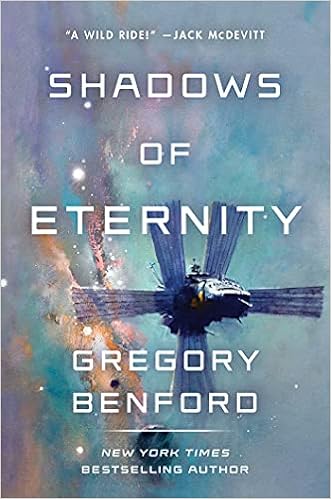
Of the SF read for the first time, then, right off the top was Gregory Benford’s Shadows of Eternity, which produced a curiously nostalgic reaction for me. Benford “borrowed” an alien species from Poul Anderson and wrote a very different sort of first contact novel that took me aesthetically right back to the Eighties, even as the approach to character and extrapolations of technology are very much of the moment.

I heartily recommend Stina Leicht’s Persephone Station, first in a series (?) that gives as an all-female crew (and supporting cast) in another “shitkicker” that has no lack of adrenaline and ample speculation involving corporations and indigenous rights and a neat Magnificent Seven riff. 

Andy Weir’s Artemis could have come from an outline left behind by Heinlein. Enormous fun, set entirely on the moon, action, problem-solving, and—again—corporate shenanigans. 

I read Ken McLeod’s trilogy beginning with Cosmonaut Keep, continuing with Dark Light and Engine City, which is a large-scale space opera somewhat in the mode of Iain M. Banks an involving interspecies intrigue, vast machinations, and ending on an ambivalent note where what problems have been plaguing the characters seem to be solved but not exactly resolved. He handles the whole time dilation question rather well and manages to tell family sagas and personal relationships against the background of centuries.  (It’s tricky to do these kinds of sagas which center on families without it becoming A Family Saga, with all the kind of homey baking bread sentimentality one usually encounters.)

I want to make special note of Nicola Griffith’s Spear, which is a compact and compelling retelling of the Arthurian—or, rather, the Percival legend—done from an unexpected point of view. Firstly, the writing is, as we expect from Griffith, first-rate. Secondly, she delivers a feminist twist which is only that in retrospect. As always, the story comes first. But story and character are bound up in the double helix of narrative. Griffith is doing some of the best history-based fiction around. The sequel to Hild is coming out soon and we should be prepared for a treat. 

Arkady Martine’s A Desolation Called Peace is the sequel to her marvelously complex debut, A Memory Called Empire. It picks up where the first left off and enriches the universe she has built, quite well. This is the kind of immersive world-building long-valued in SF/F, particularly effective because of the juxtaposition of cultures which throws the aspects of each into relief. Martine’s main character is herself something of an outsider, groping for Place in a milieu of which she has too little experience. 

Another epic work in SF I think very important is Kim Stanley Robinson’s Ministry For The Future. This is in many ways not a science fiction novel—in fact, it could be argued that a good chunk of it is textbook—but it is speculative, in that none of the specific events detailed have happened but the world is very much ours. It presents a scenario in which the world finally tackles climate change. In that so many things work and come together to positive effect I suppose render the novel SF, but…

Becky Chambers’ new series, Monk and Robot, continues with A Prayer for the Crown Shy, part of the tor.com series of novellas. All I can say is that Chambers is one of my favorites authors. She writes about community is ways I find remarkable and refreshing in science fiction. 

Two novels about radically altered futures I found compelling. Monica Byrne’s The Actual Star, which is reminiscent (in structure) of David Mitchell’s Cloud Atlas, and Benjamin Rosenbaum’s  The Unraveling. Both novels offer views of future social arrangements quite removed from our own and both present backgrounds of unexpected breadth. The writing in both is amazing and the ideas will linger.

To my great pleasure, John Crowley published a new one, Flint and Mirror, which indulges his penchant for presenting magic as a potential more than a reality and offering a view on the borderlands. This one is a historical, about the Irish Problem at the time of Elizabeth I. Unexpected. 

I continued with Jacqueline Winspear’s Maisy Dobbs series. I haven’t decided yet whether she’s doing history with embedded mystery or the reverse, but the novels have been tracking Miss Dobbs chronologically as the world heads for WWII. The last two so far, war is upon Britain and Maisy finds herself doing more security work than private investigation. We have grown up with these people now, so to speak, and the world Winspear is investigating is marvelously evoked.

Not intending to, really, but I did  a partial reread of the Ian Fleming James Bond novels. I indulged in a marathon review of the movies and wrote commentary and decided some comparison to the original novels and stories was in order. I was surprised both by how well-written many of them were and at the same time how shallow. I recall as a teenager plowing through them with relish. This time it was an academic review that yielded a few surprises, but on the whole I came away feeling I never have to look at them again.

I read Emily St. John Mandel’s new one, Sea of Tranquility. Whatever she might say, this is straight up science fiction, with time travel and an apparent time paradox. Given another fifty pages, she might have made it a very good SF novel. As it stands, it was enjoyable but derivative and relied too much on the good will of the reader. It was reminiscent of several older works by SF writers, most especially Poul Anderson’s Time Patrol stories. My best guess is, her point is to suggest that we all live in closed loops. (She might try to remember next time that gravity is different in other places and that someone who grew up on the moon might have a very difficult time standing up on Earth. Such details, which may seem fussy to literary writers, can make or break a narrative in science fiction.)

I finally read a Paul J. McAuley trilogy I had been meaning to for years, starting with Child of the River. In many ways it reminded of Gene Wolfe’s magisterial Book of the New Sun. Out in the hinterlands of galactic space, an artificial world with a long history that has evolved into a mythic background and a kind of avatar of a past race come to fulfill, etc etc. The adventures and worldbuilding are exceptional, but it ended with the feeling that another book would have been in order to satisfactorily wrap things up.

One last SF recommendation is Annalee Newitz’s new one, Terraformers, which draws on her strengths in anthropology and ecology and tells the story of the denizens of a world that has been remade by a corporation intending to lease it out to rich vacationers. The beings who did the actual work, however, presumably designed to die off when their utility is at an end, are still there and a struggle begins to claim rights. High finance, environmentalism, indigenous issues, and all the related politics combine in a rich, fascinating novel of generational evolution.

I’ve been dipping back into the past and catching up, filling in gaps. A couple of Clifford Simak novels, a reread of Ian Wallace’s Croyd (which is remarkably weird), early Le Guin (Rocannon’s World and Planet of Exile), and….

David Copperfield. Yes, the Dickens. I read this one aloud to my partner and came away with a modified view of Dickens. At least in this novel, what to a modern sensibilty comes across as verbosity, is actually very careful scene-setting and social explication. The 19th Century did not offer  movies and the stage was not universally available. I found very little that might be excised from the narrative. It all mattered.

I read Piers Brendon’s The Dark Valley, which is a heavy history of the 1930s, from the onset of the Depression to the start of World War II. Brendon takes a global view and examines each major political aspect—America, Europe, Britain, Asia—and gives a narrative of the runaway cart that took the globe to war. The parallels to the present are clear, but also deceptive. Yes, there are movements and conditions, but the failure of solutions then should not be taken as inevitabilities now.

I read Walter Isaacson’s Code Breaker, the biography/history of Jennifer Doudna, the geneticist who has given us CRISPR and whose work was part of the technological foundation thst produce the COVID vaccine is apparently record time. Isaacson, as usual, does an excellent job of making the science accessible. The people, though, shine in this lucid view of modern science.

As is my usual habit, I read some odd bits of history. For my writing, I rarely do project-specific research. Instead, I cast a wide net and gather a variety of details until suddenly they become useful. To that end, I read the following: The Future of the Past by Alexander Stille; There Are Places In The World Where Rules Are Less Important Than Kindness by Carlo Rovelli; Utopia Drive by Erik Reece; Freethinkers and Strange Gods by Susan Jacoby; A Short History of Nearly Everything by Bill Bryson; Worldly Goods by Lisa Jardine; Beyond Measure by James Vincent.

And the rather impressive History of Philosophy by A.C. Grayling. 

I can recommend all of the above whole-heartedly. 

I also read Sherlockian novels that surprised me. Kareem Abdul-Jabbar (yes, him, the former basketball player) is a serious Sherlockian and did two novels centered on Mycroft. I recommend them. Sherlock is in them, of course, but not yet out of university. They are surprisingly good. Or perhaps not so surprising, Maybe the word is uniquely good. There have been pastiches and homages to Holmes and most of them are forgettable if enjoyable. These two I feel contribute meaningfully to the mythos.

Along those lines, the Victorian Age has become almost a genre in itself, and I read my first Langdon St. Ives book by James Blaylock. I’m still unsure what to make of it, but I was impressed. We shall see if I continue the series.

There are a number I have left out. Not that they were bad, but I’m not sure what to say about them here. I discovered some new-to-me authors that I recommend—Sarah Gailey, Daniel Marcus, Nadia Afifi. 

I finally read a classic I had long avoided. High Wind In Jamaica by Richard Hughes. I’m still trying to decide how I feel about it. In many ways it is an ugly story. Children captured by pirates, who turn out to be quite not what anyone would expect. It seems to me to be a study of what happens when childhood fantasy collides with the fantasized reality. In that way, it is well done and evocative.  What it says about human nature and the condition of childhood is complex and layered.

I may have further thoughts later. For now, this review has gone on long enough.

I’m looking forward yo 2023.

Good reading to you all.

Bones Of Time

What are we talking about when we talk about science fiction? A genre defined by its trappings, its tropes? Or a mode of exploration of a kind of telec reification that only came into being with the advent of what we now recognize as science? A form of Gothic? An inversion of the historical drama? A subset of fantasy?

Or all of the above?

When encountering a writer like Jack Vance, it may be understandable that definitions (or at least taxonomies) fail to clarify how this can be the same as work by Gregory Benford. Aside from certain obvious aesthetic differences, there is the problem of, for want of a better term, scientific verisimilitude.

At a certain point, in conversation with anyone who does not “get” science fiction, it comes down to an ineffable quality that, while sharing much with all other forms of fiction, sets the experience apart, both aesthetically and culturally, and the only answer to the question “What is it about this stuff that appeals to you so much?” is: it lights up the imagination like nothing else.

(“I like it.” Why? “Why do you like Regency Romance? Or Gothics? Or murder mysteries? Something about them appeals and opens you up to an emotional and aesthetic experience you find no where else.”)

Before I continue I want to state that this is about Gregory Benford, not Jack Vance, whose work I mention as an example of the range to be found within the expanding pond called Science Fiction. It is about his new novel, Shadows Of Eternity.

Amazon.com: Shadows of Eternity: 9781534443624: Benford, Gregory: Books

This novel gave me an experience I have not had in some time, or at least only in some dilute form, embedded within texts that privileged other aspects of the fictive practice, that I almost forgot about it, namely the pleasure of didactic prose in service to the larger qualities of a science fiction novel. Shadows Of Eternity is done in the form we know as Hard SF, which only means that considerable attention is paid in the text to the presumed scientific justifications for the actions. In that, it is exemplary.

I say “presumed scientific justifications” because for the most part their accuracy is secondary for most readers, and many examples over the decades have proven unreliable in that. This is a novel, not a textbook, and the primary concern is to convince the reader in the moment that what is happening conforms, or can conform, to legitimate scientific understanding. “Getting it right” is edifying, both for the reader and, in a different way, the writer. Acknowledging that accuracy to a certain number of decimal points is less important than the Idea of accuracy is like saying that a reader of a novel set in the reign of Henry II does not, in the end, care if every single historical detail is correct as long as it feels correct and cannot be contradicted by a cursory glance at a history of the period.

That said, getting it right is a point of pride and, possibly, an ethical requirement, depending on the kind of story being told.

This gets tricky when writing about the far future and exotic physics and technological developments that might come about. We are talking about speculation, after all, which is one of the principle pleasures of science fiction. In practice, the might-be of a given story must be consistent with the have beens and probably ares of the currently known.

What does this have to do with storytelling?

Well, if you go down that road—Hard SF—then, just as in any other genre, it is incumbent on the writer to include material that produces a satisfying sense of realism in which the characters move. Only in this case, that material is of a bit more rarefied nature, namely the science behind the world being examined.

One of the criticisms of SF in this has been that the story often seems to grind to a halt while some bit of arcane scientific exposition takes place. This kind of thing bores a certain kind of reader. So be it. But why should this demote the work on the scale of worthy literary practice? (One of the earliest franchise efforts in the James Bond cosmos post-Fleming spent, in my opinion, an inordinate amount of time on Bond’s sartorial choices, as well as minutiae of cars, food, and other fashion bits. I could not have cared less, but I acknowledge that there were and are readers for whom this was a distinct pleasure. Trivial, you say? Then in the case of historical novels in which paragraphs are deployed in describing family lineages, treaties, court etiquette, or the mechanics of travel. But all that bears on the story? Of course it does.) It seems not to occur to critics and certain readers that these expository bits are among the reasons for the readers to pick this author and not that. One should judge how well it is done, not whether it is there.

Which is a long-winded way of saying that, in science fiction, the World is as much a character as any motile actor.

(Which of course is why it is legitimate to explicitly link science fiction to Gothic.)

Literary tastes in recent decades have caused many writers to bury their didacticism more and more. The underpinnings intrude less and less, often resulting in a cinematic effect. (I note that some writers still deliver the fascinating expository bits, but rendered cleverly so that they can be ignored. I’m talking here now of work in which ignoring those passages is anathema to the author’s intent.) Partly, this can be gotten away with because of the last seventy years of science fiction film and television, which for large audience provides the visual shorthand for what is happening in a novel. Partly, also, this is possible because of the explicitly didactic work done in novels and short stories over and beyond the same period, so a basic “grammar” is now in place. And partly because a lot of work simply does not rely on that level of foundational support—the stories are not about the changes in the world but about the same old sturm und drang one could find in just about every other genre.

Benford’s new novel is, in some ways, an echo of SF from long ago. Reading it, I felt a cozy sense of nostalgia produced by the form and the tactics used. I found myself pleasantly remembering Clarke, Clement, Gunn, as well as Pohl, Chad Oliver, and even Simak. This is a mode of SF that seems of late to be disappearing, the dialectic. For decades, especially in the magazines, writers spoke to each other through stories, one responding to another and creating a chain reaction of alternative “takes” on ideas. This formed a dense fabric of historical conceptualizing. (Hence Heinlein’s Starship Troopers was “answered” by Joe Haldeman’s Forever War, which spark John Steakly’s Armor as well as Orson Scott Card’s Ender’s Game and so on. True, this happens in other genres, but it is not nearly so clear or connected.)

Shadows Of Eternity is part of this. Benford took a page (or more) from Poul Anderson by using Anderson’s flying aliens, the Ythri. (He borrowed a couple of other concepts from Anderson as well, one notion going all the way back to Anderson’s very early novel Brain Wave.) Yes, this is a form of homage, but it is more as well. Benford’s Ythri are his own. What Anderson created, Benford built on and made richer.

The core of the novel, though, is an examination of time. Deep time. (Benford wrote a nonfiction study of this subject.) The fact that the universe is old, so vastly old that when we begin peering into the abysses we will risk being swallowed up in the antiquity of it. Rachel arrives on the moon to join the staff of the Library, which is what has evolved from the early SETI attempts. The signals from old civilizations have been discovered and it is the task of the Library to curate and somehow translate them. Some of these signals turned out to be entire AI templates, and the Library now houses Minds.

Though technically qualified, Rachel understands that this will not set her apart. She must demonstrate qualities that she is unsure she possesses. But she blusters her way through, becomes a Trainee, and begins delving into these Minds.

As the novel proceeds, Rachel grows into someone she never expected to become. Confidence accrues, a taste for the edge emerges, and Rachel develops into—

She comes into her own with the arrival of visiting aliens—the Ythri—and becomes, often in spite of herself, the primary liaison with them. The Ythri have come through a wormhole and want to find their way back.

Benford sets before us puzzles and takes us through solutions and along the way does something the best science fiction has always sought to do—opens the vistas of what may be Out There for us and gives us a glimpse of the possibilities.

And those expository bits, filled with the how-to and what-is-it and where-did-this-come-from that science offers? Those set the stage for a conceptual apprehension that renders the view coherent enough for us to feel the awe of understanding what we’re looking at. This is what was meant by “Gosh, wow!” and Sense of Wonder.

The other thing to notice is not what is there, but what is not there—Bad Guys. There’s no war, no evil overlords, none of that. There are irritating people, foolish people, annoying situations, and a great deal of genuinely unnerving discoveries, but this is a world that presents as recognizable. The conflicts are, in some ways, quite ordinary, but set as they are in this interesting future, the ordinariness only becomes part of the puzzles that challenge Rachel.

Finally, Benford writes well. His descriptions can fascinate. The universe he sees, in reality and in his imagination, is vibrant and wonderfilled. This is science fiction for the explorer lurking inside us.

Scandal In Romania

Lord Peter Wimsey and Harriet Vane, Nick and Nora Charles, Charles and Kate Sheridan, and in one unexpected offering Clark Gable and Carole Lombard—all have one thing in common: they are all detective marriages. Husband and wife teams, solving crimes, bringing their own domestic wrinkles to the task. Agatha Christie even wrote one, Tommy & Tuppence, as did Elizabeth Peters. The couple that solves crime together is more common than might first be suspected. And all of them have the unexpected about them, aspects of their relationship that would seem to make it unlikely, unstable, or unmanageable. And yet, they work.

The hallmark of these couples, of course, is the combined ability to solve murders, but that is only an aspect of what may be the chief attraction—for them and for the reader. Along with all the other (presumed) pleasures of the relationship, the intellectual rises to the top as an aspect of love. Unspoken though it may be in many instances, these are people drawn to each other by their shared appreciation for thinking.

And acting on the results.

Odd as many of them may seem, perhaps the least likely is the marriage of a young Mary Russell to her mentor/colleague, Sherlock Holmes.

When I encountered the first volume of Laurie R. King’s series, The Beekeeper’s Apprentice, I read the description and thought: And just how does that work? Sherlock Holmes is the most dedicated bachelor in detective fiction. Many writers have attempted to explain that, even work on the assumed “romance” between Holmes and Irene Adler, and have mined the subtext of his condition for decades, sometimes to good effect.

But married?

In a display of elegant reimagining, solid logic, and excellent prose, King convinces us that her version of the Holmes Story is the true tale underlying the gloss of fiction created by Dr. Watson. In the first twenty pages a new reality is established, making these novels feel more like revealed history than fanciful speculations. As it has turned out, she established a premise that has resulted in 18 novels (give or take) and some shorter works, each one adding to the Holmes mythos and providing terrific entertainment along the way.

The series proceeds chronologically and follows history closely. From time to time we have the added pleasure of seeing a fictional character enter the story as if part of actual history (the rescue of Kim, for example—yes, Kipling’s Kim) and the new one—Castle Shade—more or less continues in that vein.

Almost literally. After wrapping up a twisted affair in the Riviera, Holmes and Russell are summoned to Romania at the request of Queen Marie. They arrive at Castle Bran where they are presented with the problem (in the form of threats against the queen’s daughter) and tasked with finding those responsible.

We are in the thick of atmospheric evocations. Castle Bran is reputedly that castle—Dracula’s. The vampire haunts the novel. Both Russell and Holmes are grounded materialists, so obviously ghosts, devils, vampires and so forth are not the perpetrators. But they are tools.

Politics play a role—this is 1925 and Romania is slowly recovering from the shocks of World War I—as does folklore. Holmes and Russell must move carefully through a landscape fraught with the kind of peril born out of superstition and the frayed sensibilities of a people still trying to find their way into a new world without losing too much of the old.

King deftly portrays the country, the culture, the politics, and the history and moves her characters through this landscape on this most delicate quest. As in past novels, King displays a deep understanding of history, and her attention to detail is everything one would expect from a Sherlock Holmes novel.

But as I said, the pleasure of this novel and all the others in the series is in the dynamic between Russell and Holmes and it remains compelling and convincing. The biggest difference between Mary Russell and her husband is age and therefore experience, but they are intellectually matched and derive a significant part of their delight in each other from that fact.

King has humanized Holmes, perhaps more believably than most other attempts, which have generally focused on the uncommon intelligence and observational skills of the detective, so much so that many incarnations have rendered the character all but a machine. The original stories show a more rounded person, someone who it must be remembered could be extraordinarily kind. Whatever the reason—fascination with the exotic if nothing else—Holmes has been too often portrayed as some kind of intellectual freak. Conan Doyle, if he had any message beyond telling a good yarn, was that the chief distinction between Holmes and his fellow humans was his willingness to Pay Attention. Yet the message received seems to have been “thank heavens there’s only one of him, no one could be like that!” King has spent time in this series, it seems, undoing the various boxes into which Holmes has been placed. (There have been a number of stories presenting the idea that Holmes was, in fact, an alien, which explained his unique powers. Fun stories, to be sure, but again that trend of removing Holmes from the realm of the human.) King’s Holmes begins as someone who had fled London, tired of The Game, but who started his career much younger than the man in Dr. Watson’s tales (a nod perhaps to Aesop, who was said to have dressed as an old man in order to be taken seriously by those who would never accept wisdom from a young man?) and was interested in his bees, his solitude, and perhaps rejuvenating himself after near burn-out. The opportunity of training a protege in the form of a young girl who invades his quiet gives him a chance to…

Well, that would seem to be an ongoing journey, for both of them. Russell/Holmes is very much a spring-autumn romance—and there is romance, albeit understated and plausibly private (these are written in first-person by Mary)—but they have found each other as rough equals and by implication natural companions.

All that is well and good, but the best part of these novels is Mary herself, who is one of the finest sleuths to be found. Tough-minded, resilient, a scholar first, detective and occasionally reluctant spy, it is from her we learn all this, her voice that takes us through the adventures, and Holmes often takes a backseat to Mary’s navigation.

And the mysteries are fine. Just the sorts of unlikely, bizarre, exotic tangles one should expect from a Sherlock Holmes tale. But again, rendered in terms of human capacity and interest. In any event, so far each book has left me happily looking forward to the next. Mary Russell and Sherlock Holmes have together reinvigorated what had come close to being overdone and overworked.

Seeking Meaning In Sand

I have not yet seen the new film version of Dune. I may write about it after I do, although it is not the entire story. What I am interested in here is the ongoing obsession with the novel. This will be the third cinematic iteration. Famously, there are two uncompleted versions, one by Jodowrosky and another by Ridley Scott. We know how far the former came because there is a fascinating documentary about it, but as for Scott’s version there are mainly rumors and statements that he wanted to do one. Personally, I would have been interested to see that one—I very much like Ridley Scott’s palette: even those of his films that don’t quite work for other reasons I find wonderful to look at—and in some ways he has perhaps played around the edges of it through his Alien franchise. (The first film starts on a world that might have been Arakkis, the second is evocative of Gede Prime, the others keep returning to desert worlds, in theme if not setting. And Ripley becomes a kind of ghola as she is resurrected again and again.)

What is it about the original novel that compels the ongoing obsession, not only of filmmakers, but of fans? (There would be no funding for the films if the audience were not so large and committed. That speaks to the book.)

The history of the novel is something of a publishing legend, like other groundbreaking books. Multiple rejections, ultimate publication, often in a limited way, and a growing audience over years. Dune was famously rejected something like 27 times before finally being taken up by a publisher better known for automobile manuals.

It was, however, serialized in one of the top science fiction magazines, Analog, so dedicated SF readers were the first to encounter it, and doubtless formed the primary audience. I remember reading the ACE paperback from the late Sixties. Its impact on me was almost too large to detail.

I was used to science fiction novels being under 200 pages—average then was 160. From the Golden Age forward you rarely found one more than 250 pages. Stranger In A Strange Land by Robert A. Heinlein was an outlier at 408 in its first hardcover incarnation. So here I find this massive book more like the so called classics I’d been reading—Dickens, Dumas, Dostoevsky, Tolstoy—crammed into the cover of a mass market paperback which included a glossary and indexes, explanatory material (every bit as fictional as the main narrative). It felt important. I was 14, it was dense, I struggled through it. (It led to a profound teaching moment in how to read which I’ve written about elsewhere.) I could feel my horizons expand, even though at the basic level of story it was no more or less fascinating than most other good science fiction novels I had read. But it opened possibilities for narrative depth.

A handful of other novels came out around that time that exploded the confines of the thriller-format SF had been kept to—John Brunner’s Stand On Zanzibar and The Sheep Look Up; Robert A. Heinlein’s The Moon Is A Harsh Mistress; Ursula K. Le Guin’s The Dispossessed and The Left Hand Of Darkness; and the coming rage for trilogies (many of which were single narratives published economically in three volumes). By the mid-Seventies publishing had changed to accommodate a new idea of what an SF novel could be, including expanded length to include what has become known as World Building (a technique which in some instances supplanted more important aspects of fiction). Not all by itself, but certainly as a point of history, Dune helped make this possible by creating a market for fuller expositions and more detailed construction. This alone might make it significant.

But that alone would not have made it a perennial seller, almost constantly in print ever since. If Frank Herbert had written nothing else, Dune would have made his career.

It was followed up by two more—Dune Messiah and Children of Dune—completing a cycle. That first trilogy stands as a unified work. The second two books are plot-driven indulgences, but not superfluous. The second trilogy…publishing had discovered by then that science fiction could be best-selling fiction and a frenzy of large advances and high-profile publications mark the late Seventies and early Eighties. Herbert’s publisher enabled him to indulge himself with a second trilogy that often leaves people puzzled. But it kept the spotlight on the primary work.

David Lynch’s movie enlarged the audience again. That film, by a director with a certain reputation for examining the macabre oddnesses of humanity, is a spectacular curiosity. It is a mixed bag of brilliance and weird choices.

Then came a modestly-budgeted miniseries on the SyFy Channel, which went on to include the second two novels. It did a much better job of telling Herbert’s story. The chief complaints seem to be the results of that budget (and that Sting did not reprise the role of Feyd Rautha). It gets dismissed too readily, as if the world were waiting for the “real” cinema treatment.

Which we now, by all accounts, have.

As I say, I have not seen it yet. I want to address the book and its seeming tenacity.

One of the things Herbert did was lace his tale with wise-sounding profundities in the form of aphorisms and epigrams. Each chapter starts with a quote from some serious work by the presumed chronicler of the hero’s life. They sound like quotes from works like the I Ching or SunTzu’s Art of War. This was not a new trick when Herbert did it, but he was particularly adept at it in this book. It is a far future in which, presumably, philosophy has transformed along with everything else. The quasi-feudal politics and economics are given a veneer of newness this way, as if to signal that while it looks like something one would find in the 12th Century, it is not quite the same thing, but you have to take the author’s word for it, because it is the future. The quotes set an aesthetic tone that, among other things, allows us to assume something else is going on instead of just the same old historical thing. In science fiction, veneers matter—they work like orchestrations in a symphony, selecting the right instrument for the right phrase, coloring it. (Veneers should never be mistaken for the story or the theme, which is something unobservant critics do all the time.)

Seriousness established, every significant decision becomes inhabited by purpose, meaning, resonance, and a justification that raises the level of what we read almost to that of destiny, certainly of mythmaking. With this, the writing itself need not be spectacular, just functional.

There are passages in Dune that are breathtaking in what they describe. The ecological aspects of the novel, while in some ways absurd in terms of actual science, take on the same immanence as anything the actors possess. In a way, Dune is one of the first terraforming novels, embracing the idea that human action can transform an entire world. (A couple of years later, we see much more of this, often more pointedly, as in works like Le Guin’s The Word For World Is Forest—again, the novel opens up a field of possibilities, or at least prepares an audience for more of the same.)

But the characters are hard to relate to—this is a story about archetypes and aristocrats in conflict with emperors and churches. The ordinary people get lost amid the giant legs of the SF manifestations of Greek Heroes. We read this novel for the plot and world and the political revelations. We become engaged because this is in important ways a Lawrence of Arabia story—one toxically mixed with Faust. We read it because we are aware that gods and deserts change the world.

We read it because, as well, we are enamored of the idea of Enlightenment in a Pill.

Herbert was always working in the fields of mind-altering drugs—possibly his best and most relatable novel in this vein is The Santarroga Barrier—and with Melange, the Spice, he created the ultimate in mind-expanding temptations. Its use gives humanity (and others) the universe. Time and space can be brought to heel with it. Visions, prophecies, and clarity are on offer. But it is the ultimate Faustian bargain, for its loss will destroy everything.

It is aptly named. Melange, a mixture of often incongruous elements. A mess, if you will, but messes can evoke wonder, even seem beautiful.

At the heart of this Faustian conundrum are the Fremen, patterned after the Bedu of the Middle East. They are trapped on a world with profoundly limited resources and must be kept that way for the benefit of the rest of the universe. Not quite slaves, but certainly not masters of their own world. Freeing them courts disaster—because part of that freedom entails remaking their world, making it wet. Water, though, is poison to the giant worms that produce the Spice.

Trap after trap after trap populates the novel. Disaster looms. The plot compels.

And of course the relevance to our reality could not be plainer. The teetering sets of balances, all of them with ethical pitfalls, allow Dune to remain trenchant, relevant, challenging. Added to this is the clear connection to the Greek tragedians (especially in the second trilogy—I suggest boning up on Aeschylus and Euripedes before trying them) which gives the book its ongoing frustration of clear, ethical resolution. (And cleverly he took the possibility of building machines that might aid people in their problem-solving off the table, by outlawing thinking machines. It’s all on us and what we bring to the game.)

A final thread woven through the book that seems to make it constantly popular is that it is a coming-of-age story that contains a biting critique of privilege. Whatever Paul might want to be for himself, he is born into a web of expectations that impose their demands from all sides, making any choice he might make impossible outside of a constructed destiny. The adolescent struggling to make sense of the world and find a way to live in it, thinking if only he were god and could command everything to be rational or at least amenable. Paul’s tragedy is that he in fact can become god—and then discovering that this is no solution, either.

How well this new movie deals with all this, I look forward to seeing. For the moment I simply wanted to examine some of the reasons this novel continues to find audiences and why so many filmmakers are drawn to it. The elements it contains transcend the limitations from which it suffers. But whatever the case, this is a novel that allows readers to find meaning—whether that meaning is in the novel or not.

2020 and Reading for Purpose

In a year that felt more like some surreal historical melodrama that ought to be safely turned into a documentary rather than something to cling to the future like a belly-full of bad booze, what we read may have been one of the most important choices we were able to make. Our lives constrained by a pandemic, we may have lived more vicariously than ever before, but we also dealt with the world as a landscape of impending doom in ways that perhaps our parents and grandparents may have in different ways, but was unique in the manner of it collision with reality and ignorance.

I think it fair to say that never before has so much information, understanding, and intellectual resource been so available to so many and yet rejected in turn to such a degree as to challenge one’s sanity. It seemed like the more we knew, the more concrete things we could say about so many things, the more too many people flat-out denied those very things that might have made the world a better place. Watching and listening to the news day to day was an agony of frustration.

So we—some of us—turned to reading for answers as well as escape. Answers to try to make sense of things, escape to give us the spiritual resources to cope with what we learned and what we saw.

I read, cover to cover, 63 books in 2020.

What science fiction I read was related mainly to the reading group I host. I read a lot of history, political philosophy, mysteries. I did not quite finish a rather excellent biography of John Maynard Keynes, which has proven to be a timely work that throws light on the history that brought us to where we are now. Zachary Carter’s The Price of Peace should, I suggest, be read with Binyamin Appelbaum’s The Economists’ Hour. Between them they illuminate the 20th century struggle with finding our way through the morass of slogans, competing theories, political opportunists, and national identities that seem to rely on the 19th Century concepts of poverty, property, and progress to justify a kind of fearful reluctance to simply adapt.

Along with these, Shawn Otto’s The War On Science is history of the anti-intellectualism in America that has dogged us since the beginning and has resulted now in a precarious moment in which the knowledge we derive from sound scientific practice has never been more necessary to our survival while living in a time when more people refuse to acknowledge anything outside their own concepts and prejudices. Along with this, a somewhat more theoretical but complimentary work is Why Trust Science? by Naomi Oseskes.

It would seem that our greatest enemy remains ignorance. Demagogues and con artists have become far more adept at manipulating and defrauding us in greater numbers than ever before and the only defense is our ability to reason, to sort through and measure and recognize nonsense, especially when it seems enriching, empowering, and edifying. Everything has taken on an urgency that strips us of time and room to judge, to assess, to think through. Decisions must be made now, while the offer lasts, don’t be late, get yours now.

In this struggle, the only thing that we can personally do is equip ourselves with the wide gaze of grounded perspective. History, economics, philosophy. They can appear daunting. But you only have to pick a book and start. It accrues. In time, something seemingly so removed from our present experience as Jill Lepore’s The Name of War, about King Phillip’s War, which set the pattern for the European conquest of America, takes on currency in the here and now. Speaking of Jill Lepore, her newest, If Then, about the forgotten Simulmatics Incorporated and its effect on American (and global) politics is an eye-opening expose of how we managed to corrupt our political systems with introduction of demographic analysis, ad-agency thinking, and datamining.

Economics, history…what about philosophy?

Outside specialized texts, I believe one cannot do better than good science fiction. Mary Robinette Kowal’s latest in her Lady Astronaut series, Relentless Moon, offers some surprising relevancy to the present as well as a terrific yarn set in an alternate history. Annalee Newitz’s Future of Another Timeline is a rumination on choice as well as a good time-travel story. Blackfish City by Sam J. Miller examines near-future global changes and the consequences of corporate capitalism disguised cleverly as a quest/revenge/rescue narrative.

I’ve been reading aloud to my partner for a while now. We did John Scalzi’s most recent trilogy, starting with The Collapsing Empire. His approach is in some ways perhaps “irreverent” but once you get past that surface facility, it’s a first-class trilogy.

Possibly the most beautiful writing I encountered this year was Robert MacFarlane’s Underland. He’s a naturalist/explorer whose previous work has been concerned with climbing mountains and related landscapes. In this he went down. In a magnificent rumination on ecologies and the underground, both natural and artificial, he has written beautifully about a world we ignore to our peril.

Alex Ross, music critic for the New York Times, whose previous book The Rest Is Noise, about music and 20th Century history, is wonderful, has published his intricate study of Wager and the impact he had on, well, everything. Wagnerism in some senses is an expression of the often-unacknowledged influence of art on politics and identity. Ross examines how Wagner became the focal point for movements and countermovements up till the present with his outsized presence in film scores. An aspect of history that deserves a bit more attention.

I have my to-be-read pile already building for 2021. It includes several books that I hope will help me ride the unpredictable currents of our ongoing struggle with the world. But never more strongly do I feel that the encounter with other minds through the agency of the written word is one of our best tools for managing and emerging from darkness. We have such a wealth of resource. I look around at the world and cannot help but feel that if more people simply read more and more widely, things would begin to resolve. Never before have we had it thrown in our faces with such force the costs of ignorance.

Here is wishing you all a safe and aspirational year. Read on, read well.